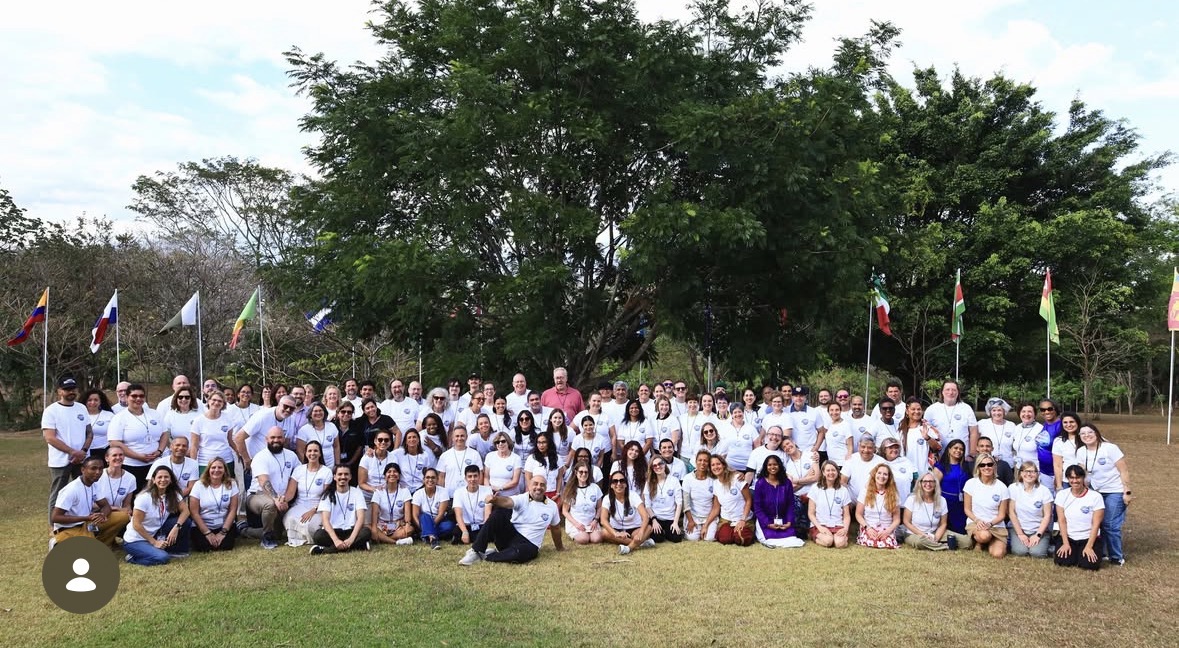
community
From the Hero’s Journey to the Soul Group Journey: A Path to Fundamental Peace
Joseph Campbell gave the modern world a powerful language for transformation. In The Hero with a Thousand Faces, he described the monomyth as a recurring pattern of separation, initiation, and return. That insight mattered because it reminded us that growth is not accidental. Human beings cross thre
March 11, 2026·Luis Miguel Gallardo·9 min read
AI insights
Joseph Campbell gave the modern world a powerful language for transformation. In The Hero with a Thousand Faces, he described the monomyth as a recurring pattern of separation, initiation, and return. That insight mattered because it reminded us that growth is not accidental. Human beings cross thresholds, endure ordeals, receive revelation, and return changed. It also matters that Campbell’s own foundation clarifies something often forgotten today: he did not offer a rigid screenplay formula, and even the now-famous phrase “the hero’s journey” became popular after the publication of his 1949 book. At its best, Campbell’s work was never a mechanical template. It was an invitation to see transformation as sacred, existential, and deeply human.
And yet every living map must evolve. Maureen Murdock’s The Heroine’s Journey was one of the great corrections of the last decades because it exposed what the standard heroic frame often left out. Her work emerged in response to Campbell’s dismissal that women did not need to make the journey, and it reframed the path as a psycho-spiritual search for wholeness in a culture structured by masculine values. This was not simply a matter of inserting women into the old template. It was a deeper recognition that many journeys are not about conquest, domination, or singular achievement, but about healing the split from the feminine, recovering embodiment, restoring relationship, and integrating what a culture has devalued.
Now the conversation is moving again. Recent scholarship and commentary increasingly argue that the monomyth has become too dominant, too flattened, and too easily mistaken for a universal law. Roy Hanney and others have challenged the idea that Campbell’s model should remain the default narrative architecture for contemporary storytelling, describing its dominance as historically situated rather than timeless and calling for forms built around community, companionship, plurality, and nonlinearity.
Sarah Lynne Bowman similarly notes that the standard heroic script often centers an idealized young male savior battling a monstrous other, leaving many human archetypes and experiences at the margins. Even recent mainstream commentary reflects this tension: some writers argue the lone-hero story is constraining the collective imagination, while others note that contemporary stories still unconsciously rely on its deep structure even when they try to subvert it.
My sense is that the next step is not to discard the Hero’s Journey, nor even to stop at the Heroine’s Journey. It is to evolve them into a Group Journey, a Team Journey, a Soul Group Journey. In this new arc, the protagonist is no longer only the individual self learning mastery. The protagonist becomes the field of relationship itself. The treasure is no longer private success, private awakening, or private redemption.
The treasure is the restoration of belonging, the rebuilding of trust, the healing of fragmentation, and the emergence of communities capable of shared flourishing. This shift is deeply aligned with the worldview I have been developing through Fundamental Peace and Happytalism: individual and collective development are not separate projects. They are one living movement.
Why does this matter so much now? Because the deepest crisis of our time is relational. Polarization, loneliness, humiliation, inherited trauma, social breakdown, and ecological estrangement cannot be healed by the mythology of the isolated achiever. In my own writing, I have returned many times to a simple truth: there is no self-made person. We climb as a rope team. One hand reaches forward and another reaches back. Peace, then, is not merely the absence of war.
Fundamental Peace is the integration of freedom, consciousness, and happiness in both persons and societies. It is the lived realization that human flourishing depends on the quality of our bonds, our institutions, and the cultures we co-create together. Public health and peacebuilding research increasingly reinforce that social connection, cohesion, and trust are not sentimental extras; they are conditions of human and civic wellbeing.
In the spiritual vocabulary I often use, this also means that we do not evolve alone. I do not offer the idea of soul groups as a dogma that everyone must believe. I offer it as a sacred language for an experience many people recognize: that our lives are woven with certain others through deep patterns of learning, service, mirroring, challenge, and love. In my recent reflections, soul groups describe the intuition that consciousness matures through clusters of relationship, not in isolation.
Whether one reads that metaphysically or symbolically, the invitation is the same. Stop asking only, “What is my mission?” and begin asking, “What are we here to remember together? What healing is trying to move through this circle of lives?” The soul, in this sense, is never merely individual. It is relational, communal, and evolutionary.
Systems thinking gives this intuition a grounded psychological depth. Bowen family systems theory understands the family as an emotional unit, where each person’s functioning affects the whole, and where patterns of anxiety, adaptation, and relationship are transmitted across generations. Internal Family Systems adds another profound layer by describing the psyche itself as a system of parts guided by a core Self, suggesting that inner healing is already a form of relational reordering.
Family constellations, used by some practitioners as a group-based symbolic method, seek to reveal hidden loyalties, exclusions, and entanglements across a family field. Here honesty matters: the existing research suggests some possible benefits, but the evidence remains limited and mixed, and ethical, professional, and cultural sensitivity are essential. Even so, the larger insight remains invaluable. No journey is purely personal. Every life is nested in visible and invisible systems: parents, children, siblings, ancestors, descendants, and the untold stories that still organize a family’s emotional world.
When we widen the lens beyond the nuclear family, we find the wisdom of extended families and many Indigenous traditions offering an even deeper correction to the lonely hero. Indigenous knowledge systems are not one thing, and it is important never to homogenize them. Yet many are rooted in kinship, reciprocity, relationship with land, intergenerational continuity, and responsibility to those not yet born.
The Haudenosaunee Great Law of Peace remembers the burial of weapons beneath the Tree of Peace and a form of social order grounded in unity and responsibility to future generations. Smithsonian educational materials likewise emphasize that kinship and extended family relationships remain central across many Native communities. This is a radically different civilizational story. It asks not, “How do I win?” but “How do we keep the circle intact?” It asks not, “What treasure do I possess?” but “What relations have I honored, restored, and protected?”
This matters for violence because violence is rarely only an individual act. It is often the eruption of unprocessed fear, humiliation, exclusion, disconnection, and inherited trauma within a larger social field. Research from public health and violence prevention consistently shows that connectedness to family, caring adults, prosocial school climates, and cohesive communities are protective factors, while isolation, social disorganization, and weak community participation increase risk.
The World Health Organization similarly emphasizes multisectoral violence prevention, including parenting supports and community-based strategies, while peacebuilding institutions like UNDP focus on social cohesion and the healing of tensions before conflict escalates. This strongly echoes what I have written elsewhere: belonging can become dangerous when it is hijacked by fear, but it becomes healing when it expands into the lived recognition that we belong to one human family.
So what does the Group, Team, Soul Group Journey actually look like? It begins with a call to interdependence, the moment we realize that my wellbeing is bound to yours. Then comes the mapping of the field: the family histories, cultural wounds, silences, privileges, exiles, and traumas that shape the group. Then comes the descent into the shared shadow, where we encounter scapegoating, domination, denial, and inherited fear without turning away. But the turning point is no longer the destruction of an enemy.
It is the recovery of deeper belonging through truth-telling, mourning, accountability, boundary-making, reconciliation, and systemic redesign. The return is not a triumphant hero holding a prize. The return is a community that has become more capable of justice, compassion, wise coordination, and collective care. Healing, in this journey, moves in spirals, not straight lines.
This is where community building becomes both sacred and practical. The Agora, the circle, the extended family, the local chapter, the intergenerational commons: these are not peripheral to consciousness. They are the places where consciousness becomes culture. They are the containers where awakening can become durable enough to shape policy, education, economics, and the daily habits of care.
This is also why the move from personal healing to systemic transformation is so essential. A healed individual inside a traumatized system remains vulnerable. A system redesigned without inner transformation remains brittle. The next story asks for both: inner work and institution-building, shadow integration and social architecture, awakened selves and coherent teams. That is the deeper promise of a Happytalist civilization and of the polycentric peace infrastructures I have been describing in recent writing.
The evolution from the Hero’s Journey to the Heroine’s Journey and then to the Group, Team, Soul Group Journey is, in the end, an evolution from conquest to wholeness to communion. Communion is the soil of Fundamental Peace. We will not build that future with weapons or walls, but with consciousness, compassion, and love made concrete in relationships, families, communities, and systems.
We will move toward the eradication of violence not only by responding to harm, but by transforming the stories and structures that keep reproducing separation. The deepest return is always a return to one another: the family repaired, the stranger rehumanized, the ancestor honored, the child protected, the Earth respected, and the future invited into the room. That is how violence loses its mythology. That is how peace becomes fundamental.
—
From Individuation to Wholeness to Communion.
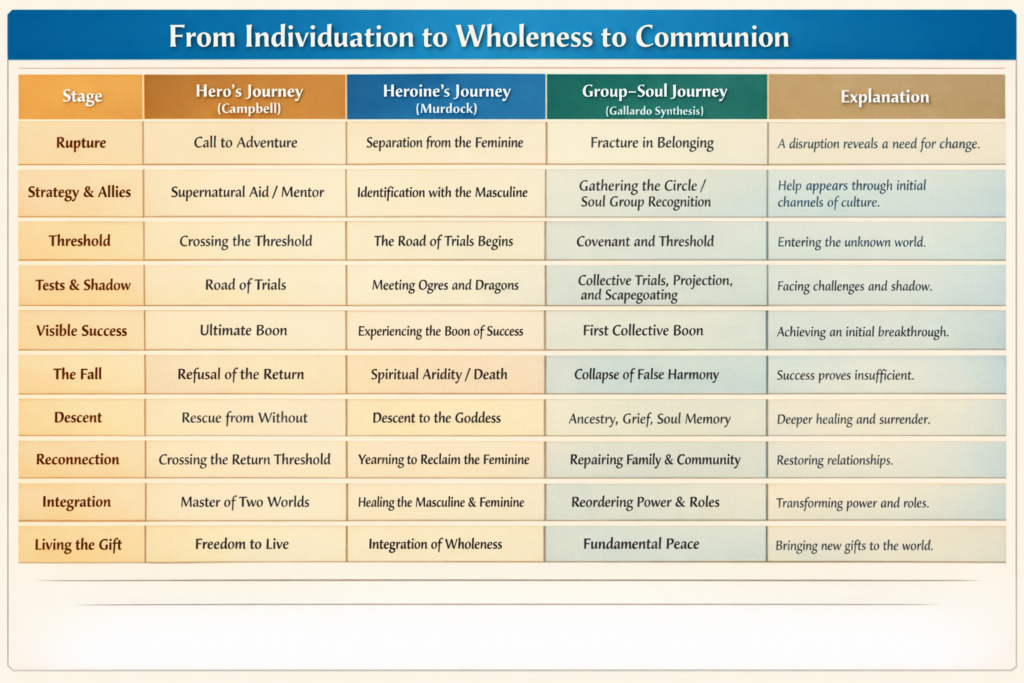
The Hero’s Journey centers transformation of the individual self. The Heroine’s Journey moves toward wholeness by healing the split between the feminine and masculine. The Group–Soul Journey extends both arcs into collective evolution, where healing includes soul groups, family systems, extended kinship, community, land, and the redesign of power itself so that peace becomes relational, structural, and lived.
| Comparative phase | Hero’s Journey (Campbell) | Heroine’s Journey (Murdock) | Group–Soul Journey (Gallardo synthesis) | Explanation |
|---|---|---|---|---|
| 1. Rupture | Call to Adventure | Separation from the Feminine | Fracture in Belonging | A disruption reveals that the old identity, family pattern, or social order is too small to hold the next stage of life. |
| 2. Strategy and allies | Supernatural Aid / Mentor | Identification with the Masculine & Gathering Allies | Gathering the Circle / Soul Group Recognition | Help appears, but at first it often comes through the dominant logic of the culture before deeper wisdom is recovered. |
| 3. Threshold | Crossing the First Threshold / Belly of the Whale | The Road of Trials Begins | Covenant and Threshold | The crossing becomes real and irreversible; the self or the group enters unknown territory. |
| 4. Tests and shadow | Road of Trials | Meeting Ogres and Dragons | Collective Trials, Projection, and Scapegoating | Obstacles expose capacities, fears, shadow material, and the hidden dynamics that must be faced. |
| 5. Visible success | Revelation / Ultimate Boon | Experiencing the Boon of Success | First Collective Boon | A real gain appears: victory, insight, recognition, healing, or early communal coherence. |
| 6. The first solution fails | Refusal of the Return | Spiritual Aridity / Death | Collapse of False Harmony | Outer success proves insufficient; the deeper wound remains, and the journey must go further inward. |
| 7. Descent for deeper healing | Rescue from Without / Magic Flight | Initiation and Descent to the Goddess | Descent into Ancestry, Grief, and Soul Memory | Transformation now requires surrender, support, and contact with what was hidden, excluded, or ancestral. |
| 8. Reconnection | Crossing the Return Threshold | Urgent Yearning to Reconnect with the Feminine | Repairing Kinship, Extended Family, and Community Bonds | The path turns toward belonging: what was split off must be welcomed back into relationship. |
| 9. Integration of power | Master of Two Worlds | Healing the Mother/Daughter Split + the Wounded Masculine | Reordering Power, Roles, and Institutions | Power becomes relational, accountable, and life-serving rather than dominating; systems begin to heal with the people inside them. |
| 10. Living the gift | Freedom to Live | Integration of the Masculine and Feminine | Fundamental Peace / Community as Living Boon | The final fruit is not private triumph but a new way of being that serves the whole through care, stewardship, and nonviolence. |
#Happytalism #HeroJourney #HeroineJourney #OurJourney #Wejourney #FundamentalPeace #SoulJourney
…
Explore this topic
Field notes to your inbox
Stay connected to the shift.
Monthly essays from the Observatory, invitations to Fests and Academy cohorts. Written from abundance — never urgency.