consciousness
Before the First Breath
A reflection from the EUROTAS Symposium in Portugal — on regression, the Integrative Transformation Model, and the path to ten billion free, conscious and happy by 2050. By Prof. Luis Miguel Gallardo · World Happiness Foundation · Shoolini University A lecture, and a longer arc There are talks one g
May 27, 2026·Luis Miguel Gallardo·14 min read
AI insights
A reflection from the EUROTAS Symposium in Portugal — on regression, the Integrative Transformation Model, and the path to ten billion free, conscious and happy by 2050.
By Prof. Luis Miguel Gallardo · World Happiness Foundation · Shoolini University
A lecture, and a longer arc
There are talks one gives, and there are talks one is given. The 45-minute lecture I delivered at the EUROTAS Symposium in Portugal — Regression and Pre- and Perinatal Imprints: From Shadow to Essence through the Integrative Transformation Model — belonged to the second kind. The room was a quiet community of clinicians, transpersonal psychologists, somatic practitioners and contemplative researchers from across Europe. The atmosphere was the one EUROTAS has cultivated for decades: rigorous, reverent, and unafraid of the depths.
I had been invited to speak about the earliest chapters of human experience — the imprints laid down before language, before story, before what we call autobiographical memory. But I wanted to do something more than catalogue a clinical territory. I wanted to show how the work we do at the smallest scale — with a single nervous system remembering its first thresholds — is the same work we are being asked to do at the largest scale, as a civilization preparing to cross its own threshold toward ten billion lives by 2050.
This article is the longer arc of that lecture. It is also an invitation: to see regression not as archaeology, but as remembrance; to see leadership not as control, but as the capacity to host one’s own shadow with such compassion that it becomes a gift; and to see the World Happiness Foundation’s mission — ten billion free, conscious and happy by 2050 — as a clinical question scaled to the size of a species.
The question that opens everything
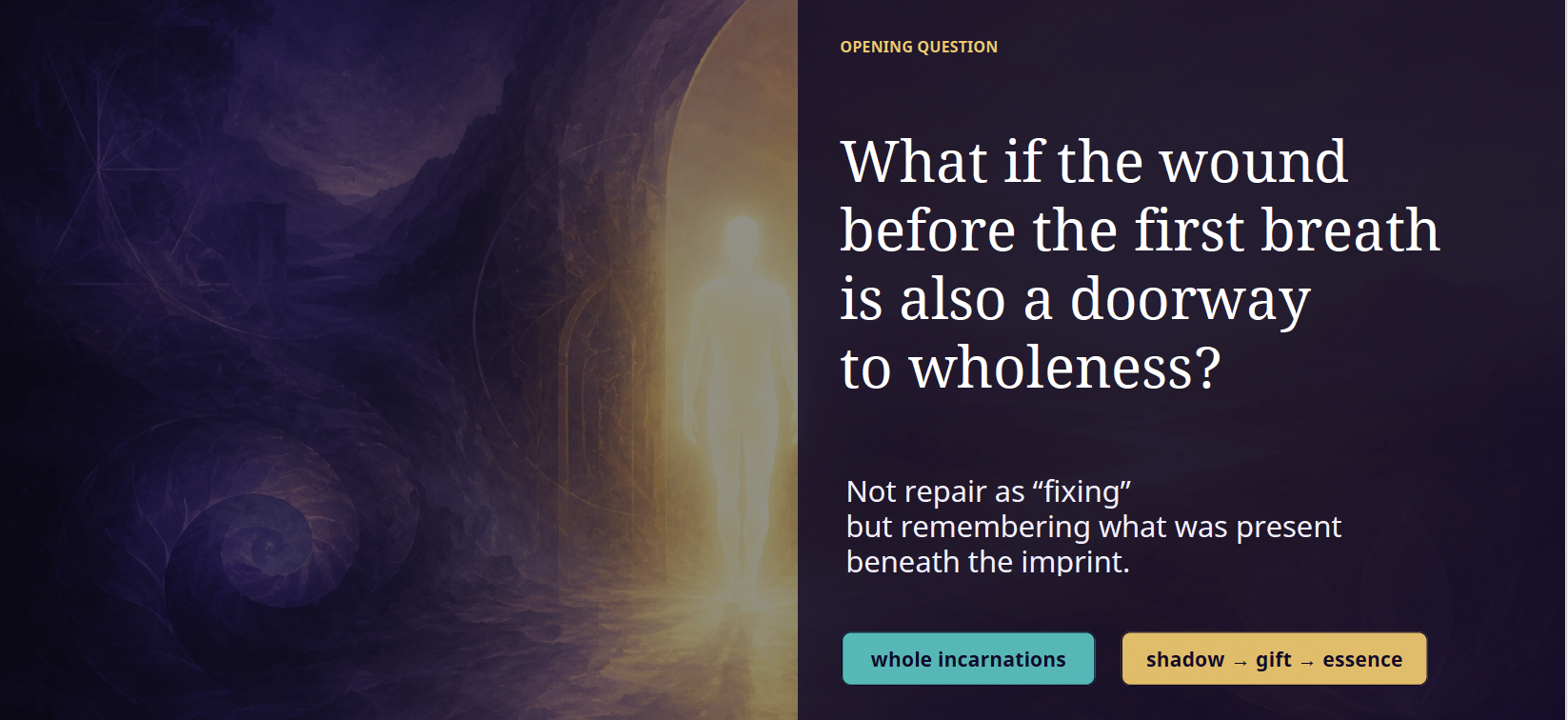
What if the wound before the first breath is also a doorway to wholeness?
This was the opening question of the lecture, and it is, in many ways, the opening question of my life’s work. Not repair as fixing. Not therapy as removal. But remembering — a return to what was already present beneath the imprint.
In transpersonal practice, we have long known that some of the most stubborn adult patterns — chronic urgency, relational distance, a quiet unwillingness to take up space, an inability to rest, a refusal to be seen — do not originate in childhood. They originate earlier. They are pre-verbal templates encoded in the body, in the chemistry of the womb, in the rhythm of a heartbeat heard from inside, in the first felt answer to a wordless question: What kind of world am I entering?
When that question receives a frightening answer, the small system does something remarkable. It does not collapse. It organizes. It builds a strategy — a protector — that will keep it alive through whatever is coming. Decades later, the strategy is still running. The adult does not know why they cannot stop performing, or cannot stop hiding, or cannot stop hurrying. They only know it feels like life itself depends on continuing.
The regression doorway, opened with skill and care, allows the system to meet that earliest moment with the awareness it did not have at the time. Not to relive it. Not to extract a literal memory. But to update the protector — gently, lovingly — so that the gift it has been guarding can finally come into the room.
Four movements in the talk
The lecture moved through four arcs — a clinical and transpersonal journey from imprint to essence:
- The imprint — how pre- and perinatal experience can organize the psyche as body, affect, attachment and meaning, long before narrative memory can catch it.
- The shadow — how original wounds become protective structures: anxiety, disconnection, control, urgency, relational defence. The shadow, in the Integrative Transformation Model, is never the enemy. It is the part of us that once saved us.
- The doorway — how clinical hypnosis, age regression and Life Between Lives work can access implicit, symbolic and transpersonal layers safely, without coercion, without leading, without confusing phenomenology with forensics.
- The remembering — how the Shadow–Gift–Essence integration recovers Fundamental Peace and lets authentic self-expression return to daily life.
These four movements are not just a teaching structure. They are the structure of every full regression session I have ever held, whether the client is a CEO in Madrid, a mother in Miami, or a coach finishing the Conscious Wellbeing Officer certification at the World Happiness Academy. The architecture holds because the human being holds it.
The earliest chapters are encoded differently
One of the most important clinical points of the lecture — and one of the most frequently misunderstood in the broader culture — is that pre- and perinatal experience is real, but it is not stored the way we usually mean by the word memory.
Explicit autobiographical memory needs language, time and story. It is the I remember when… of the older child and the adult. The earliest chapters predate that capacity entirely. What gets encoded instead is implicit, procedural and affective: body, sensation, attachment expectation, defensive reflex. An imprint is not a guaranteed literal record of an event. It is an embodied template — a tonal answer the nervous system gave to its first conditions, which can still organize adult perception and response decades later.
This distinction protects both the practitioner and the field. A regression scene is meaningful — sometimes profoundly so — but it is not, by itself, a forensic instrument. Phenomenological truth (what the psyche is showing right now) and historical claim (what can be externally verified) are two different categories, and the responsible practitioner never collapses them. Track the body, track the affect. Invite, never impose, meaning. Integrate the protector. Do not use regression to prove events. This is the clinical stance that lets the work go deep without going careless.
The heart of the model: Shadow → Gift → Essence
Everything I teach, write and practise sits on this three-word arc. It is the engine of the Integrative Transformation Model, and it is, I believe, one of the simplest and most underrated maps of the human interior.
- Shadow — defended pain, reactive pattern, protective strategy. The behaviour we wish we did not have.
- Gift — the adaptive intelligence underneath. The positive intention the shadow has been quietly serving all along. Sensitivity that became hypervigilance. Loyalty that became self-abandonment. Vitality that became urgency.
- Essence — the integrated being beneath both. Peace. Clarity. Compassionate action. The expression that does not need to perform or hide.
In pre- and perinatal work, the shadow almost always began as a brilliant survival strategy. The question we learn to ask of every defence is not how do I get rid of this? but what life-serving intelligence is this protecting? When that question is held with enough warmth, the answer always comes. And when it comes, the shadow does not have to die. It only has to be updated — with love, choice and awareness.
Every shadow is a protected gift. Every protector is waiting to be welcomed home.
Two composite cases — the architecture in action
During the lecture I shared two composite illustrations, anonymized and adjusted for teaching. They are worth repeating here because they show, in miniature, how the arc actually moves.
The Vanishing Protector
Adult presentation: “When I am seen, something bad happens.” Conflict avoidance, shame about visibility, dissociation in groups. The regression threshold opens into watery darkness, muffled voices, a tightening around the heart. The younger self forms the vow: I will take up less space.
In integration, the shadow (hide, do not disturb, be invisible to stay safe) is welcomed rather than fought. The gift is recognized as exquisite attunement — a capacity to sense the field that very few people possess. The essence that emerges is peaceful presence: a visible self that does not need to perform. The integration anchor in the body is simple — one hand on heart, one hand on belly — and the new sentence is equally simple: I am safe to be here, and I can choose how much space I take.
The Breath-Fight Pattern
Adult presentation: “If I slow down, I will fail or die.” High achievement, panic under deadlines, breath-holding, intolerance of pause. The regression threshold opens into pressure, no breath, a fight to get through. The vow forms: I have to force life.
In integration, the shadow (push, rush, hold breath and survive) is honoured for keeping the system alive. The gift is recognized as vitality and agency — the very power to move through. The essence that emerges is calm power: steady momentum, breath-led action. The anchor is three slow breaths before any significant action, and the new sentence is: I can move with life without forcing life.
These are not unusual cases. They are the daily texture of transpersonal clinical work. And they are also, I want to suggest, the daily texture of organizational and civilizational life. Most of what we call dysfunction in leadership is the Breath-Fight Pattern dressed in a suit. Most of what we call cultural shame is the Vanishing Protector with a national flag draped over it. The arc that heals the individual is the same arc that, scaled up, heals the field.
Regression is a meaning process — not a forensic instrument
This was one of the firmest lines in the lecture, and one that the European transpersonal community received with visible relief. The field has spent decades being misrepresented by people who wanted to use regression to prove things — past lives as biographical claims, womb scenes as legal evidence, recovered memories as factual records. None of that is what the work actually is.
Regression is a meaning process. It is the psyche given a language of images, sensations and symbolic encounters, in a state of altered attention that the contemporary neuroscience of hypnosis is beginning to map (Jiang et al., 2017, Cerebral Cortex). What emerges is real in the way poems are real, in the way dreams are real, in the way the body’s organization is real. It is not the historian’s category of real. We do not need it to be.
Held this way, the work is safe, deep and ethically clean. It can sit inside a trauma-informed protocol — consent and scope, resourcing the body, induction and witness, somatic bridge, the pre- or perinatal scene, the Shadow–Gift–Essence and Life Between Lives widening, embodied closure. Safety is not a prelude to transformation. It is the condition that makes transformation possible.
From clinical practice to transpersonal leadership
Here is where the lecture began to widen, and where it connects to the book I have spent the last year preparing: The Transpersonal Leader.
The leadership crisis of our era is not, fundamentally, a crisis of strategy, technology or policy. It is a crisis of unintegrated imprint. We are governed, increasingly, by people whose nervous systems are still answering the wordless question of their first conditions — and answering it with hide, perform, rush, control, attack. The ROUSER Leadership Model, which structures the book, is my attempt to offer a different way: leaders trained to recognize their own shadow, to honour their own protector, to reclaim the gift beneath the defence, and to operate from essence rather than from imprint.
A transpersonal leader is not someone who has transcended their wound. That fantasy is what produces spiritual bypass and authoritarian charisma. A transpersonal leader is someone who has met their wound with such compassion that it no longer governs them. They can sit with the pressure of a perinatal pattern without re-enacting it on their team. They can be visible without needing to perform. They can pause without panicking. They can hold a vast field — a city, a foundation, a company, a movement — because they have first learned to hold the small system that is themselves.
This is why I keep insisting, in every academy cohort and every coaching certification we run at the World Happiness Foundation, that depth work and leadership work are the same work. Not adjacent. Not complementary. The same. The Integrative Transformation Model is at once a clinical map and a leadership map, because the human interior is at once a clinical and a civic territory.
Scaling the arc: ten billion free, conscious and happy by 2050
And from leadership, the arc opens once more — out to the planetary.
By 2050, demographers project that humanity will have crossed ten billion lives. That number is not abstract. It is ten billion nervous systems, each carrying its own imprint. Ten billion first thresholds. Ten billion answers to the wordless question. The mission I have framed for the World Happiness Foundation — ten billion free, conscious and happy by 2050 — is sometimes received as a slogan. It is not. It is a clinical thesis at planetary scale.
The Global Pain & Trauma Map (GPTM) measures, across 196 countries and 321 communities, the seven domains in which collective imprint hardens into structural suffering. The Fundamental Peace Index (FPI) measures the inverse — the conditions under which essence has room to emerge. The Wheel of Happiness and the five Ecosystems of Happiness translate these measurements into design: the schools, cities, workplaces, hospitals and communities a flourishing civilization actually requires. Happytalism, the framework I have offered to the United Nations system as a post-Agenda 2030 successor paradigm, is the political philosophy that follows when one takes this thesis seriously.
None of these instruments is exotic. Each is a scaling of what happens in a single regression session done well. We learn, in the room with one client, that you cannot legislate a shadow away — you can only welcome it into integration. We learn that protection without awareness becomes pathology, and that awareness without compassion becomes cruelty. We learn that essence is not given; it is remembered. Scale those lessons by ten billion and you have the architecture of a conscious civilization.
The arc that heals a single nervous system is the arc that heals a species. The work is not different. Only the scale changes.
A bridge needs two strong banks
Throughout the lecture I held a line that EUROTAS in particular understands: neuroscience and spirituality must illuminate each other without being asked to erase each other.
Neuroscience can support and ground the work — prenatal learning and stress programming (Kapoor et al., 2006), implicit and procedural memory (Alberini & Travaglia, 2017; Damis, 2022), trance as altered attention and connectivity (Jiang et al., 2017), body-based integration as documented across the trauma field. These are not optional ornaments. They are the floor under our feet.
Spirituality can reveal what neuroscience does not yet have instruments for — symbolic meaning and archetype, compassion beyond the biographical self, soul-level purpose and belonging, the felt reality of essence. Life Between Lives work in particular widens the field from “What happened to me?” to “What is life asking me to remember?” — held, always, with humility and clear boundaries about what is clinically meaningful versus metaphysically claimable.
This is the posture of a mature transpersonal field. It is the posture EUROTAS has modelled for decades, and the posture I hope our work at the World Happiness Foundation continues to embody. Two strong banks. One flowing river.
Fundamental Peace
Fundamental Peace is not the absence of pain. It is the transmutation of its energy into love and compassion.
This is the outcome the lecture moves toward, and it is the outcome the whole architecture moves toward. Not the absence of difficulty. A sustainable inner coherence beneath difficulty.
Fundamental Peace is what self-acceptance feels like when the protector is finally welcomed. It is what emotional integration feels like when affect can move through the body without flooding it. It is what inner-outer alignment feels like when expression matches truth. It is what relational coherence feels like when connection no longer requires self-abandonment.
It is, at the personal scale, the essence remembering itself. And at the civilizational scale, it is the only foundation on which ten billion lives can flourish without consuming the planet or each other.
Five touchstones the EUROTAS room carried home
I closed the lecture with five working principles — small enough to remember, large enough to last. They are not formulas. They are postures.
- Track the body before the story. The narrative will catch up; the soma is already speaking.
- Honour the protector before seeking change. Nothing integrates that has not first been welcomed.
- Treat regression scenes as meaningful, not automatically factual. Phenomenology is sacred; forensics is a different category.
- Use the Shadow–Gift–Essence arc to convert defence into capacity. Every symptom is a portal when held this way.
- Close with embodied action. Essence must enter daily life, or it remains a beautiful idea that no one inhabits.
Healing becomes remembering
The lecture closed where it began — with the suggestion that healing, in its deepest sense, is not repair. It is remembering. A return to the wholeness that was already present beneath the imprint.
This is what regression, done with humility and skill, finally is. Not a digging up of the past, but a coming home to what was never lost. Not a fixing of what is broken, but a recognition that the protector is part of the wholeness too. Not the elimination of shadow, but its integration as gift, in service of essence, in service of life.
From the EUROTAS Symposium in Portugal, from the long arc of the Integrative Transformation Model, from the daily practice of clinicians and coaches and leaders across the network we are building, the same invitation continues to extend itself — quietly, persistently, across nervous systems and across nations:
Come home. Bring the protector. Reclaim the gift. Live from essence. And join, in whatever way is yours, the work of ten billion free, conscious and happy by 2050.
The wound before the first breath is also a doorway. It always was.
Prof. Luis Miguel Gallardo is Founder and President of the World Happiness Foundation (UN ECOSOC consultative status), Clinical and Transpersonal Hypnotherapist, ICF PCC Coach, LBL® Certified practitioner, and PhD Scholar at Shoolini University. His new book is The Transpersonal Leader.
World Happiness Foundation · Shoolini University · gallardohypnotherapy.com
© 2026 Luis Miguel Gallardo · World Happiness Press
Access to my presentation here:
EUROTAS_ITM_PrePerinatal_Regression_Luis_Miguel_Gallardo.pptxDownload…
Explore this topic
Field notes to your inbox
Stay connected to the shift.
Monthly essays from the Observatory, invitations to Fests and Academy cohorts. Written from abundance — never urgency.