

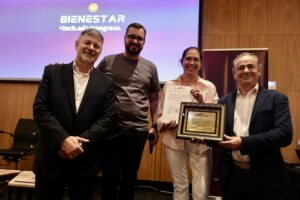
Córdoba’s Turn: Regenerative Happiness Builds a ‘City of Happiness’ Ecosystem
After lighting up Buenos Aires with the World Happiness Fest

At the heart of each tradition lies a view of the soul or ultimate self. The Brahma Kumaris (BK) teach that our true identity is the immortal soul – an infinitesimal point of spiritual light residing in the forehead, distinct from the body. All souls are originally pure and existed with God in a dimension of light and silence (the Soul World). God, termed the Supreme Soul, is also understood as an incorporeal point of light – an eternal source of wisdom, love, and purity who never takes birth in a body. In BK understanding, God is the Father/Mother of all souls, and knowing Him as an incorporeal being of light helps souls remember their own divine essence. The innate qualities of the soul are said to be purity, peace, love, bliss, and power; it is only when identified with the body and its vices that the soul’s light is obscured. Thus, “soul awareness” – the practice of knowing I am a soul, not a body – is fundamental to BK spirituality, reconnecting one with one’s original goodness and with God as the Ocean of Light.
Other traditions echo the idea of an inner divine essence, though in diverse terms. Sri Aurobindo refers to the psychic being, a divine spark or evolving soul within each person that carries the continuity of identity through lifetimes. This psychic being is the “innermost being” – the true self that is imperishable and stands behind the surface personality. It is inherently one with the One Self or Spirit that pervades all, but in most people it is hidden by ignorance. Aurobindo’s integral philosophy holds that realizing this inner divine principle – the psychic soul or ātman – is key to transformation. In a similar vein, Meher Baba teaches a nondual view: each soul is actually God wandering in illusion until it realizes its identity as God. He stated that God alone exists and that the individual soul is “God passing through imagination in order to realise its own divinity”. In other words, from Meher Baba’s perspective the soul (often called the drop-soul) is one with the infinite Ocean of God; it only imagines itself separate during its journey, and the end goal is to awaken from this dream of separateness. This view underpins Meher Baba’s emphasis on the fundamental divine love between the soul and God – since the soul is God, the spiritual path is about the lover (soul) merging back into the Beloved (God).
Not every tradition frames the soul as eternal or individual. Buddhism, in particular, made a radical departure with its doctrine of anatman (no permanent self). The Buddha taught that what we call a “self” is only a temporary aggregation of phenomena (body, feelings, mind, etc.), with no enduring soul-substance. Yet Buddhism still speaks of a continuity of consciousness or mental-stream that carries karma forward. This continuity, sometimes likened to a flame passing from one candle to another, serves a similar role to “soul” in explaining personal identity across lives – but without positing an unchanging essence. The absence of an eternal soul in Buddhism is actually seen as liberating: by not clinging to a false self, one can realize Nirvana, the unconditioned truth beyond ego. Taoism, on the other hand, tends not to analyze an individual soul in the same way; its focus is on the Tao (the primordial Way or source of reality) that underlies all beings. Classical Taoist texts like the Tao Te Ching suggest that by returning to one’s original nature – a state of simplicity and harmony – one aligns with the Tao. Later Taoist spiritual practices (especially in Inner Alchemy, or Neidan) do speak of refining one’s spirit (shen) to attain an immortal state. In internal alchemy, the practitioner seeks to form an “immortal spiritual body” that survives physical death, ultimately returning to the primordial unity of the Tao (a state sometimes called Taoist immortality). In essence, this is about realizing one’s identity with the eternal Tao. All these perspectives, despite their differences, affirm that there is more to our being than the material persona – be it an immutable divine soul, an evolving spark of spirit, a continuum of consciousness, or a oneness with the cosmic principle.
Since antiquity, Eastern philosophies have viewed life as a continuum that extends beyond a single physical birth. Reincarnation – the cyclical rebirth of the soul or consciousness – is a common thread linking many of these traditions. The Brahma Kumaris hold a distinctive version of this doctrine: souls take birth repeatedly in the human realm, cycling through the ages in a grand 5,000-year World Drama. Every soul plays multiple roles life after life, and all souls will eventually return to a pure state at the dawn of a new cycle. A notable BK belief is that a human soul never transmigrates into animal bodies – each soul’s births are within the human family only. Thus, while sharing the broader Indian cultural belief in karma and rebirth, BK teachings emphasize a fixed cycle of identical repetition. The motive for reincarnation in BK understanding is to experience life’s variety and eventually attain “liberation-in-life” (jeevanmukti) when one’s karmic accounts are settled and the soul returns to its original purity. Purity in this context is not just moral virtue but the soul’s original perfect state, which is restored through God’s help at the end of the Iron Age (Kali Yuga).
Research from modern hypnotherapy has added an interesting perspective to the idea of life between lives. Michael Newton, a pioneering regression therapist, conducted case studies of clients under deep hypnosis who recalled detailed experiences of the spirit world between incarnations. According to those accounts, after death the soul leaves the body and is greeted by guides or loved ones in a peaceful realm of light. Newton’s subjects consistently described undergoing an orientation or review of the life just past, spending time in soul groups or “homes” to learn and rejuvenate, and eventually planning the next incarnation. They reported that souls choose their upcoming life circumstances – such as their future body or family – in order to work on lessons and balance karma. Moreover, Newton’s work suggests there are levels of soul development (beginner, intermediate, advanced souls) which determine how freely a soul can choose its next life and how much wisdom it carries. This aligns with traditional teachings that more evolved souls incarnate with greater purpose and awareness. Such findings from Journey of Souls and similar works have given many spiritual seekers a concrete narrative of the soul’s journey: death is not the end but a transition, a pause in a long schooling process for the soul. Newton’s accounts, while coming from a therapeutic setting rather than a religious scripture, intriguingly echo concepts from ancient traditions – for example, the idea of a karmic blueprint for each life and the presence of spiritual guides (comparable to guardian angels or deities overseeing rebirth).
Classical Eastern doctrines provide their own rich maps of samsara (the cycle of birth and death). Buddhism shares the general Indian belief in rebirth but uniquely interprets it through the lens of anatman. In Buddhism, a person’s intentional actions (karma) lead to a new existence after death in an endless cycle known as saṃsāra, which spans various realms (from heavens to hells). Importantly, this cycle of rebirth is seen as dukkha – unsatisfactory and imbued with suffering – no matter how exalted one’s rebirth might be. The ultimate goal, therefore, is to escape the cycle altogether. This is achieved by attaining Nirvana, which is liberation from suffering and the end of rebirth through the extinguishing of craving and ignorance. In Buddhist philosophy, rebirth does not imply a fixed soul jumping bodies; rather, it’s like one life lighting the next like a flame. Each rebirth is the result of past causes, yet nothing permanently lasting transmigrates. Still, in practice, most Buddhists do speak of past and future lives and the continuity of individual existence in a pragmatic sense. The journey of the soul (or consciousness-continuum) is governed by karma until the chain of causation is broken by enlightenment.
Hindu and Sufi-influenced mystics like Meher Baba elaborate reincarnation in grand and colorful ways. Meher Baba outlined what he called the “Divine Theme”, describing the soul’s origin, evolution, and involution back to God. In his account, the journey begins with God as an unawake ocean of power who has the whim to know Himself. To fulfill this, an infinite number of souls (each a drop of the ocean) emerge and start their evolutionary trek from the very simplest forms of matter. The soul gains consciousness gradually by experiencing life as gas, stone, metal, plant, insect, fish, bird, and animal, in that order. By acquiring impressions (sanskaras) through all these experiences, the soul’s consciousness expands. Eventually, the soul achieves full consciousness upon reaching the human form – considered the culmination of evolution – but it remains ignorant of its true identity as God. At this point begins the second phase: reincarnation as a human. Meher Baba specified that each soul takes exactly 8.4 million human births (male and female, in every culture and circumstance) to experience all facets of human life. During these lives, the soul’s accumulated impressions are gradually worn away (through joys, sorrows, and seeking), preparing it for the spiritual path proper. The third phase, which he terms Involution, is the inner journey back to the Source. This spans seven planes of consciousness: the first three are subtle (energetic) spheres, the fourth is a perilous transition, and the fifth and sixth are higher mind planes, until the soul merges in the seventh plane as God-realized, experiencing itself as one with God. At that final stage, the drop realizes “I am God” and the long journey of the soul is complete. Such a detailed cosmology vividly underscores the idea that reincarnation is a progressive journey toward truth. As one summary of Sri Aurobindo’s view similarly puts it, reincarnation is not a punishment or meaningless cycle but a progressive evolution of consciousness – a chance for the soul to grow ever higher. In both Meher Baba’s and Aurobindo’s outlooks (though their metaphysics differ), there is an inherent optimistic thread: all souls are destined to eventually attain divine consciousness, and the many lives we live are the necessary chapters in that cosmic process.
Even Taoist philosophy, which is more worldly and present-life oriented, absorbed ideas of rebirth in its later religious development (in part through Buddhism’s influence in China). Traditional Taoism places less emphasis on an endless cycle of reincarnation and more on achieving harmony with the Tao here and now. However, certain Taoist tales and teachings speak of adepts who attained immortality – some understood literally as ascending to the heavens with an immortal body, others more symbolically as uniting with the eternal Tao and thus no longer bound by the mortal cycle. Taoist Neidan practices aimed to refine the life-energy to such perfection that the practitioner transcends ordinary death. In essence, rather than repeatedly cycling through births, a Taoist master’s goal might be to cheat the cycle by achieving spiritual longevity or immortality. One way to interpret this is that the fully realized person in Taoism leaves the wheel of birth and death by becoming one with the Tao, analogous in result (if not in concept) to the Buddhist attaining Nirvana or the Hindu yogi achieving moksha. A Taoist text might thus describe a sage wandering free of worldly fetters, riding on clouds among the immortals – a poetic image for liberation.
Across these perspectives, we see a shared understanding that life is an ongoing journey of the soul or consciousness. There is a strong interconnection between lives: what we do in this life shapes the circumstances of the next. All traditions encourage living responsibly and spiritually now, so that one’s future – whether in another incarnation on earth or in a spiritual realm – will move closer to ultimate freedom. Karma is the thread that links the beads of these many lifetimes, and cultivating virtue, knowledge, or devotion in the present is how one gradually untangles that thread.
A unifying theme for spiritual seekers is the attainment of higher states of consciousness or enlightenment. Each tradition offers its insight into the spectrum of consciousness – from ordinary awareness up to the loftiest divine realization – often using its own terminology for the gradations along the way.
The Brahma Kumaris emphasize a shift from body-consciousness to soul-consciousness as the gateway to higher awareness. In deep meditation, BK practitioners aim to experience themselves as souls: weightless points of light, intrinsically full of peace and love. They report that by remembering God (whom they affectionately call Shiv Baba, the beneficent Father) as the supreme point of light, they experience a state of serenity and “super-sensuous joy.” This could be seen as a foretaste of an enlightened state – a consciousness beyond physical sensory inputs, rooted in spiritual identity. However, Brahma Kumaris do not describe enlightenment as extinction or merging; rather, the pinnacle for them is a state of complete purity and divine connection, often described as “Karmateet” (beyond the influence of karma) and viceless. In their millenarian vision, those souls who attain perfect purity at the end of the cycle will be the deities of the new Golden Age. Thus, purity and enlightenment are closely linked in the BK worldview: enlightenment means returning to the original satopradhan (completely pure) state of the soul, reflecting God’s qualities.
David R. Hawkins, a contemporary spiritual teacher, offered a modern schema for states of consciousness that has resonated with many in the West. Hawkins famously created a Map of Consciousness, calibrating levels of consciousness on a logarithmic scale from 1 to 1000. Each level is associated with specific attitudes and experiences. At the very bottom are the life-destructive or suffering states – for example, Shame (calibration around 20), Guilt (30), Apathy (50), Grief (75), Fear (100), Desire (125), Anger (150), and Pride (175). These all calibrate below 200, which Hawkins identified as the critical threshold between negative and positive influence. Reaching Courage (200) is seen as a pivotal shift into life-supporting consciousness. Above this are progressively higher states: Neutrality (~250), Willingness (~310), Acceptance (~350), and Reason (~400) mark stages of expanding capability, understanding, and emotional balance. Transcending the purely intellectual realm, one then comes to Love (500) – defined not as romantic love but as unconditional, unselfish love for all – and Joy (540), a state of pervasive happiness and compassion. Beyond Joy lies Peace (600), a state of blissful quietude and oneness where the personal ego thins out. Finally, at the apex is Enlightenment, calibrated by Hawkins in the range 700 to 1000. He associated this highest level with the consciousness of the great avatars and mystics such as the Buddha, Jesus, or Krishna. At Enlightenment, according to Hawkins, the individual identity merges into the universal – it is the realization of the Self (with a capital “S”) as the omnipresent Divinity. In his words, “Enlightenment is realizing one’s true nature as the Presence of God, always present and accessible”. In this nondual state, all separation dissolves and one experiences unity with the Source of all that is. Hawkins’ contribution was not only to describe these states qualitatively but to propose that they can be quantified or calibrated (he used kinesiology-based methods for this). While some are skeptical of the numerical precision, his framework usefully illustrates a continuum of consciousness that maps well to descriptions from older spiritual traditions – from the hellish realms of ignorance and suffering up to the heavenly realms of enlightenment and God-consciousness.
Sri Aurobindo offered an equally sweeping vision of consciousness, rooted in his own yogic experiences. He posited that human consciousness is not the end of evolution; above our ordinary mind lie higher gradations: the Higher Mind, Illumined Mind, Intuition, Overmind, and finally the Supermind (or supramental consciousness). Each level represents an ascent closer to Truth. The Overmind, for instance, is a plane of cosmic consciousness where one perceives the unity in the diversity, but it still has a sense of separation (and was associated by Aurobindo with the level of spiritual inspiration of great saints and prophets). The true enlightenment for Aurobindo is the supramental consciousness – a complete truth-consciousness that is inherently divine. In the supramental state, one possesses unity-awareness by nature; it is a Gnostic consciousness that perfectly knows and governs the manifestation. Aurobindo wrote that supramentalisation of the being would “enable the birth of a new individual, fully formed by the supramental power… the forerunners of a new supra-humanity, grounded in truth-consciousness”. All ignorance, division, and falsehood in the being would be replaced by a seamless unity with the Divine on all planes of existence. Moreover, Aurobindo’s vision of enlightenment was not otherworldly – it included the transformation of the physical nature. He predicted that the descent of Supermind would even divinize the body, bringing about a “new supramental species… living a divine life on earth”. In simpler terms, his concept of enlightenment wasn’t just individual liberation (as in leaving the cycle of rebirth) but the beginning of a collective evolution: humanity itself rising to a higher consciousness. This is often referred to as the Supramental Transformation, and it is a unique contribution of Sri Aurobindo among 20th-century spiritual teachers.
Mystics in Sufi and Bhakti traditions, like Meher Baba, tend to describe states of consciousness in terms of one’s relationship with God or the experience of love and beauty. Meher Baba delineated the journey in terms of planes: as the soul traverses the seven inner planes, it gains access to subtler and more blissful states of awareness. The first three planes correspond to awakening of subtle senses (one might experience dazzling lights, sounds, or powers), but ego still remains. By the time a soul reaches the fifth plane, it experiences an overpowering love for God and sees God everywhere; by the sixth plane, it is lost in divine awe and only a thin veil (of the mind) separates it from the Absolute. The seventh plane is True Enlightenment – the state of God-realization, where the drop (soul) has merged in the Ocean (God) and knows itself as that Ocean. Meher Baba often described the experience of God-realization as infinite knowledge, infinite power, and infinite bliss, accompanied by the declaration “I am God” (analagous to the Vedantic Aham Brahmasmi). Interestingly, he also spoke of a stage beyond individual liberation: God-realized souls who return to ordinary consciousness while retaining enlightenment become Perfect Masters who can help others. And in his theology, the most advanced souls (like the Avatar, which he claimed to be) periodically descend to awaken humanity’s love for God. But throughout his teachings, the thread of love is paramount – Meher Baba asserted that “it is only through love that man gets happiness and becomes one with God”. He encouraged seekers to cultivate divine love, which he described as love for God for its own sake, beyond wanting anything in return. At the pinnacle of consciousness, love and oneness converge: “I am the Divine Beloved who loves you more than you can ever love yourself,” he said, implying that in the highest state, God is experienced as infinite love enveloping the soul. Thus for Meher Baba, enlightenment can be characterized as union with God in love. This resonates with the bhakti (devotional) traditions of the East, where the measure of spiritual advancement is the depth of one’s love-bliss for the Divine.
Buddhist enlightenment (Bodhi or Nirvana) is described in somewhat different terms – often as emptiness (shunyata), cessation of craving, and peace. Yet, advanced states of meditative consciousness are well-mapped in Buddhism. In early Buddhist teachings, the development of samadhi (concentration) leads through the Jhanas – a series of progressively subtler and more peaceful absorption states, from the first jhana (characterized by rapturous joy and one-pointedness) up to the fourth jhana (perfect equanimity and neither pleasure nor pain). Beyond these, the mind can attain formless absorptions (like infinite space, infinite consciousness, etc.). However, these states, while beautiful, are still considered conditioned and not the final freedom. The breakthrough to Nirvana comes with insight (vipassana) into the true nature of reality – seeing the three marks of existence (impermanence, unsatisfactoriness, and non-self) with such clarity that all clinging stops. When the mind is completely without craving or aversion, it is said to be “unbound” or “cool”, like a fire that has gone out. This is Nirvana: not a place or a thing, but the unconditioned state of liberation beyond the cycle of birth and death. Traditional texts often speak of it in negatives – deathless, unborn, unconditioned, extinction of the fires – to indicate what it is not. But they also equate it with ultimate happiness and peace. In Mahayana Buddhism, the Enlightenment of a Buddha is further described as the realization of emptiness (the insubstantiality of all phenomena) and great compassion arising together. A Buddha operates freely in the world for the benefit of all beings while never losing the immaculate Dharmakaya (truth-body) awareness. These are lofty concepts, but in practice Buddhist traditions encourage practitioners to look for signs of progress such as increasing compassion, wisdom, and mental peace as they approach enlightenment. One could draw parallels: Hawkins’ scale sees Love (500) and Peace (600) as precursors to full enlightenment, much as Buddhism sees the cultivation of metta (loving-kindness) and upekkha (equanimity) as integral to awakening.
Taoism speaks less of graded “levels” of consciousness, but it has its own vision of the enlightened or realized person – often called zhenren (the True Person) or sage. In the Taoist classics, the mark of the sage is effortless action (wu wei) and spontaneous alignment with the Tao. In practical terms, this means the sage’s mind is clear, still, and mirroring nature without distortion. The sage has emptied themselves of ego-driven desires and concepts, allowing the Tao to act through them. Laozi describes such a person as “One who accepts the world as it is; if you accept the world, the Tao will be luminous inside you and you will return to your primal self”. This return to the primal self suggests a state of consciousness that is natural, uncorrupted and in harmony with the Tao (often likened to the simplicity of an infant or the purity of an uncarved block). Another line from the Tao Te Ching portrays the enlightened master thus: “The Master keeps her mind always at one with the Tao; that is what gives her her radiance… Because she doesn’t cling to ideas.”. In other words, the enlightened Taoist is deeply present and flexible, shining with an inner light but not full of themself. An example given is how the sage uses solitude and embraces aloneness, “realizing he is one with the whole universe.”. This is a beautiful expression of unity consciousness in Taoism – without using theistic language, it conveys that the realized person experiences oneness (with the ten-thousand things, with the cosmos). Taoist sages like Zhuangzi even speak of a state where one “dreams” oneself to be in all beings, a kind of universal selfhood, which parallels the unity-awareness spoken of in Vedanta or by mystics of all traditions. So while Taoism doesn’t categorize enlightenment in analytical detail, its ideal of the fully realized human is clear: one who lives in harmony with the Tao, exudes simplicity, compassion and humility, and enjoys a wordless understanding of the universe’s flow.
In summary, despite differences in description, all these traditions acknowledge higher states of consciousness beyond the ordinary mind. Whether it’s called Christ-consciousness, Buddha-nature, Supermind, Paramatma, Nirvana, or union with the Tao, there is a shared recognition that human beings have the potential to awaken to a divine or true state of being. These states are characterized by qualities like profound peace, joy, love, wisdom, and oneness. They represent the full flowering of the soul’s journey. In the next section, we will see how each path prescribes specific practices and disciplines to cultivate such states and ultimately arrive at liberation or enlightenment.
All the philosophies under discussion converge on one point: spiritual attainment requires practice. While grace or divine help is often acknowledged, seekers are universally advised to engage in disciplines like meditation, contemplation, ethical living, or devotion to purify and focus the mind. Here we compare the practical methods and emphases of the Brahma Kumaris, Newton’s inferences, Aurobindo’s Integral Yoga, Meher Baba’s path of love, Hawkins’ recommendations, and the practices in Buddhism and Taoism.
The Brahma Kumaris path is frequently described as Raja Yoga meditation – a practice of remembering the self as a soul and remembering God with love. BK meditation is typically done with open eyes, often gazing softly at a point of light, which symbolizes the soul and the Supreme Soul. A simple instruction encapsulates it: “Consider yourself to be a soul and focus your mind on the Source, the Supreme Power, the Higher Intelligence, God. Go within, stay within and experience your inner self… Sitting in the consciousness of the soul, you gradually become silent.”. This inward focus is considered the first step of self-transformation. By repeatedly returning the mind to soul-consciousness and God-consciousness, practitioners aim to clean the “mirror” of the soul, removing body-conscious vices like lust, anger, greed, attachment, and ego. The BK lifestyle strongly emphasizes purity as a foundation for this practice. Purity for BKs means celibacy (even within marriage), pure diet (vegetarian and free from alcohol or intoxicants), and pure thoughts. It’s taught that “all power lies in the purity of the soul” and that souls lost their inner power only when they became impure (body-conscious and viceful). Thus, strict personal ethics and self-restraint are not seen as repression but as means to restore one’s original energy and peace. Daily routine in a BK’s life involves waking up at 4 AM for Amrit Vela meditation, studying spiritual teachings (murli), maintaining a remembrance of God throughout the day, and communal evening meditation. Rather than formal rituals, BKs practice a constant mental discipline: every situation is an opportunity to respond with soul-conscious virtues (peace, love, patience) instead of ego. In essence, the Brahma Kumaris path is a yoga of the mind – uniting the mind with God – and a way of life guided by simplicity, service to others, and seeing the world with spiritual vision (e.g. greeting others with “Om Shanti” to affirm the peace of the soul).
In the case of Michael Newton’s work, it doesn’t prescribe a spiritual practice per se; rather, it reveals the spiritual processes that (according to his case studies) are already at work between lives. However, one could infer practical lessons: for instance, people often emerge from Life-Between-Lives regression with a clearer sense of purpose and the importance of personal growth. Newton’s reports imply that lifetimes are planned for learning, so one could say that living consciously and reflectively is a practice – since we will review our life afterwards, we might as well live in alignment with our higher intentions now. Some who are inspired by Newton seek to experience those between-life states through hypnosis regression as a form of spiritual practice. While not traditional meditation, a deep hypnotic regression can be akin to a guided meditation that traverses spiritual memory. It often yields a perspective of the soul that can be profoundly healing: people report meeting their spiritual guides or soul group and re-experiencing the unconditional love and insight of that realm. This can motivate them to practice forgiveness, to pursue their talents (viewing them as chosen “lessons”), or to meditate more regularly to maintain a connection to their soul consciousness. In sum, Newton’s contribution here is indirect – he doesn’t teach “how to meditate” – but by mapping the afterlife, he provides context that can energize one’s inner work and make practices from other traditions more meaningful.
Integral Yoga, the path of Sri Aurobindo (and The Mother, Mirra Alfassa), is comprehensive in scope. The very term “integral” indicates that multiple aspects of yoga are combined: Jnana (knowledge or discernment), Bhakti (devotion and surrender), and Karma Yoga (selfless action) are all incorporated, as well as aspects of Raja Yoga (concentration and meditation). The aim is not to renounce life but to bring the higher consciousness into life. Sri Aurobindo wrote that “a conversion has to be made, a turning of the consciousness by which mind has to change into the higher principle… This method is found through the ancient psychological discipline of Yoga.”. But unlike classical yogas that often advocated withdrawing from the world, Aurobindo’s method calls for the descent of the spiritual consciousness into worldly life. In practice, an Integral yogin might have a meditation practice for quieting the mind and opening to the above (perhaps akin to mindfulness or mantra repetition), but equal emphasis is given to working on one’s character and motives. There is a strong ethical component: one must conquer desires and attachments, not necessarily by physical asceticism, but by inward renunciation of ego-gratification. One strives to act from the soul (psychic being) rather than the vital ego – meaning acts should be offered in service of the Divine or the greater good, rather than driven by selfish ambition. Devotion and surrender to the Divine are also central; practitioners often concentrate in the heart to contact the psychic being and cultivate a loving relationship with the Divine Presence (often personified as the Mother or Krishna). Aurobindo and the Mother gave many specific techniques as well, such as aspiration (a sincere prayer from the heart for growth), rejection (of lower impulses when they arise), and surrender (to the higher guidance). Meditation in this yoga can be dynamic: one might meditate while reading his epic Savitri or while walking, maintaining an awareness of the Divine in all. There are also phases of development described (like the Triple Transformation: psychic awakening, spiritual descent, supramental descent) which guide the practitioner’s focus. But Integral Yoga is notably non-formulaic – there is no set timetable or posture; each individual’s path is unique. The Mother said, “What is required is an inner discipline more than an outer one.” The ultimate “practice” is to live each moment consciously, as if it were an offering or an act of yoga. Over time, this leads to an integral change of the being, preparing it for higher consciousness to permanently take hold.
For Meher Baba’s followers, the path is often summarized in one word: Love. Meher Baba did not teach complicated techniques of meditation; in fact, he sometimes discouraged mere occult or psychic practices if done for their own sake. Instead, he stressed selfless love for God, service to others, and surrender to the God-realized Master. One of his well-known quotes is “Love God and become God.” In practical terms, this means remembering God (through prayer, chanting His name, or thinking of the beloved Master) throughout the day, serving others as a form of serving God within them, and keeping the company of other lovers of God. He advised his followers to lead normal lives in the world – work, marry, etc. if they chose – but to remain inwardly detached and always focused on the true aim of life, which is God-realization. Meher Baba established no new rituals or strict rules (beyond common ethical precepts like avoid alcohol, drugs, etc., which he saw as impediments). However, he did place a high importance on certain symbolic practices: for example, he enjoined his followers to observe silence on July 10th each year (in remembrance of his own long silence) as a form of inner connection, and many do so as a meditation in silence. He also gave a prayer called the “Parvardigar Prayer” praising God, which followers recite, and encouraged the repetition of God’s name (any name one chooses) as a simple mantra. But above all, the cultivation of divine love in the heart was paramount. In Meher Baba’s Discourses, he elaborates on the stages of love – from initial attraction to God, to longing (which purifies the heart through what he calls the “fires of separation”), to ultimately the stage of Union where lover and Beloved become one. For those inclined, Meher Baba’s path intersects with Sufism and Bhakti Yoga: practices like singing devotional songs, reading the poetry of mystics like Rumi or Hafiz, and contemplating the life of the Master are encouraged to stoke the fire of love. Alongside love, selfless service (seva) is a key practice he emphasized: “He advised followers wishing to attain God-realisation, emphasizing love and selfless-service.”. Doing good for others without expectation purifies the heart and automatically draws one closer to God, in his view. In summary, Meher Baba’s “methods” might look subtle: no compulsory meditation routine or yoga postures, but rather a transformation of one’s daily life into an expression of love for God. For the earnest lover of God, every action and experience becomes a form of spiritual practice – a way to remember the Beloved.
David Hawkins’ approach to spiritual practice is eclectic, reflecting his background in both clinical psychology and mystical traditions. In his writings (such as Power vs. Force and Letting Go), Hawkins advocates a few core practices. One is meditation and contemplation: quieting the mind to become aware of the Presence of God within. He often recommended simple meditation techniques (like following the breath, or repeating a holy name) to reach a state of calm awareness. Another key practice is what he calls letting go or surrender: observing one’s feelings and thoughts and relinquishing the energy of negative emotions to the Divine. Whenever an emotion like fear or anger arises, instead of suppressing or expressing it, Hawkins advises one to feel it fully and then release it, allowing it to dissipate. This practice of non-attachment and surrender gradually raises one’s baseline state. Devotion is also central in Hawkins’ method – he spoke of “Devotional Nonduality,” meaning one uses devotion (love of God, prayer, worship) as a means to transcend the ego and realize nondual truth. He saw surrender to God (or to one’s higher power) as perhaps the ultimate practice, aligning with the teachings of saints who say self-will must die for God’s will to take over. On a practical level, Hawkins suggested integrating spiritual awareness into daily activities – maintaining a mindful, prayerful attitude. He also introduced the idea of muscle-testing (kinesiology) to discern truth from falsehood, which some people use as a sort of biofeedback to guide their choices (though he cautioned that it requires proper conditions). But aside from that controversial tool, Hawkins’ guidance largely mirrors classical practices: daily meditation, regular prayer, immersion in inspirational teachings, association with enlightened teachers or teachings (what in Sanskrit is called satsang), and most importantly, living by high ethical and moral principles. He emphasized kindness, compassion, and forgiveness as qualities to cultivate. In effect, one could say Hawkins synthesized elements of AA’s 12-step surrender (he was influential in recovery circles), Christian prayer, Hindu nondual philosophy, and Zen-like mindfulness into a path of continuous inner work. The reward of this work, he promised, is an ever-expanding happiness and the eventual realization of the Self. Indeed, many who follow his map treat everyday life events – whether facing a stress at work or an emotional trigger in a relationship – as opportunities to practice letting go and choosing a higher response, thereby climbing the ladder of consciousness in real time.
Buddhist practice is perhaps the most codified of all these traditions, given its monastic heritage and detailed teachings on meditation. The Buddha’s prescription, the Noble Eightfold Path, lays out an entire lifestyle of cultivation. This path is often grouped into three trainings: Sila (ethical conduct), Samadhi (meditation/concentration), and Prajna (wisdom/insight). Ethical conduct includes right speech, right action, and right livelihood – essentially living a morally upright life of non-harming, truthfulness, and simplicity. These form the foundation without which higher meditation cannot succeed (much like the emphasis on purity in BK or virtue in other traditions). Then comes the practice that most people identify with Buddhism: mindfulness and concentration meditation. Right effort, right mindfulness, and right concentration are three parts of the path that involve training the mind. Mindfulness (whether via breath awareness, body-scanning, etc.) helps one develop a calm, focused mind and insight into the changing nature of phenomena. Practices like Vipassana (insight meditation) systematically cultivate observation of one’s moment-to-moment experience to uproot craving and ignorance. Meanwhile, practices such as Metta (loving-kindness meditation) directly cultivate compassionate feelings toward oneself and all beings, balancing the insight with heart-opening. The Buddhist meditative repertoire is vast – from Zen’s just-sitting (shikantaza) to Tibetan visualization practices – but all aim at the same result: liberating wisdom and unbounded compassion. A distinctive aspect of Buddhism is the community practice; monastics live in sanghas under strict disciplines (vinaya) that support their practice, and laypeople also practice in groups, do retreats, and take guidance from teachers. Bowing, chanting sutras, studying Dharma, observing precepts (like periodic fasting or celibacy on retreat) – these all reinforce the central work on the cushion and in daily life. Because Buddhism is non-theistic, practice is directed less toward union with a deity and more toward knowing reality. The fruits of practice are measured in terms of reduced suffering, clarity, and kindness. Advanced practitioners might attain states of jhana or reported psychic powers (the Buddha acknowledged these but warned not to get distracted by them). Ultimately, the practice leads to stream entry and progressively higher stages of enlightenment, culminating in Arhatship or Buddhahood, where the practice completes itself because the goal (Nirvana) is attained.
Taoist practice, especially in the organized religious Taoism of later centuries, can resemble a fusion of meditation, health exercises, and ritual. Early philosophical Taoism emphasized wu wei – a sort of effortless living – which as a practice means going with the flow of nature, not overthinking, and being content with simplicity. This in itself is a kind of mindfulness practice in daily activity: the sage practices non-interference, allowing each situation to unfold without the ego’s imposition. Later Taoists developed specific meditation methods. One well-known practice is Zuowang, literally “sitting and forgetting,” where one sits quietly and lets go of all thoughts, distinctions, and even the sense of self – essentially achieving an empty, receptive state to merge with the Tao. This has parallels to Buddhist and Hindu meditations aimed at dissolving the ego-mind. Another aspect of Taoist practice is Internal Alchemy (Neidan), which is both metaphorical and literal. Practitioners work with breath (Qi), bodily postures, visualization of energy centers (dantians), and sometimes sexual energy cultivation to harmonize yin and yang forces within the body. For example, the practitioner might guide the breath and awareness through the microcosmic orbit (a circuit along energy meridians) to refine jing (essence) into qi (energy), and qi into shen (spirit), and then merge shen with the void, achieving the “Golden Elixir” of immortality. This is an esoteric practice that not all Taoists do, but it’s a prominent part of Taoist yoga. Then there are the more familiar Tai Chi and Qigong exercises – these moving meditations and energy exercises are Taoist practices to strengthen the body, breathe consciously, and circulate internal energy, often with the secondary aim of spiritual clarity and longevity. Taoist ethics, while not spelled out in commandments, revolve around principles like naturalness (ziran), simplicity, gentleness, and compassion. Laozi spoke of the “three treasures” to hold: compassion, frugality, and humility. Living by these values is a practice in itself. Additionally, Taoist religion has rituals for honoring deities and nature spirits, talismanic practices, and feng shui (harmonizing with environment) – all of which are meant to align human life with the Tao’s harmony. In quiet cultivation or in communal ritual, the Taoist adept seeks to tune themselves as an instrument of the Tao. The ultimate “practice” is often described as wuji – cessation of all activity into the primordial stillness, from which taiji (the dynamism of yin and yang) arises. Therefore, the culmination of practice is often a state of effortless being where virtue and action flow spontaneously without contrivance. As one Taoist saying goes, “By doing nothing, everything is done.” This is not inaction in the literal sense, but rather action perfectly in accord with the whole, which is the fruit of long internal practice.
Seen in a broader perspective, all these practices – whether meditating on the soul, praying to God, chanting AUM, repeating the name of Allah, practicing mindfulness, or aligning one’s qi – serve to quiet the ego-mind, purify the heart, and open the gates to higher consciousness. They differ in form (one sits in silence, another dances ecstatically, another serves in a homeless shelter), but they share the effect of transforming the practitioner’s consciousness. Through practice, the aspirant gradually embodies the spiritual ideals: the peace, love, wisdom, or whatever qualities signify enlightenment in their tradition. Each tradition offers tools to deal with the very human obstacles on the path: desire, fear, anger, ignorance. Whether it’s confession and prayer in Christianity, or self-inquiry in Advaita, or isolation retreats in Taoism, the aim is to remove inner impurities so the light of truth can shine forth.
All spiritual traditions ultimately ask: What is the final goal of our journey? And while they use different names and metaphors, their answers revolve around a set of related ideas: knowing the Truth, realizing the Self, uniting with the Divine, attaining liberation (moksha, mukti), or awakening from illusion. Here we highlight both the convergences among our selected traditions in their vision of the final ideal, and the unique contributions of each to our understanding of truth and liberation.
A strong point of convergence is the notion that the highest truth is unitary – a state of oneness or non-duality. In the Brahma Kumaris, this oneness is expressed as the realization of the brotherhood of souls and the experience of God’s unlimited love. BK teachings often say “we are all children of the one Father”; when one is soul-conscious, the divisions of race, religion, gender, etc. fade and a natural love for all souls emerges. This reflects an understanding that in our essence we are one family, and the differences belong only to the physical costume. Moreover, in deep meditation, BKs may experience a stage called “avyakt” (subtle angelic stage) where the soul feels light and unbound, connected with all, as if near to God in the Soul World. This could be likened to a taste of the nirvana state – complete peace and freedom from worldly bondage – though BKs would describe it in theistic terms (as being merged in God’s light). The end of the 5000-year cycle in BK lore is the time of liberation for all souls: souls return to the Soul World to rest in the incorporeal God, and then the pure ones come down to start the Golden Age. Thus, liberation is both an individual and collective event. While this cosmology is unique, the essential theme of returning to an original unity and purity resonates with many paths.
For Michael Newton’s case studies, interestingly, the ultimate goal of souls was not discussed as often as their intermediate purposes. His clients described learning lessons, advancing to higher soul levels, and taking on roles like spirit guides. Some spoke of “graduating” from the reincarnation cycle on Earth – after which a soul might incarnate elsewhere or exist perpetually in the spirit world to help others. The absence of a single dramatic liberation event (like Nirvana or union with God) in these accounts may reflect the limits of the information people could retrieve, or it may suggest that in Newton’s framework, souls continue evolving indefinitely. However, a few subjects did mention a sort of endpoint: highly advanced souls that draw very close to the Source, radiating great light, who no longer need to incarnate. These might correspond to what religions call liberated souls or ascended masters. Newton himself, coming from a therapeutic and research perspective, refrained from declaring an ultimate metaphysical endpoint. Yet his work vividly affirms a core idea shared with others: life has a purpose directed toward spiritual growth. Each life is an opportunity to become more loving, wise, and “high vibration” – essentially moving closer to the Divine Light that many report perceiving in between lives. The interlife state itself, as described, is one of profound truth and understanding – people often say they recall “all knowledge” being accessible there and feeling an overwhelming sense of belonging and peace. This resembles the accounts of near-death experiencers who glimpse a realm of light and knowledge. We might say that, according to these findings, the soul’s journey toward truth is a gradual awakening to its own godlike nature, achieved over many incarnations and intermissions, until eventually it fully realizes that nature and no longer needs the training ground of physical life.
Sri Aurobindo’s unique contribution regarding liberation was his insistence on a collective and earthly transformation, not just an individual escape. Traditional Hinduism (as well as Buddhism and Jainism) often speaks of mukti or moksha – release from the cycle of rebirth – as the ultimate goal. In such older paradigms, the world is maya (illusion or at least impermanent) and the soul’s highest destiny is to transcend it, either by merging in God (sayujya mukti) or attaining a formless liberation. Aurobindo acknowledged the possibility of such a static liberation (he called it nirvana in some of his writings, which he himself attained in 1908, experiencing the silent Brahman). But after that experience, he was shown another path: a dynamic liberation in which the world itself is embraced and divinized. He wrote, “Our aim is not to be free from action, but to be free in action. Not extinction of the soul, but perfection of the soul.” In Aurobindo’s vision, the Truth-Consciousness (Supermind) will descend to Earth, ending the reign of ignorance and falsehood. This means that enlightenment is not just for rare yogis, but could become the new norm of humanity – a collective step in evolution. This forward-looking, evolutionary view of liberation is a hallmark of his teachings. It interconnects with modern notions of progress while keeping the spiritual essence intact. The supramental transformation he speaks of would result in a divine life: society would reflect spiritual truth (e.g., unity, harmony, creativity) rather than egoism and division. It’s an inspiring vision that extends the idea of liberation from a personal state to a new age or species. While time will tell how this plays out, Aurobindo has certainly expanded the conversation about enlightenment to include the very cells of the body and the fabric of earthly life as candidates for transformation.
Meher Baba and other Sufi or Bhakti masters put unsurpassed emphasis on Love as both the path and the goal. The journey toward truth for Meher Baba is nothing without Prem (love). He asserted that divine love is higher than intellect and even higher than meditation in this age. The convergence here with other devotional traditions is clear: whether one looks at Rumi’s poetry, the Bhagavata Purana’s tales of Krishna’s devotees, or the songs of Christian mystics, love is hailed as the quickest and sweetest road to God. Meher Baba often told the story of the lover and Beloved: initially the soul loves God as separate, then through intense longing and grace, the lover and Beloved become one – that is the moment of God-realization, where the soul exclaims “I am God” in absolute bliss. Yet, interestingly, Meher Baba also highlighted the Bodhisattva-like ideal of coming back to help others. He said that the realized soul often (by its own choice) returns to normal human consciousness but retains God-knowledge, thus becoming a Perfect Master who can lead others to the Goal. He even described a kind of grand interconnection between realizations: five Perfect Masters maintain the universal balance in each age, and periodically one of them is the conduit for the Avatar (God in human form) to incarnate, which he claimed happens every 700-1400 years. While this is a theological detail specific to his narrative, it underlines a key point: enlightened beings are intimately involved in helping humanity. In Meher Baba’s view, the journey toward truth is not complete until one has also given truth to others – love naturally wants to share itself. Thus, true liberation carries within it the seed of service. This resonates with the Mahayana Buddhist concept of the Bodhisattva who foregoes final Nirvana to rescue all beings, and with the idea in Hinduism of the Jivanmukta (liberated being) who still walks among us doing good. The unique flavor Meher Baba adds is the sheer romance of the soul’s journey: he describes creation itself as God’s lila or whim to experience love. The key learning here is that the nature of the soul is divine love, and full realization is the experiencing of infinite love. All knowledge and power come along with that, but love is the core.
David Hawkins contributes a modern, inclusive perspective that in many ways bridges East and West. One of his key teachings about the journey to truth is the concept of attractor fields: that as you advance in consciousness (by relinquishing negativity and aligning with truth), you begin to resonate with higher fields of energy – essentially, grace. He suggests that even wanting to seek truth means you’re already influenced by higher calibration fields (like the energy of the saints and enlightened ones). This emphasizes the interconnectedness of consciousness: high states uplift others. In fact, Hawkins famously claimed that a single individual at a consciousness level of 500 (Love) can counterbalance tens of thousands of individuals below 200 (in negativity), and one avatar at 1000 can offset the collective negativity of millions. Whether or not one takes the numbers literally, the principle is that enlightenment benefits the whole. This converges with the notion of collective evolution (Aurobindo) and compassionate service (Bodhisattvas). Hawkins also demystified the path by couching it in somewhat scientific language, making ancient wisdom more accessible to a rational-minded contemporary audience. His unique map allows people to self-diagnose (with caution) where they might be stuck – say in pride or anger – and work through it. Thus, he’s given a practical tool for the journey: you move up by resolving inner blocks, consistently choosing forgiveness over resentment, courage over fear, and so on. The journey toward liberation, in Hawkins’ terms, is a gradient rather than a sudden shift (though he acknowledges sudden enlightenment can occur). It’s accessible – you don’t have to be a monk; everyday life is the dojo. And crucially, he reminds us that Truth is omnipresent – it’s not something you fabricate, it’s something revealed when falsehood is removed. This aligns perfectly with classic enlightenment teachings: the Self is always shining; it’s only clouds of ignorance that need clearing.
Buddhism and Taoism, the two major Eastern traditions explicitly mentioned, offer complementary takes on truth and liberation. Buddhism’s vision of liberation (Nirvana) has a certain dynamism in Mahayana where the Truth is seeing the emptiness of all phenomena, which paradoxically means seeing the unity of everything (since all share the same empty nature) – from that arises great compassion, the mark of a Buddha. Taoism’s notion of ultimate truth is a bit more elusive since the Tao that can be spoken is not the eternal Tao. In a sense, Taoism is content to let the Great Mystery remain wordless; the sage simply dwells in harmony with what is. One might say the Taoist “liberation” is a life of naturalness and longevity, moving in sync with the cosmos, free of conflict and strain – essentially, Heaven on Earth. Indeed, both Buddhism and Taoism end up influencing East Asian notions of an enlightened person as someone very simple, ordinary in behavior yet extraordinary in presence. The Zen monk and the Taoist hermit often resemble each other: living in the mountains, drinking tea, watching the moon – having realized the ultimate, they find joy in the suchness of each moment. This serves as a reminder that truth and liberation are not somewhere else – they are right here, in the present moment, if we can but awaken to it. The journey’s end might not be a fireworks display but a return to the exquisitely ordinary now, seen with new eyes (the primal self, as the Tao Te Ching put it).
In reflecting on all these, we recognize each tradition’s unique contribution:
In a community of “conscious catalysts” and spiritual seekers such as we address here, all these perspectives serve as catalysts indeed – each can trigger realizations and deepen our understanding of the ultimate journey. One seeker might find that meditating on the soul’s original purity (as BKs do) suddenly makes it easier to forgive themselves and others – a Brahma Kumari catalyst. Another might find that reading Newton’s Journey of Souls erased their fear of death and gave them courage to pursue their life purpose wholeheartedly – a Newtonian catalyst. Studying Aurobindo might expand someone’s aspiration from personal liberation to a passionate will to help transform the world, viewing their work in society as part of a divine plan. Singing Meher Baba’s arti (prayer) might flood another’s heart with devotion, melting intellectual blocks and making God a living presence for them. Practicing Hawkins’ letting go could enable someone to finally drop a long-held resentment, leaping from contraction to freedom in an instant of grace. Embracing Buddhist mindfulness might ground a normally anxious person in the here and now, revealing a glimpse of the peace that was always available. And contemplating Taoist wisdom could help an over-striving seeker learn to relax into the flow, trusting life more and thereby actually moving closer to the Tao.
Ultimately, the journey toward truth and liberation is a personal one, but we do not walk it alone. We have the footprints and handrails left by many who went before us, in all corners of the world. Each tradition reviewed here is like a facet of a great diamond. Looking through each facet, we see a slightly different hue, but the light illuminating them is one. The Brahma Kumaris speak of the Supreme Soul as the one light that all prophets have called by different names. Likewise, we can see the enlightenment each tradition points to as that one light of truth, refracted through cultural lenses: call it Brahman, call it Buddha-nature, call it God or the Tao, it is the same eternal Reality.
Given the rich comparisons above, it is helpful to distill the common ground and then honor what is unique in each path:
Another convergence is the concept of self-transcendence. Whether it’s dissolving the ego, conquering the lower self, or emptying the mind, each tradition sees the ordinary ego-bound consciousness as limited or illusory, and calls for a leap beyond. The Brahma Kumaris ask us to let go of body-conscious identities and even familial attachments (while fulfilling duties) – not to be cold, but to love spiritually rather than possessively. Buddhism explicitly identifies the delusion of a separate self as the root of suffering. Taoism warns that rigidly asserting oneself (like being inflexible or willful) goes against the Tao, whereas yielding and forgetting self leads to harmony. Aurobindo speaks of surrender of the ego to the Divine Shakti as crucial for transformation. Meher Baba famously said, “Die before you die,” meaning let the ego die to realize God (a sentiment also found in Islamic mysticism). Hawkins likewise notes that the ego cannot become enlightened; enlightenment dawns when the ego is dissolved in the light of the true Self. So, all roads direct us to go beyond the little “I”. This is perhaps the hardest convergence to actualize, but a clear signpost they all share.
When it comes to liberation, we find that each tradition’s ultimate goal, while described differently, involves freedom from suffering and limitation, and union with a higher reality. BKs envision Jeevanmukti (liberation in life) where one lives in the world utterly free of vices and in God’s remembrance, effectively an angel on Earth, and then Paramdham (the soul world) as ultimate rest. Hindus, Sufis, and others speak of God-realization or Union with the Beloved. Buddhists talk of Nirvana or cessation of the causes of rebirth. Taoists hint at immortality and being one with the Tao. These can all be seen as facets of Moksha, the ancient Sanskrit word for release – release from bondage, ignorance, and separateness. Notably, none of these paths encourage a seeker to seek power or occult abilities for their own sake; such things might come as byproducts, but the focus is always on liberation and/or loving service. In convergence, true spiritual success is marked by humility, simplicity, and selfless love, not by fanfare or ego-aggrandizement.
In weaving these paths together, it becomes evident that they are complementary, not contradictory. Where one is strong in a certain approach, another compensates with a different emphasis. For instance, where Buddhism might seem a bit austere or void-centric, Meher Baba or Bhakti paths bring in a warm personal God and love. Where purely devotional approaches might risk sentimentality, Buddhism or Advaita brings in sharp wisdom to cut through delusions. The Brahma Kumaris focus on a personal God helps those who struggle with abstract conceptions, whereas Aurobindo’s impersonal cosmic approach might attract those who think bigger. Taoism’s laid-back naturalness balances out Hawkins’ structured levels and effort. And Newton’s empirical bent grounds metaphysical discussions in experiential data, satisfying the modern intellectual. Together, they form a tapestry of truth: each tradition a thread in a grand design. As conscious catalysts in a community, we can draw on all these threads to effect holistic transformation – personal and collective.
In exploring the Brahma Kumaris’ wisdom alongside the teachings of Michael Newton, Sri Aurobindo, Meher Baba, David Hawkins, Buddhism, and Taoism, we find a rich diversity of expressions pointing to a unity of insight. Each path has charted a route toward understanding the nature of the soul, the cycles of life and death, the expansions of consciousness, and the ultimate liberation into truth. They use different maps – a cycle of time, a calibrated scale, an evolutionary ladder, a wheel of becoming, or the spontaneous flow of the Tao – yet these maps often intersect at key coordinates. All affirm that our essence is spiritual and immortal, all encourage us to know ourselves at the deepest level, and all counsel us to live by higher virtues as we journey forward.
For a spiritual seeker in today’s world – often no longer confined to a single tradition but rather a conscious catalyst drawing inspiration eclectically – these convergences are encouraging. It means one can meditate like a Buddhist in the morning, practice soul-consciousness and remember God’s light as a Brahma Kumari during the day, read a little from Savitri or Hawkins or the Tao Te Ching in the evening, and perhaps say a loving prayer before bed – and all these acts support each other rather than conflict. There is a growing interfaith spirituality that recognizes the validity of multiple approaches. In such a context, understanding the thematic overlaps (like reincarnation concepts or levels of enlightenment) helps build a cohesive worldview, preventing fragmentation. One can, for example, reconcile the Brahma Kumaris’ insistence on one God with Buddhism’s non-theism by understanding that the experience of Nirvana (emptiness) might well be the same ultimate reality that a bhakti feels as the loving presence of God – just perceived through different lenses of mind. Aurobindo’s concept of the Supermind descending could be seen as analogous to the Buddhist prophecy of Maitreya (future Buddha) or the Second Coming of Christ or the Brahma Kumaris’ Golden Age: all speak to a future fulfillment of the divine plan on Earth.
By highlighting both convergence and uniqueness, we avoid a pitfall: the notion that “all paths are the same” (which can flatten the beautiful nuances), or its opposite, that “only one path is true” (which leads to division). Instead, we appreciate that truth is a diamond with many facets. Each tradition polished one facet to brilliance. When a light (divine revelation) shone through that facet, a certain color emerged – one tradition gave us golden compassion, another sapphire wisdom, another ruby love, another emerald equanimity. To get white light, we can embrace the whole spectrum, integrating those colors. This does not mean a mishmash with no identity; rather, it’s a harmonious orchestra where different instruments play distinct parts in the same grand symphony of awakening.
What have we learned about the nature of the soul? That it is a point of conscious light, eternal and divine, yet evolving in expression – the soul’s journey is real and purposeful. That in essence, the soul is God (per Meher Baba’s “I am God” realization and Aurobindo’s Atman = Brahman), or at least of the same substance as God (BK’s child of God, or the “Buddha-nature” within). However, the soul’s true nature can be obscured by ignorance (avidya) or illusion (maya), so spiritual life is about removing those veils.
What about reincarnation? We see it affirmed strongly by BKs, Newton, Aurobindo, Meher Baba, Buddhism – each adding flavor: a fixed cyclic drama, a schoolhouse for learning, a means for consciousness to evolve, the divine comedy of God seeking Himself, or the mechanical wheel of samsara to transcend. Even traditions that don’t harp on reincarnation (like mainstream Taoism or some interpretations of Christianity) often have analogous ideas of continuity (ancestral existence, heaven and rebirth at resurrection, etc.). Reincarnation, far from being a fanciful idea, emerges as a logical extension of the soul’s immortality combined with the observation of moral order (karma). It speaks to justice (we reap as we sow across lifetimes) and to mercy (we get many chances to grow). It also fosters compassion, as the Dalai Lama often points out: if we’ve all been reborn many times, every being might have been our mother or friend in a past life, so how can we harm them now? This dovetails with the Brahma Kumari vision of universal brotherhood.
Regarding divine consciousness and meditation, all agree that simply living at the surface mind is not enough to perceive truth. There are higher or deeper states we must access. Whether one does that by silent meditation, chanting God’s name, doing tai chi, or selfless service, the end result is similar – the normal ego-boundaries blur, a larger sense of identity emerges, intuition and sometimes extraordinary perceptions open up, and one feels connected to something vast (be it the Tao, Brahman, Buddha-nature, or Christ Consciousness). It is noteworthy that the descriptions from advanced meditators of various faiths often resemble each other more than they do an ordinary person of their own faith. A Christian mystic and a Hindu sage might both describe an experience of oneness and light, whereas the Christian mystic might sound very unorthodox to a dogmatic church-goer. This confirms the perennial wisdom: Mystics of all traditions speak a common language – the language of direct experience of unity. Our essay found that language in many sources: the Brahma Kumaris describing soul consciousness as a state of unlimited peace and power, Hawkins describing enlightenment as unity with the Divine, Tao Te Ching speaking of the sage seeing himself in all things.
Finally, on the journey toward truth and liberation, the central learning is that it is a path of inner transformation leading to outer harmony. The inner work – purifying the mind, shedding ego, opening the heart, expanding awareness – eventually manifests as a life of freedom and love, which naturally benefits others. As one advances, the separation between one’s own salvation and others’ welfare dissolves. Aurobindo saw his yoga not as an escape but as paving the way for others. Bodhisattvas delay their Nirvana to guide others. The Brahma Kumaris believe in becoming world benefactors (Vishva Kalyankari) by radiating peace. Meher Baba, even as he asserted no one is actually separate from God, spent his life traveling and comforting and uplifting the “separated” ones. This gives a clue that true liberation is not selfish. If someone claims enlightenment but doesn’t care about the suffering of others, one might question their attainment. In contrast, genuine sages exhibit profound compassion. Thus, service is both a means and an end: we serve others as practice, and when liberated, we continue to serve automatically out of love.
In conclusion, the comparative exploration of these spiritual traditions shows a wonderful interconnectedness: they are like streams originating from different mountains, but all converging in the great ocean of Truth. Each stream’s water has a slightly different taste (cultural flavor), but water is water – it quenches the thirst. In an age where we have access to all these teachings, we are fortunate to be able to drink from many streams. We can honor the uniqueness of each path (preserving its beauty and integrity) while also celebrating the unity they reveal. This holistic appreciation can make us more tolerant, more curious, and more devoted on our own chosen path, knowing that we are part of a larger spiritual family seeking the One Reality.
As conscious catalysts – people who aim not just to awaken individually but to spark awakening in others and society – we draw inspiration from every tradition’s strengths. We can be inclusive without being aimless, and focused without being narrow. We recognize in the Brahma Kumaris the power of purity and the remembrance of our sweet Father. We recognize in Newton’s work the assurance that love and learning continue beyond death. In Sri Aurobindo’s integral vision, we see the call to transform life and not be satisfied until Earth reflects Heaven. In Meher Baba’s gentle smile, we see the primacy of love and the promise that God is personally knowable as the Divine Beloved. In Hawkins’ map, we see a practical ladder out of suffering and a reminder that enlightenment is a real, reachable condition. In the Buddha’s teachings, we find a precise guide to end suffering through our own efforts and mindfulness. In Laozi’s verses, we relax into the flow, trusting the natural holiness of existence.
All paths converge in the truth that we are spiritual beings on a human journey. The nature of the soul is divine; reincarnation is the soul’s classroom; divine consciousness is our birthright; meditation and love are the keys to the kingdom within; and the journey toward liberation ends where it began – in the realization of the Oneness of all. Thus, the spiritual seeker’s journey, though it meanders through many landscapes, ultimately leads to the summit of the same mountain. Standing there, one beholds with awe that all the rivers below, in their diverse courses, were reflecting the one moon all along.
References:
After lighting up Buenos Aires with the World Happiness Fest

Executive Summary The Doha Political Declaration adopted at the 2025
Introduction: Science and Spiritual Wisdom United for Peace Every year