leadership
Repair and Regenerate: The Leadership the Living World Is Asking For
Why the most advanced leadership is not measured by what we build, but by what we heal — and by what we leave more alive than we found it. By Luis Miguel Gallardo Founder & President, World Happiness Foundation — There is a logic running quietly beneath most of how we lead, and it is […]
May 30, 2026·Luis Miguel Gallardo·9 min read
AI insights
Why the most advanced leadership is not measured by what we build, but by what we heal — and by what we leave more alive than we found it.
By Luis Miguel Gallardo
Founder & President, World Happiness Foundation
—
There is a logic running quietly beneath most of how we lead, and it is older than any management theory. It is the logic of extraction.
Take value. Optimise output. Move faster. Get more out of the team, the market, the quarter, the planet, the self. We rarely name it, because it is simply how things are done. But extraction has a cost we have been trained not to look at: it always leaves something broken behind. A depleted team. An eroded trust. A relationship that still functions on the surface and is hollow underneath. A culture where people have learned that it is safer to say nothing than to risk a truth no one will mend.
The Global Pain & Trauma Map makes this visible at planetary scale. Suffering is no longer a private matter — it is the operating climate of our organisations, our cities, and our era. We have become extraordinarily skilled at building and extraordinarily unskilled at healing what building costs.
This is why I believe the next era of leadership rests on two movements we have almost entirely forgotten how to make. Not strategy. Not vision. Not even purpose, important as it is. Two quieter, harder disciplines:
Repair. And Regenerate.
They are the two movements that separate a leader who gives life from a leader who takes it. And they belong together, because each one fails without the other.
Two Movements of the Same Energy
Let me define them simply, because their simplicity is deceptive.
Repair is the work of restoring what rupture has broken. Its attention faces backward — toward the harm, the breach, the moment the connection tore — but its result faces forward, toward a trust that did not exist before. Repair is relational and personal. It happens between two people, in a room, in a conversation most leaders would do almost anything to avoid.
Regeneration is the work of designing conditions that create more life than they consume. It is the move from extractive to regenerative — from a system that depletes its people, its trust, its attention and its environment, to one that replenishes them. Regeneration is systemic. It is measured not in what you accumulate, but in what you leave behind.
Here is why they cannot be separated. You cannot regenerate a system you refuse to repair — unhealed rupture quietly poisons every effort to build something better on top of it. And repair without regeneration is only a reset: you restore the relationship to the very conditions that caused the rupture, and you wait for it to tear again.
Repair heals the wound. Regeneration makes sure the wound becomes the source of new strength rather than the rehearsal of old harm.
This is, in fact, the Shadow–Gift–Essence pathway operating at the scale of relationships and systems. The rupture is the shadow. The repair is the gift hidden inside it. The regenerated, stronger relationship — or culture, or ecosystem — is the essence that was waiting on the other side. And it is the deepest expression of what I have come to call Fundamental Peace: not the avoidance of pain, but the transmutation of its energy into something more alive than what came before.
Why Repair Is the Hardest Skill in Leadership
I have had to learn repair the hard way, and I will not pretend otherwise.
There were years when my global ambition outran my relational attention — when I was building a foundation dedicated to human happiness while the people closest to me were experiencing my absence. The shadow of the mission-driven leader is precisely this: the mission becomes the justification for neglecting the very relationships that make the mission sustainable. I had to learn that repair is not apology. Apology is the surface version. Repair is the slow, specific, often uncomfortable work of genuinely reckoning with the impact of my choices on the people I love and lead — and then changing.
Most of us were never taught this. We were taught to win the argument, defend the decision, and manage the narrative. We were not taught to sit in the discomfort of having harmed someone and do the patient work of restoring trust. So organisations everywhere are littered with unrepaired relationships: partnerships that look functional and are hollowed out underneath, teams that collaborate on tasks while avoiding one another emotionally, leaders who are technically respected and quietly unreachable.
And here is the truth almost no one tells you, because it sounds impossible until you have lived it: post-repair trust is stronger than pre-rupture trust. A relationship that has been tested by reality and survived holds a different quality of trust than one that has never been tested at all. The relief in the room when people finally stop managing the story and start telling the truth is almost physical. I have witnessed it hundreds of times — between co-directors, between spouses, between teammates, between friends.
This is why I am convinced that if organisations trained repair as seriously as they train strategy, the entire field of leadership would shift. Repair is not a soft skill. It is the hardest skill. And it is the one that changes cultures from the inside.
The Anatomy of a Repair: A Practice You Can Use This Week
Repair becomes possible the moment you have a shape for it. Here is the one I teach — five moves, and they are harder than they look.
- Name the rupture plainly. No softening, no managing the narrative, no pre-emptive defence. “Something broke between us, and I want to address it.” Naming is already most of the courage.
- Own the impact, not only the intent. This is the move almost everyone skips. We explain what we meant. Repair requires owning what the other person experienced: “Here is the impact my choice had on you.” Intent lives in your head; impact lives in their body. Repair lives in the gap between them.
- Listen at three depths.Informational listening hears the content. Emotional listening hears the feeling beneath the words — what their body is telling you that their language is not. Soul listening hears the person beneath the role. Most leaders stop at the first. Repair needs all three.
- Ask what repair would actually require. Do not assume. “What would help make this right for you?” The answer is often smaller and more specific than you fear.
- Commit to a concrete change — and to asking for help if it is hard. Repair that ends in a feeling and not a behaviour is theatre. Name what you will do differently, and give the other person permission to remind you.
If you embed only one organisational norm from this entire article, make it this one. I call it the 48-hour repair norm, and the best teams I know post it visibly where they meet:
In this organisation, we commit to naming harm within forty-eight hours, offering repair within one week, and asking for help when repair feels too hard to do alone.
It does not guarantee that every rupture will be mended perfectly. It guarantees that silence will not be the default — and that single shift accelerates relational recovery in a team more powerfully than any conflict-resolution training I have seen.
Why Regeneration Is the Deeper Measure
If repair is how we heal what we have broken, regeneration is how we stop building things that need breaking.
The shift here is from a scarcity logic to a generative one. The extractive leader asks, How much can I get out of this? The regenerative leader asks, What conditions am I creating, and what will they leave behind? This is the difference between thinking in quarters and thinking in generations. The shadow of scarcity, fully integrated, becomes the gift of careful stewardship — and stewardship, matured, becomes the essence of generative abundance: the trust that there is enough, and the discipline to create from fullness rather than fear.
At the World Happiness Fest in Buenos Aires we gave this a name — Regenerative Happiness — a way of asking not only how an individual can feel well, but how a community can design the conditions for collective flourishing that regenerate rather than extract. That is the whole shift in a single phrase. Most well-being programmes try to help people recover from depleting environments. Regenerative leadership redesigns the environment so it stops depleting them in the first place.
This is what it means to measure success by the freedom, consciousness and happiness left in your wake — and it is the principle that turns the 5 Ecosystems of Happiness from an aspiration into a design brief. A regenerative leader leaves the soil richer than they found it: the people more capable, the trust higher, the culture more alive, the commons more intact than when they arrived.
Regeneration in Practice: Designing for What You Leave Behind
Two practices make regeneration concrete and measurable.
The Regenerative Decision Test. Before any significant decision, run it through four questions:
- Does this leave our people more capable or more depleted?
- Does this leave trust higher or lower?
- Does this serve generations or only quarters?
- Who is not in the room — and how does this decision affect them?
These do not replace strategic analysis. They sit beneath it, ensuring the decision you are about to optimise is one worth optimising.
The Quarterly Regeneration Audit. Once a quarter, the team answers two honest columns: What did we deplete this quarter? and What did we replenish? — across people, trust, attention, talent and the wider commons. Most organisations measure only what they produced. A regenerative culture also measures what it cost and what it gave back. The gap between those columns is the truest measure of whether your leadership is extractive or life-giving.
For Whom This Work Is Written
If you are a leader who senses that your title is no longer big enough for the work you came here to do — who has built impressively and is quietly aware of what the building cost — this is for you.
If you guide a team, an organisation, a school, a hospital or a city, and you are tired of well-being initiatives that touch only the surface while the underlying culture keeps extracting — this is for you.
And if you suspect, in your quietest hours, that leadership is meant to give more life than it consumes — that we are here to repair what we break and regenerate what we touch — then this is, especially, for you.
Repair and Regenerate are not the soft edges of leadership. They are its hardest, most advanced disciplines — the two movements through which a leader stops taking from the world and begins, at last, to give it life.
Begin
This article is one thread in a larger tapestry. The full map — the ROUSER Leadership Model, the Shadow–Gift–Essence integration, the Ten Competencies of Conscious Leadership, and the science beneath them — lives in the book.
Read the deeper vision: The Inner Revolution Leadership Has Been Waiting For
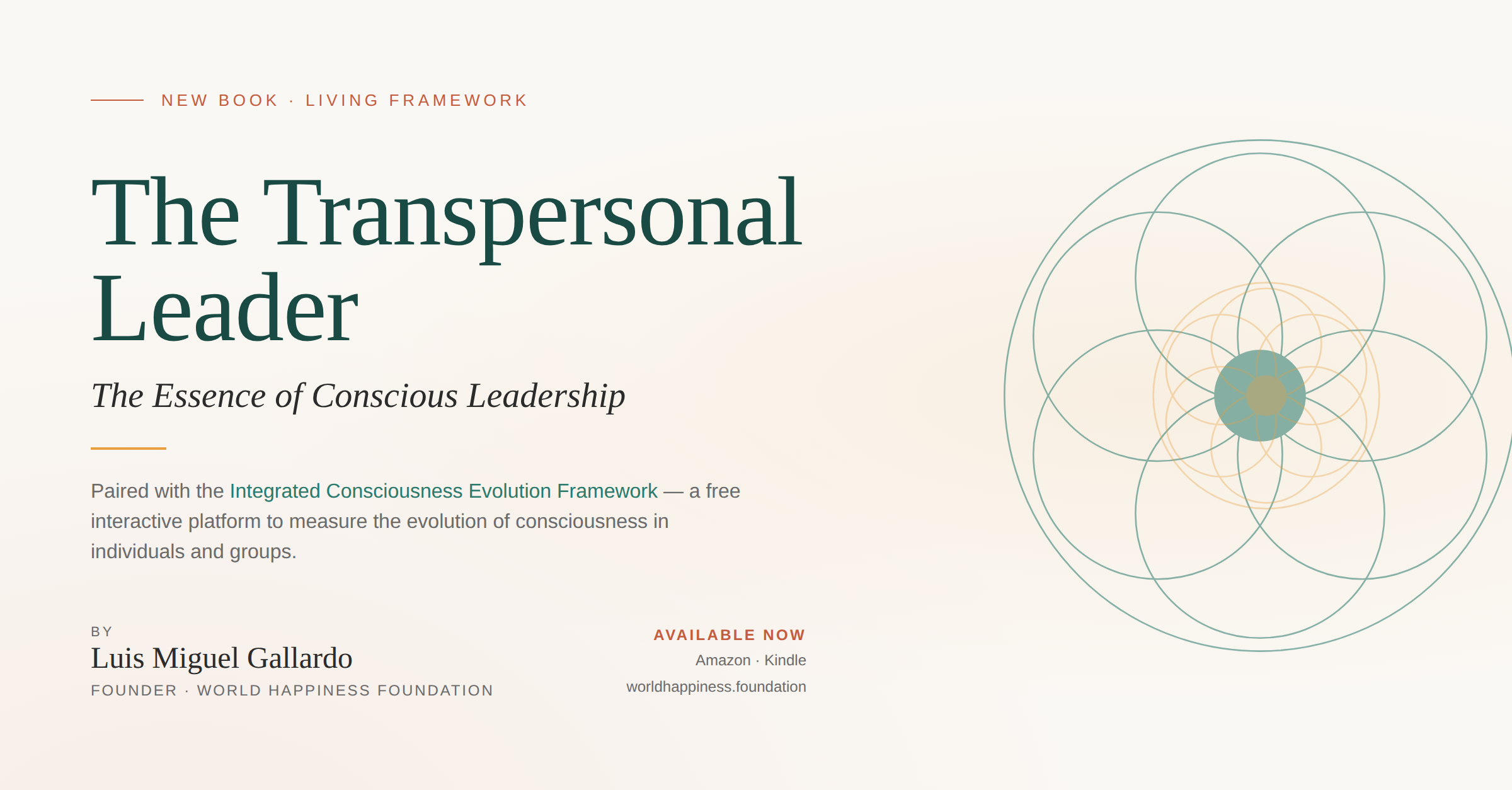
The book is available now on Amazon: The Transpersonal Leader: The Essence of Conscious Leadership
And the practice layer is open and free — measure your own journey with the Integrated Consciousness Evolution Framework (ICEF).
Name one rupture you have been avoiding. Offer repair within the week. Then ask of your next decision: what will this leave behind?
The world does not need more managers of the extractive paradigm. It needs leaders who can heal what they have broken and regenerate what they touch — remembered, integrated, and free.
“Fundamental Peace is not the absence of pain… it is the transmutation of its energy into love and compassion.”
— Luis Miguel Gallardo
World Happiness Press • © Luis Miguel Gallardo and World Happiness Foundation
…
Field notes to your inbox
Stay connected to the shift.
Monthly essays from the Observatory, invitations to Fests and Academy cohorts. Written from abundance — never urgency.