

Ken Wilber’s Integral Theory and How I Integrate It with the Integrative Transformation Model
Executive summary In my Integrative Transformation Model (ITM), I explicitly
By Prof. Luis Miguel Gallardo
There is a quiet epidemic sweeping through modern life, and no amount of productivity hacks, vision boards, or five-year plans can cure it. It is the crisis of meaning — the gnawing sense that despite everything we have achieved, something essential is missing.
We feel it in the Sunday-night dread before another week of going through the motions. We see it in high performers who reach every goal they set and still feel hollow. We hear it in the question that haunts millions of people across every culture and generation: What am I actually here for?
The conventional wisdom says you need to find your purpose. Go on a retreat. Take an assessment. Make a list of your passions and skills. Think harder. Try more.
But what if the entire premise is wrong?
What if purpose is not something you create through conscious effort, but something you remember — something that has been inside you all along, buried under layers of protection you built to survive?
This is the radical proposition at the heart of the Shadow→Gift→Essence (SGE) model and the Integrative Transformation Model (ITM): your authentic purpose already exists in your deeper self. The work is not invention. It is excavation. It is homecoming.
Here is what decades of psychological research and clinical work reveal: the most painful form of the meaning crisis is not not knowing what matters. It is knowing — and being unable to live it.
You know creativity gives you life, but you cannot bring yourself to create. You know deep relationships matter, but you keep people at arm’s length. You know you have something important to offer the world, but you sabotage yourself at every threshold.
This is the knowing-doing gap, and it points to something cognitive approaches alone cannot touch. You can journal about your values every morning. You can meditate on your purpose statement. You can set SMART goals and track them religiously. But if the subconscious patterns running beneath your awareness are working against you, conscious effort is like trying to steer a ship while an invisible hand grips the rudder.
Viktor Frankl’s logotherapy, Self-Determination Theory, positive psychology — these are powerful frameworks. They have helped millions. But they share a common blind spot: they operate primarily at the level of conscious thought. They assume that if you can articulate meaning, you can live it. Clinical reality tells a different story.
The disconnect between knowing your purpose and embodying it almost always traces back to the same place: the subconscious patterns that depth psychology calls the shadow.
Carl Jung defined the shadow as the parts of ourselves we reject, deny, or repress because they conflict with who we believe we should be. But here is the part most people miss: the shadow does not just contain the qualities we dislike about ourselves. It also contains the qualities we need the most — what Jung called undeveloped potentials and creative capacities.
The child who learned that her anger was dangerous pushed it underground — and with it went her capacity for assertiveness, her ability to say no, her power to pursue what she wanted. The boy who was shamed for his sensitivity buried it — and with it went his empathy, his emotional intelligence, his gift for deep connection.
Every time we disown a part of ourselves, we lose access to the energy, creativity, and authentic expression that part contains. The shadow becomes a vault of lost purpose.
This is why so many people feel like they are living someone else’s life. In a very real sense, they are. The self they present to the world is what Jung called the persona — the social mask, the edited, sanitized, safe version. The self that knows its purpose, the self that burns with creative fire or aches to serve or longs to lead — that self has been locked away.
And it stays locked away no matter how many conscious strategies you throw at it. Because you cannot think your way out of a pattern that lives below the level of thought. You cannot reason with a wound that was inscribed before you had words.
The SGE model offers something that has been missing from the purpose conversation: a structured pathway for transforming what blocks you into what frees you.
The model works through three interconnected dimensions:
The Shadow is the disowned aspect of self — the quality, emotion, or need you learned was unacceptable. It manifests as self-sabotage, procrastination, people-pleasing, perfectionism, withdrawal, or any of the countless strategies we use to avoid being seen as we truly are. Shadow emotions show up in the body as tightness, heat, numbness. They speak through repetitive thought patterns: I can’t. I’m not enough. It’s too late. It’s pointless. But here is the crucial insight: every shadow pattern originally served a protective function. The child who repressed her truth was protecting herself from punishment. The teenager who denied his needs was preserving a fragile family system. The shadow is not your enemy. It is a protector that no longer serves you.
The Gift is the adaptive intelligence hidden beneath the shadow. Every shadow, no matter how destructive its surface expression, contains something essential — an unmet need, an authentic desire, a core value trying to express itself. Fear’s gift might be discernment or the motivation to prepare. Anger’s gift might be clarity about boundaries or energy to address injustice. Shame’s gift might be a yearning for authenticity and belonging. The gift is what the emotion is trying to restore: safety, dignity, connection, truth, agency. When you uncover the gift, the entire relationship with your shadow transforms. It is no longer a flaw to be fixed. It is a messenger pointing you toward what matters most.
The Essence is the integrated quality that emerges when shadow and gift unite — not as an intellectual concept, but as a lived, embodied state. Essence qualities include peace, wisdom, unconditional love, freedom, authentic joy, courage, compassion, and clarity. These are not merely pleasant feelings but fundamental qualities of your true nature, accessible when inner conflicts are resolved. Essence is who you are once the protective reactivity drops away and the wisdom of the emotion is absorbed. It is transpersonal. It connects the personal to the universal. When you embody your essence, you are not becoming someone new. You are becoming who you always were beneath the armor.
The SGE model maps six fundamental wound-virtue pairs that reflect universal human patterns of suffering and their potential for transformation:
Repression becomes Honesty. When you stop pushing down your truth, you gain the power of authentic self-expression — the ability to speak what is real, even when it is difficult.
Denial becomes Ease. When you stop refusing to acknowledge what is, you discover the grace of relaxed acceptance — the ability to move through life without constant resistance.
Shame becomes Humour. When you stop believing you are fundamentally flawed, you access genuine lightness — the ability to hold yourself and life with playfulness rather than punishment.
Rejection becomes Gentleness. When you stop being harsh with yourself and others, you embody compassionate presence — the ability to meet pain with tenderness rather than judgment.
Guilt becomes Forgiveness. When you stop blaming yourself for things you cannot control, you find the freedom of release — the ability to let go and move forward with an open heart.
Separation becomes Love. When you stop living in disconnection from yourself, others, and the world, you remember the deepest truth of all — that you belong, that you are connected, that unity is your natural state.
These are not abstract ideals. They are lived capacities that emerge through the concrete work of shadow integration. And when they emerge, something remarkable happens: purpose stops being a question and starts being self-evident.
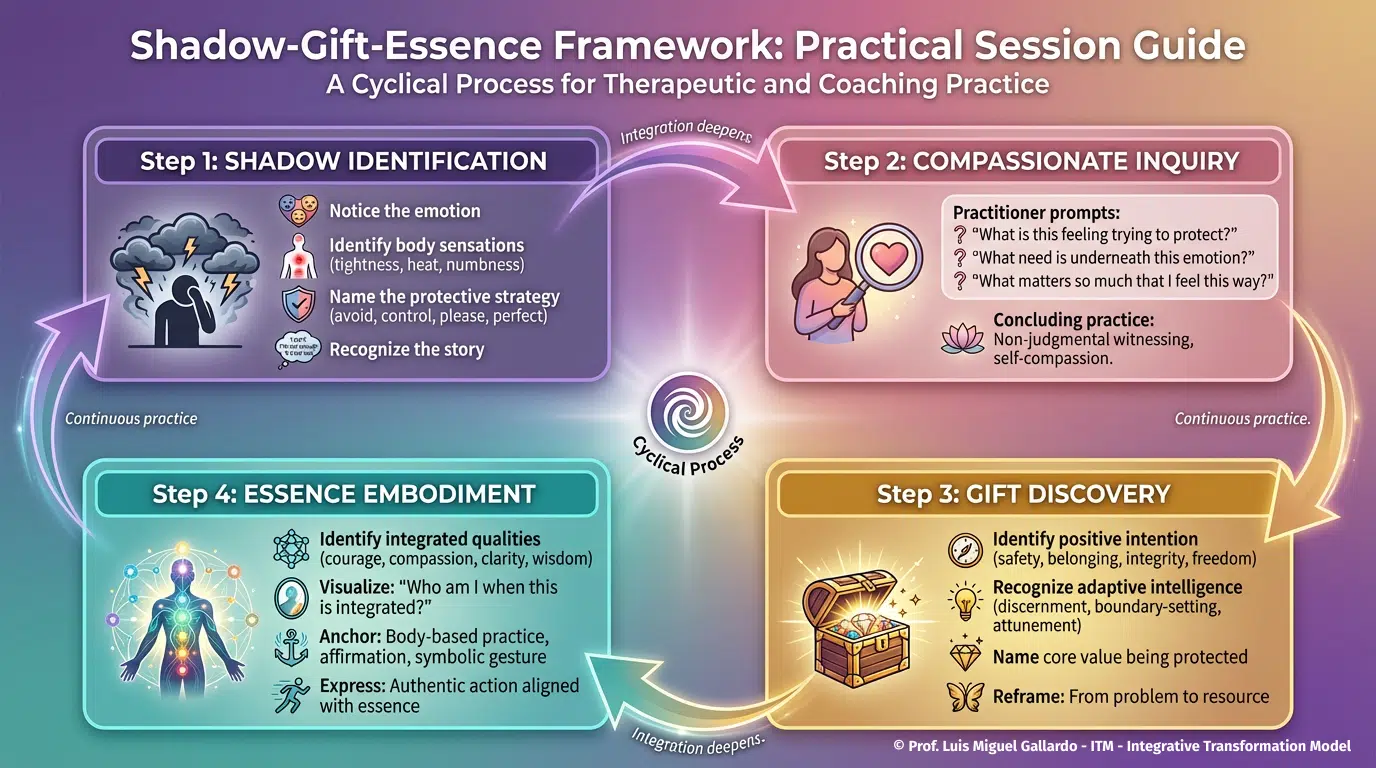
The SGE model unfolds through a therapeutic process designed to make shadow work safe, systematic, and sustainable:
Stage 1 — Safe Container. Before any depth work begins, you need safety. Psychological safety is not a luxury; it is a prerequisite. This stage builds the ground you will stand on when the ground beneath your usual identity starts to shift. Grounding practices, resource-building, and a secure therapeutic relationship create the conditions for honest exploration.
Stage 2 — Shadow Explore. With safety established, you begin to meet the parts of yourself you have hidden. This is not analysis from a distance. It is embodied encounter — tracking sensations in your body, following emotional threads to their origin, recognizing patterns of self-sabotage as messages from the underground. The stance is curiosity, not judgment. You ask: What are you trying to tell me? What do you need? The shadow has been waiting to be heard.
Stage 3 — Gift Uncover. This is the turning point. By asking what the shadow was trying to do, what it was protecting, what need it was attempting to meet, you discover the gold within the wound. And with that discovery, something shifts at a fundamental level. Shame softens into understanding. Self-rejection gives way to self-compassion. You stop fighting yourself and start listening.
Stage 4 — Essence Install. Understanding is not enough. The essence must be felt in the body, encoded in the nervous system, installed at the level where it can operate without conscious effort. Through somatic techniques, visualization, and experiential practices, the integrated quality becomes a way of being rather than a concept you agree with intellectually.
Stage 5 — Integrate and Act. Transformation that stays in the therapy room is incomplete. The final stage is about bringing your essence into the world — practicing honesty in difficult conversations, allowing ease in situations that used to trigger you, responding with gentleness where you once reacted with harshness. This is where purpose comes alive. Not as a statement on a wall, but as a way of moving through each day.
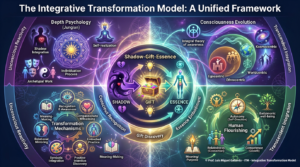
The SGE model does not exist in isolation. It operates as the core mechanism within a larger, more comprehensive framework: the Integrative Transformation Model (ITM). Where SGE provides the how of emotional transformation, the ITM provides the architecture — a unified developmental model that synthesizes Jungian individuation, consciousness evolution theory, and contemporary flourishing research into a coherent map of human transformation.
The ITM was born from a recognition that the great psychological traditions — depth psychology, positive psychology, integral theory, contemplative practice — have been speaking about the same process from different angles, often without knowing it. Jung’s shadow integration, the SGE emotional alchemy, Ken Wilber’s stages of consciousness development, and Self-Determination Theory’s research on basic human needs all converge on a single destination: the realization of our authentic nature and the conditions that allow it to flourish.
Drawing on ninety peer-reviewed studies across Jungian analytical psychology, integral consciousness theory, and positive psychology, the ITM reveals that these apparently different models describe complementary dimensions of a unified developmental process. Jungian stages emphasize archetypal and symbolic dimensions. SGE describes emotional transformation. Integral theory maps how consciousness organizes experience. Self-Determination Theory addresses motivational integration and need satisfaction. Together, they form a more comprehensive picture than any single framework could provide.
The ITM rests on seven foundational principles that bridge these traditions:
Consciousness as Primary. Transformation happens not just through changing behavior or restructuring thoughts, but through shifts in consciousness itself — in how awareness organizes and relates to experience. This is why contemplative and hypnotherapeutic practices work: they operate directly on the instrument of change.
Shadow as Messenger. Difficult emotions are not pathologies to be eliminated. They carry vital intelligence about what matters to us and what needs attention. This single reframe — from symptom to signal — changes everything about how we relate to inner difficulty.
Development as Transcend-and-Include. We do not discard earlier stages as we grow. Each new level of development incorporates what came before into a more comprehensive whole. The persona is not destroyed; it is seen through. The shadow is not erased; it is integrated. Nothing is wasted.
Needs as Foundation. Drawing from decades of Self-Determination Theory research, the ITM recognizes that flourishing depends on satisfying three basic psychological needs: autonomy (acting from your authentic values rather than external pressure), competence (feeling effective and capable of mastering challenges), and relatedness (experiencing genuine connection and belonging). Shadow emotions are frequently signals that one of these needs is under threat. Anger often signals a threat to autonomy — you are feeling controlled. Anxiety may signal a threat to competence — you are feeling inadequate. Loneliness signals a threat to relatedness — you are feeling disconnected. By uncovering the gift within the shadow, the SGE process reveals precisely which need requires attention — and the action stage provides the pathway to meeting it.
Embodiment as Essential. Lasting transformation must be experienced somatically, at pre-verbal levels, not merely understood intellectually. This is why cognitive insight alone so rarely produces lasting change. The wound was encoded in the body; the healing must be, too. Breathwork, somatic anchoring, guided visualization, and hypnotherapy facilitate what abstract understanding cannot.
Individuation as Social. Contrary to the myth that deep inner work is self-indulgent navel-gazing, authentic self-realization actually enhances our capacity for relationship and contribution. Shadow integration reduces the projection that poisons relationships. Essence embodiment enables more authentic connection. Consciousness evolution expands circles of care from self-centered to world-centered. As contemporary Jungian scholarship emphasizes, individuation leads not to withdrawal but to greater collective solidarity and genuine connection. Becoming more whole makes us more generous, not less.
Practice as Path. Transformation requires sustained engagement, not merely insight or peak experiences. Whether through Jungian active imagination, SGE emotional inquiry, meditation, or need-satisfying action, regular practice gradually reorganizes consciousness and behavior. Neuroplasticity research confirms this: the brain literally rewires through repeated engagement with transformative practices, and the dose-response relationship is significant — the more you practice, the deeper the neural remodeling.
One of the ITM’s most powerful contributions is mapping the developmental journey through five distinct stages of consciousness. These stages synthesize Jungian individuation, SGE transformation, integral consciousness theory, and Self-Determination Theory’s model of motivational development into a coherent sequence. Each stage describes not just where you are, but what kind of inner work you are capable of — and what kind you need next.
Stage 1: Pre-Reflective. At this foundational stage, consciousness is largely identified with bodily impulses, immediate emotions, and concrete circumstances. Self-reflection is minimal. Emotional regulation depends primarily on external support. The developmental task here is not shadow work — it is building a stable enough ego to function in the world. We all pass through this stage, and some adults return here when overwhelm floods their capacity for self-reflection.
Stage 2: Persona-Identified. This is where most people spend much of their lives. You have developed a stable social identity — what Jung called the persona — and you are identified with it. You are the good employee, the responsible parent, the successful professional. Emotions that threaten this identity get suppressed. Shadow consists of everything that does not fit the mask. Need satisfaction depends on meeting external standards: promotions, approval, belonging to the right group. The inner motivation is largely should-based — what Self-Determination Theory calls introjected motivation. This stage is not a failure; it is a necessary developmental achievement. But staying here comes at a cost — the growing sense that something vital has been exiled.
Stage 3: Shadow-Aware. Something cracks the persona. Often it is a crisis — a divorce, a job loss, a health scare, a depression that will not lift. The mask begins to slip, and for the first time, you start to see it as a mask. Emotional literacy develops. You can name what you feel with more precision. You begin to recognize your shadow patterns — noticing projections, acknowledging disowned feelings, seeing how your protectors have been running the show. In SGE terms, you develop the capacity to meet your shadow with curiosity rather than combat. In SDT terms, motivation shifts from doing what you should toward doing what you genuinely value — what researchers call identified motivation. This is where purposeful inner work becomes possible.
Stage 4: Gift-Oriented. At this stage, something fundamental shifts. You can consistently recognize the adaptive intelligence within difficult emotions. You see that your shadow and your strengths are not opposites — they are two faces of the same energy. Meta-awareness allows you to hold multiple perspectives simultaneously, what integral theory calls vision-logic. The SGE process becomes a reliable practice: you can move from shadow through gift to essence with increasing fluency. Meaning-making capacity expands. You extract purpose and significance from your challenges rather than being crushed by them. In SDT terms, motivation becomes fully integrated and autonomous — you act from your deepest values because they feel genuinely your own, not because anyone told you to.
Stage 5: Essence-Embodied. At this culminating stage, consciousness transcends exclusive identification with the separate self while maintaining functional individuality. Essence qualities — peace, wisdom, compassion, clarity — become your primary mode of being rather than occasional peak experiences. Shadow integration becomes ongoing and fluid, requiring less and less disruption. Purpose does not need to be searched for; it is the natural expression of living from your authentic nature. This parallels what Jung described as the culmination of individuation: the ego recognizing itself not as the center of personality but as serving a larger Self that encompasses both conscious and unconscious dimensions. Eudaimonic living — pursuing intrinsic goals, behaving autonomously, acting mindfully — becomes not a discipline but a stable way of being.
These stages are not a hierarchy to climb or a competition to win. They describe a natural developmental unfolding — and each stage is dignified and necessary. You cannot skip stages any more than you can skip learning to walk before you run. But you can engage with the process consciously, and that conscious engagement accelerates it dramatically.
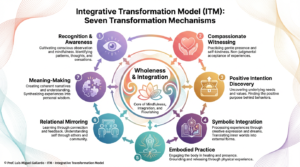
The ITM identifies seven primary mechanisms through which transformation actually occurs. These are not theoretical abstractions. They are practices — things you can do, repeatedly, that gradually reorganize consciousness and behavior.
Compassionate Awareness. The foundation of everything. Bringing non-judgmental, present-moment attention to your experience. Mindfulness practices, body scanning, the SGE practice of simply arriving — settling into awareness of what is, without fighting it. Research consistently demonstrates that this kind of awareness supports emotion regulation, psychological need satisfaction, and well-being. As the SGE framework emphasizes, simply recognizing an emotion with acceptance rather than judgment begins the healing process on its own.
Emotional Inquiry. The SGE core practice of asking shadow emotions: What are you trying to tell me? What do you need? This transforms the relationship with difficult feelings from adversarial to collaborative. You stop trying to kill the messenger and start reading the message. This parallels Jungian active imagination and Internal Family Systems therapy’s practice of dialoguing with parts — approaching them with curiosity, compassion, and confidence.
Symbolic Engagement. Working with dreams, guided visualization, creative expression, and active imagination. These practices engage unconscious material in its native language — images, sensations, metaphors, and symbols — rather than trying to force everything through the narrow channel of rational thought. Hypnotherapy amplifies this by inducing focused trance states where the subconscious mind communicates through the language it knows best.
Somatic Integration. The body holds what the mind forgets. Breathwork, movement, somatic anchoring — placing a hand on the heart, noticing shifts in posture and breathing — these practices address the reality that much of our psychological material is stored pre-verbally. Neurophysiological research validates this: visualization activates the same brain regions involved in perceptual processing, and embodied practices produce measurable changes in brain connectivity between emotional and cognitive centers.
Need-Satisfying Action. Insight without action is incomplete. Transformation requires concrete steps to satisfy the basic psychological needs that shadow emotions have been signaling. Setting boundaries (autonomy). Developing skills (competence). Cultivating relationships (relatedness). The SGE framework always concludes with identifying concrete action steps — because understanding your gift is not enough if you do not honor it in how you live.
Developmental Challenge. Growth requires encountering challenges that exceed your current capacities. Life crises, relationship conflicts, chosen growth edges — these are not obstacles to transformation but catalysts for it. Jung recognized that individuation is often precipitated by suffering that cannot be resolved at the ego’s current level. The key is meeting challenges with enough support that they catalyze growth rather than trauma.
Community and Relationship. Transformation does not happen in isolation. It is supported by relationships that provide mirroring, challenge, and belonging — therapeutic relationships, peer support, mentoring, and community. Relatedness is not just a nice-to-have. Self-Determination Theory identifies it as one of three basic psychological needs essential to flourishing. Individuation, while deeply personal, paradoxically enhances our capacity for authentic connection with others.
The ITM is not merely a theoretical synthesis. It is increasingly supported by neurophysiological research that validates what contemplative traditions have long practiced.
Advanced meditation produces measurable reorganization of brain connectivity patterns, with deeper absorption corresponding to greater global integration between sensory and higher-order regions. Hypnotic trance generates reproducible neural signatures distinguishable from baseline states with high accuracy. Visualization practices activate the same neural networks engaged during actual perceptual experience — the occipital pole, lingual gyri, cuneus, and precuneus — explaining why guided imagery can produce lasting psychological and behavioral change. Randomized controlled trials of meditation practices have demonstrated significant changes in hippocampal connectivity, suggesting neural substrates for modifying the emotional conditioning patterns that Jungian psychology would recognize as shadow patterns.
And the dose-response relationship is clear: cumulative practice hours correlate significantly with progressive neural remodeling. The brain does not just tolerate transformation. It participates in it — rewiring itself in response to sustained engagement with practices that shift consciousness.
These findings validate a core ITM principle: practices that work with consciousness directly — not just with thoughts or behaviors — engage fundamental mechanisms of neural transformation. The ancient insight that the imagination is a doorway to real change is no longer just a poetic claim. It has neural evidence behind it.
Perhaps the deepest insight of the ITM is the alignment between the SGE model’s concept of Essence and Jung’s concept of the Self — the archetype of wholeness and the psyche’s organizing center. Both point toward an integrated state of being that emerges when inner conflicts are resolved and consciousness expands beyond identification with the ego.
The Jungian Self is not the ego. It encompasses the ego as one element within a larger whole. Individuation — Jung’s word for the lifelong journey toward wholeness — involves the ego’s gradual recognition of and alignment with this larger Self. It is not ego inflation but the opposite: the ego recognizing it is not the center of the universe but a servant of something deeper and more comprehensive.
The SGE framework’s Essence maps onto this with striking precision. Essence qualities — peace, wisdom, compassion, clarity — closely match what Internal Family Systems therapy calls Self-energy: calmness, clarity, compassion, confidence, courage, creativity, curiosity, and connectedness. These are not states to be achieved. They are your natural condition when not obscured by unmet needs and unintegrated shadow material.
This convergence carries a radical implication for purpose: the Essence state is the purpose state. When you have integrated your shadows and met your basic psychological needs, purpose does not need to be manufactured. It flows from the natural expression of who you are. From this perspective, psychological suffering results not from inherent pathology but from unmet needs and unintegrated shadow material. Transformation involves both inner work — shadow integration — and outer action — need satisfaction — with each supporting the other. Shadow integration increases your capacity for autonomous need satisfaction, while need satisfaction reduces the intensity and frequency of shadow activation. It is a virtuous cycle, and purpose is what emerges when the cycle is turning freely.
Most of psychology aims at reducing suffering. And that is important work. But the ITM and SGE model aim at something more: a state called Fundamental Peace.
Fundamental Peace is not the absence of difficulty. It is not a blissful state that depends on everything going well. It is a sustainable inner coherence — a baseline of self-acceptance, authenticity, and alignment that holds steady regardless of external circumstances.
It is what it feels like when you are no longer at war with yourself.
Fundamental Peace has five qualities:
Deep self-acceptance — embracing your whole humanity, shadows and all, without the need to perform or pretend.
Authentic self-expression — living from your essence rather than from roles, expectations, or the exhausting effort of maintaining a persona.
Inner coherence — your thoughts, feelings, values, and actions pointing in the same direction instead of pulling you apart.
Grounded presence — the capacity to be fully here, fully now, instead of being driven by old wounds or future anxieties.
Compassionate responsiveness — meeting life’s challenges from a resourced, centered place instead of reacting from unconscious patterns.
This is the ITM’s vision of what Aristotle called eudaimonia and what Self-Determination Theory describes as stable eudaimonic living: consistently pursuing intrinsic goals, behaving autonomously, acting mindfully, and experiencing psychological need satisfaction. It is not reserved for monks or mystics. It is the natural result of doing the deep work — of integrating shadow, embodying essence, and allowing purpose to emerge from the inside out.
We are living through a time of extraordinary disruption. The pandemic shattered familiar structures of meaning. Artificial intelligence is rewriting the relationship between humans and work. Political polarization and social fragmentation have eroded shared sources of purpose.
Cognitive coping strategies — the ones that work well enough in stable times — are failing under this pressure. People need something deeper. They need access to the part of themselves that remains steady when the external world is anything but.
The SGE model and the ITM offer that access. Not through more thinking, more planning, more effortful searching — but through the counterintuitive move of turning toward what we have been avoiding. The shadow. The wound. The parts of ourselves we abandoned long ago.
Because it turns out that what we are looking for — meaning, purpose, peace — has been waiting for us in the last place we would think to look.
And this work is not only personal. The ITM recognizes that individual transformation and collective evolution are inseparable. As individuals integrate their shadows and move toward Essence-Embodied living, they become capable of addressing collective challenges with greater wisdom, compassion, and systems awareness. The transition from what integral theory calls first-tier consciousness — where each perspective views itself as the only valid one — to second-tier consciousness — where you can appreciate the necessity of all perspectives — mirrors the personal journey from Persona-Identified to Gift-Oriented living. Organizations, communities, and cultures that support deep human development simultaneously enhance their collective capacity for navigating complexity. The personal is not separate from the collective. The path inward is also the path forward.
If you have been searching for your purpose and coming up empty, consider this possibility: you are not failing to find it. You are looking in the wrong direction.
Purpose is not out there. It is in here — in the places within you that are still tender, still waiting, still holding the truth of who you were before the world told you to be someone else.
The shadow is not your obstacle. It is your doorway.
The wound is not your weakness. It is your wisdom.
And the purpose you have been searching for? You do not need to create it. You only need to remember.
Luis Miguel Gallardo is Founder and President of the World Happiness Foundation and Professor of Practice at Shoolini University’s Yogananda School of Spirituality and Happiness. His work integrates depth psychology, hypnotherapy, and contemplative approaches to facilitate individual and collective transformation. This article draws from his integrative review “Purpose and Meaning at the Subconscious Level” (Preprints.org, doi: 10.20944/preprints202602.1864.v1) and his foundational paper on the Integrative Transformation Model, which synthesizes Jungian individuation, the SGE framework, consciousness evolution theory, and Self-Determination Theory into a unified developmental model grounded in 90 peer-reviewed studies.
Executive summary In my Integrative Transformation Model (ITM), I explicitly
Executive summary I wrote the Integrative Transformation Model (ITM) to
I want to tell you about a conversation that changed