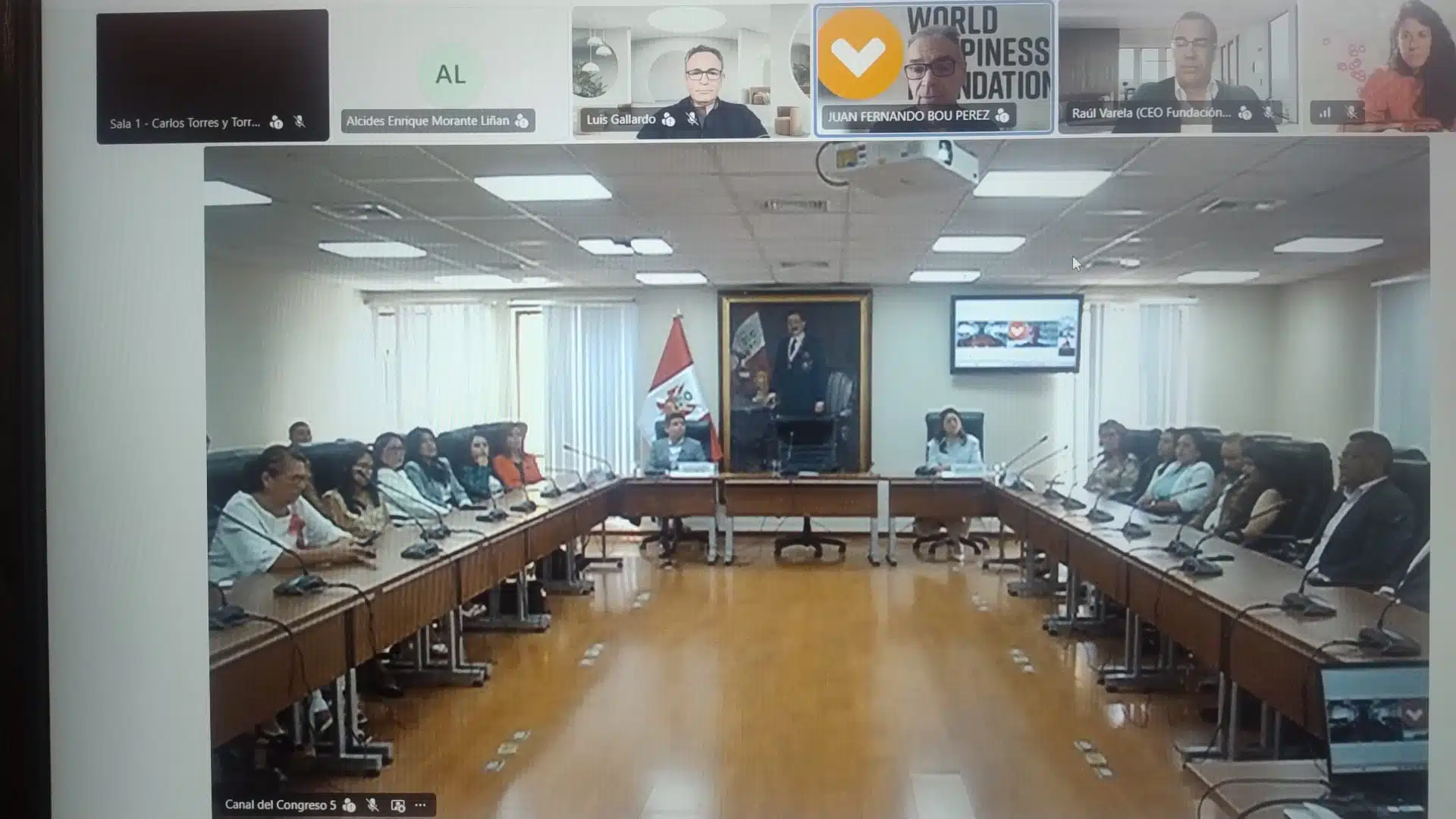

There are moments in a country’s history that arrive without fanfare. They happen in a chamber of sessions, before open microphones and skeptical welcomes, when someone rises and says something the protocol did not expect. This past April, in the Congress of the Republic of Peru, one of those moments took place.
Luis Miguel Gallardo, President and Founder of the World Happiness Foundation, appeared before the honorable members of Congress with a concrete proposal: to establish in Peru an Agora of the Foundation — a living ecosystem of human transformation that would position this country as a beacon of well-being for the continent and the world.
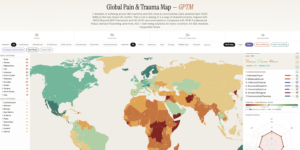
What distinguished that address was not its rhetoric, but its empirical foundation. Behind the words lay years of research distilled into an unprecedented instrument: the Global Pain & Trauma Map (GPTM), version 4.9, published in April 2026 by the World Happiness Foundation.
The evidence that changes the debate
What GDP cannot see
For decades, public policy has navigated by a single lighthouse: Gross Domestic Product. GDP measures transactions, not dignity. It captures the movement of money, not the weight of the soul. The GPTM arrives to offer what no conventional index has offered before: a complete map of the seven domains of human suffering, at the scale of 196 countries and 321 cities and communities.
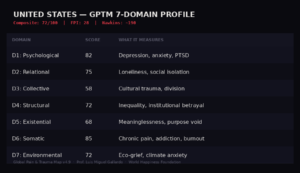
The GPTM reveals something uncomfortable: 70% of global suffering concentrates in just three domains — structural/systemic (D4), individual/psychological (D1), and somatic/biological (D6) — and conventional mental health systems barely address the first. The rest remains invisible to the metrics that guide government decisions.
“Fundamental Peace is not the absence of suffering — it is the active presence of all seven dimensions of flourishing.”Prof. Luis Miguel Gallardo, World Happiness Foundation, 2026
The seven domains
The complete map of human pain
The GPTM’s conceptual framework articulates seven dimensions of suffering that operate interdependently. Ignoring any one of them is like treating a disease without knowing its etiology.
Depression, anxiety, PTSD. The only domain conventional systems address. Over 1 billion people affected.
Loneliness, attachment wounds, isolation. 33% of adults globally experience this.
War trauma, intergenerational grief, cultural erasure. Transmitted epigenetically across generations.
Poverty, discrimination, institutional betrayal. What appears individual has systemic roots.
Meaninglessness, death anxiety, purposelessness. Invisible to all conventional metrics.
Chronic pain, addiction, burnout. The body stores the trauma the mind cannot access.
Climate anxiety, eco-grief, nature deficit. 75% of young people report climate anxiety.
The GPTM is not a country ranking. It is, as the map itself proclaims, “a cartography of shared humanity.” Its purpose is not to single out the laggards, but to identify with surgical precision where to intervene, how to do it, and at what cost.
The Fundamental Peace Index
Measuring the distance to flourishing
To translate diagnosis into action, Gallardo developed the Fundamental Peace Index (FPI), a metric that inverts the GPTM: FPI = 100 − GPTM. Where the GPTM maps the concentration of suffering, the FPI measures each community’s proximity to the state of active flourishing.
The current global average is FPI 37 — barely above the crisis threshold. Only 12 countries exceed FPI 50. No country surpasses FPI 60. Fundamental Peace, as Gallardo’s research defines it, remains an aspiration for all of humanity. That makes the Agora proposal in Peru not merely timely — it makes it urgent.
Why Peru
The wisdom the world needs
GPTM data reveals something orthodox economics has systematically ignored: the communities with the least suffering are not the wealthiest, but those that have preserved or intentionally designed conditions for human flourishing. Plum Village in France registers an FPI of 78 — higher than Luxembourg’s FPI of 53 — despite its monks owning nothing.
In this context, Peru does not emerge as one candidate among many. It emerges as the territory where the convergence between well-being science and ancestral wisdom is densest and most urgent on the planet. The GPTM places Machu Picchu at a D5 (Existential) score of 18 — among the lowest of any place measured on Earth — and Pisac, in the Sacred Valley, at D5 of 25, comparable to Bhutan and Rishikesh. These numbers are not accidental. They are the result of millennia of conscious practice and a relationship with the land that the modern world has lost and urgently needs to recover.
Sumak kawsay — the Good Life, or buen vivir — is not a folkloric concept or a romantic aspiration. It is a philosophical and practical system that responded, thousands of years in advance, to the same seven domains of suffering the GPTM identifies today with scientific instruments. Where Domain 2 (Relational) describes loneliness and disconnection, sumak kawsay counters it with the ayllu: the community network as the fundamental fabric of existence. Where Domain 7 (Environmental) records eco-grief and climate anxiety, the Pachamama offers a worldview in which the human being is not above the Earth, but within it.
Pachamama — Mother Earth in Quechua and Aymara — is not a metaphor. She is the oldest and most complete articulation of what contemporary science calls D7: the environmental and planetary dimension of human suffering and flourishing. Andean communities living in reciprocity with the Pachamama — through the ritual of the despacho, the practice of ayni (sacred reciprocity), and the vision of Pacha as living time-space — register in the GPTM the lowest D7 indicators of any urban or semi-urban community on the American continent.
Furthermore, the GPTM documents that Andean and Amazonian traditions — the ayahuasca ceremony, San Pedro (huachuma), the ayllu system — rank among the most effective modalities for simultaneously addressing domains D3 (Collective), D5 (Existential), and D7 (Environmental). Not because they are exotic, but because they were designed, across generations, for precisely that: to heal the fabric between the human being, their community, and the Earth. Peru is not a passive recipient of an international initiative — it is its deepest reservoir of wisdom.
The concrete proposal
What the Agora is and what it changes
The World Happiness Foundation’s Agora is not a building or a conference. It is a living infrastructure of human transformation: spaces of deep listening, evidence-based flourishing programs, training of conscious leaders, and well-being technology in service of the most vulnerable communities.
Its conceptual architecture integrates the same seven pillars the GPTM diagnoses: physical, emotional, mental, spiritual, relational, communal, and planetary well-being. And in the case of the Agora in Peru, each of those pillars has an equivalent in the Andean worldview: sumak kawsay already named them, the Pachamama already sustains them. What the Agora contributes is the bridge between that millennial wisdom and the scientific instruments — such as the Global Pain & Trauma Map — that allow it to be measured, communicated, and scaled to the world.
The Schools of Happiness network, which has already trained more than 60,000 teachers across Latin America, has one of its most active hubs in Peru. The Peruvian Agora would amplify this presence, incorporating the GPTM methodology as a community diagnostic tool and the Fundamental Peace Index as a compass for local and national public policy. What makes Peru a unique case is not being the first, but being the most complete: no other country in the world simultaneously holds the depth of the buen vivir tradition, the active presence of Schools of Happiness, and sacred sites with the lowest existential suffering indices on the planet.
“The gap between the most flourishing communities — average score 26 — and major world cities — average score 68 — is not explained by wealth, climate, or genetics. It is explained by sustained collective practice of awareness, compassion, and belonging.”Global Pain & Trauma Map, version 4.9, April 2026
Before Congress, Gallardo did not ask for blind faith. He asked for something more demanding: the institutional backing of the Republic to create the legal framework that would allow this collaboration to flourish — a framework agreement between the Peruvian state, civil society, academia, and the World Happiness Foundation.
The roadmap
2026–2050: from diagnosis to global flourishing
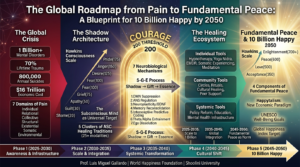
The GPTM is also a roadmap. The vision Gallardo presented to Congress is inscribed within an explicit horizon: 10 Billion Free, Conscious & Happy by 2050. The numbers are as concrete as they are ambitious.
In the 2025–2027 window, the Foundation phase foresees the adoption of the GPTM as an open-intelligence platform, the training of 500,000 teachers, the certification of the first 10 Cities of Happiness, and the presentation of the Happytalist Goals to the United Nations. The Scale phase (2028–2032) projects 100 certified cities and the integration of ASC modalities into 25 national health systems.
By 2050, the target is for the global GPTM average to fall below 35 — currently at 65 — and for the collective consciousness average to surpass Hawkins level 300 (Willingness/Acceptance). The mathematics are rigorous: it requires +1.1 FPI points per year across the entire planet for 25 years. The instruments exist. School mindfulness, if deployed to all 1.5 billion enrolled children globally, would alone produce a 12% reduction in D1 within one generation. The cost of the five most scalable interventions is under $20 per person per year.
The only real barrier, the GPTM concludes, is neither economic nor technological. It is one of consciousness. And consciousness is precisely what the Agora is designed to elevate.
Conclusion
The Peru the world is waiting for
There are countries that export natural resources and countries that export ideas. The most influential in human history have been those that, at moments of civilizational crisis, had the courage to offer the world a different vision of what is possible.
The GPTM places Peru at an exceptional crossroads. On one hand, the country carries indicators the map reflects honestly: structural inequality (elevated D4), social fragmentation (D2), and the weight of historical trauma (D3) on communities that have gone generations without their wounds receiving a name. On the other, it holds within its territory some of the most powerful healing resources on the planet — wisdom traditions the GPTM identifies as among the most effective antidotes to contemporary human suffering.
Sumak kawsay, the Good Life, proved for millennia that it is possible to build community from fullness rather than from scarcity. The Pachamama taught that true prosperity is born from reciprocity with the Earth, not from its exploitation. The Agora does not propose importing a foreign model to Peru: it proposes that Peru share its own with the world, enriched by the measurement and scalability tools that well-being science now places at its disposal.
The Agora does not pretend to resolve that tension with a magic formula. It seeks to create the space where tension can be transformed — where accumulated pain finds a name, and the name finds a path, and the path finds community. Where ayni — Andean sacred reciprocity — becomes the organizing principle of a new kind of public policy.
Before the Congress of Peru, Gallardo put it with the clarity only possible when conviction and evidence align: “I come in the name of something older and more urgent than any policy: the human need to heal, to grow, and to live with dignity.”
The map already exists. The Pachamama always knew. Now it is Peru’s turn to decide whether it will be the territory where the world finds its way back to itself.