community
Siwa: The First Oasis of Happiness
Why the World Happiness Foundation has named this ancient Berber sanctuary the inaugural Oasis in our Cities of Happiness program There are places that offer an answer, and places that return you to your question. Siwa, deep in Egypt's Western Desert — a hundred kilometres from the Libyan border and
May 9, 2026·Luis Miguel Gallardo·9 min read
AI insights
Why the World Happiness Foundation has named this ancient Berber sanctuary the inaugural Oasis in our Cities of Happiness program
There are places that offer an answer, and places that return you to your question. Siwa, deep in Egypt’s Western Desert — a hundred kilometres from the Libyan border and almost seven hundred from Cairo — is the second kind. To arrive here is to be quieted before being instructed.
I have come to Siwa as part of an inquiry that has been guiding the World Happiness Foundation for years: where on Earth, today, are human beings still building life around belonging, meaning, and peace rather than productivity, performance, and noise? Our Cities of Happiness program has long focused on capital cities and metropolitan ecosystems. With Siwa, we open a new tier.
Today, the World Happiness Foundation names Siwa Oasis the first Oasis of Happiness — a designation reserved for small, traditional, often remote communities whose way of life already embodies the conditions of human flourishing that our research and frameworks try to describe.
This is not a tourism story. It is a recognition.
A geography below sea level
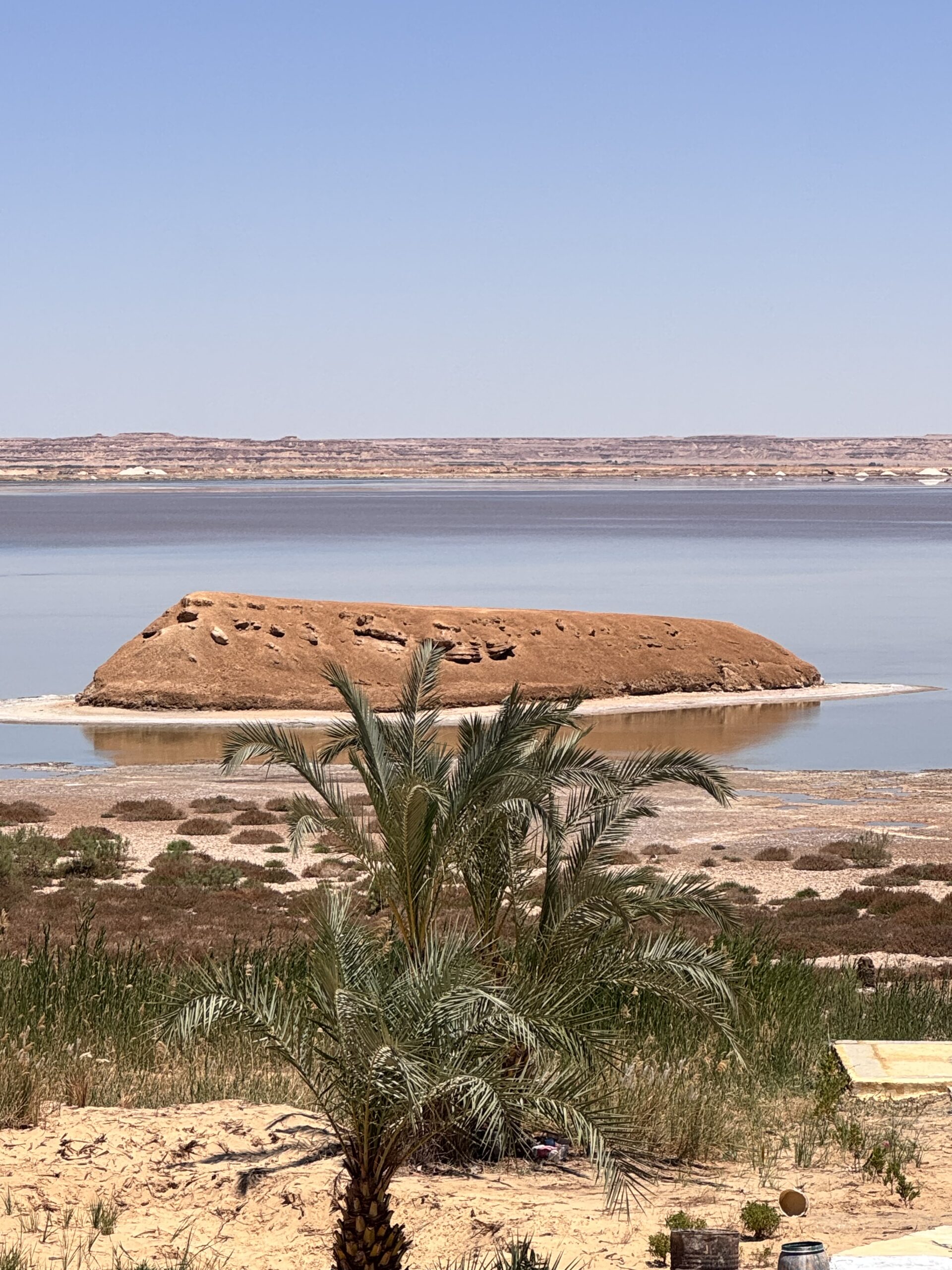
Siwa sits in a depression roughly nineteen metres beneath the surrounding desert — a long green ribbon of palm groves and olive orchards floating between the Great Sand Sea to the south and the Qattara Depression to the east. About 200 natural springs feed the oasis. Salt lakes and freshwater pools alternate with date palms and mud-brick fortresses. The most ancient of these, Shali, is built of kershif — salt and clay mixed with palm logs — a material that quite literally requires the desert and the rain to coexist in order to stand.
The oasis is home to roughly 25,000 people, primarily Siwi Berbers (Amazigh) — the easternmost concentration of Berber peoples in the world. They speak Siwi, a Berber language understood almost nowhere else, alongside Arabic. Their ancient name for this land was Sekht-am, “the field of palms.”
To stand here is to be reminded that human flourishing has nothing to do with abundance of stimulation. It has everything to do with the right relationship between scarcity, structure, and meaning.
The Eleven Families: psychological safety as governance
Siwa’s social architecture is one of the reasons we chose it.
The community is organised into eleven tribal families, divided into Eastern and Western groupings, each led by a sheikh and a council of elders. Decisions about land, water, marriage, and conflict resolution are made within and across these families through a layered consensus process that has held for centuries — surviving Persian armies, Roman administration, Ottoman rule, two World Wars, and the arrival of paved roads, satellite television, and mobile networks.
In our ROUSER Leadership Model and across the World Happiness Academy, we describe family — biological, chosen, or communal — as the first scaffold of psychological safety a human being ever experiences. It is the place where the nervous system learns whether the world is safe enough to relax into; whether one’s gifts will be welcomed or punished; whether one’s shadow will be witnessed or weaponised. When that scaffold holds, a person can engage with risk, novelty, and difference without collapsing. When it doesn’t, every later institution — school, workplace, government — has to compensate, usually unsuccessfully.
The eleven families of Siwa are imperfect. No human community is otherwise. But they have managed, generation after generation, to keep that primary scaffold intact. Disputes are mediated. The vulnerable are absorbed. The young are raised by more than their parents. The annual Siyaha festival on Gabal al-Dakrur, which dates back over 160 years, was originally a peace agreement between tribes, and is still observed each autumn as a ritual of reconciliation, communal eating, prayer, and forgiveness — Eid el-Solh, the Festival of Peace.
It is governance as belonging. It is what most modern democracies have forgotten how to design.
Where Alexander asked the question
Four kilometres from the modern town of Siwa, on the rocky outcrop of Aghurmi, stand the ruins of what the Greeks called the Temple of Zeus-Ammon and the Egyptians called the Temple of Amun — the Revelation Temple. I came here on this trip the way pilgrims have come for two and a half thousand years: with a question.
In 331 BCE, Alexander the Great, having just conquered Egypt, marched his retinue across hundreds of kilometres of open desert specifically to consult this oracle. The historians around him reported that the priests of Amun confirmed his divinity and named him the legitimate Pharaoh — the Son of Amun. The political consequences were immense; the personal ones, perhaps, more so. He never returned to Macedonia. He died young, far from home, and reportedly asked to be buried at Siwa — a wish never fulfilled, though some still claim a tomb here.
What strikes me, standing inside what remains of the inner sanctum, is not the grandeur of empire but the intimacy of the question Alexander brought. He had everything power could give a man and was still searching for a sentence — who am I, really? — that only silence and the desert could deliver.
That is the deeper lineage Siwa carries. It is a place where leaders have come to ask not for strategy but for essence.
In our Shadow–Gift–Essence (SGE) model, we describe Essence as what remains of a human being once shadow has been integrated and gift has been offered. It is the part the Oracle was always pointing to. Alexander left here with a title; whether he left with an answer is a different question. The temple still asks it, of every visitor willing to listen.
The salt that heals, the sand that simplifies
A few minutes’ drive from the temple, the salt lakes appear like fragments of broken sky pressed into the desert floor. Hyper-saline, electric turquoise, edged with crystallised white. You step in and you float without effort. The body learns, in about ninety seconds, what it has been refusing to know for years: that it is held.
Siwa’s salt is not metaphorical. It is the local economy, the building material, the export, the sacrament. The Siwans construct walls, furniture, even lamps from it. Salt lamps, salt cubes, salt floors. The town is, in a real sense, made of dissolved oceans that lay here when this depression was a sea.
Beyond the lakes lies the Great Sand Sea — one of the largest sand accumulations on the planet, dunes rising over a hundred metres, extending uninterrupted into Libya. At sunset there is no sound except wind and breath. The horizon is round again. The mind, which spends most of its life in rectangles, remembers what it is for.
These two ecologies — the salt lake and the dune — are why Siwa qualifies as an Oasis of Happiness in a way that goes beyond cultural beauty. They engage the Wheel of Happiness at the somatic level: physical regulation through salt and sun; mental quiet through silence and space; emotional release through floating and breath; social belonging through shared meals at Fatnas Island as the sun drops behind the palms; spiritual contact through the simple, unmediated immensity of the desert. A wheel that turns in most cities only with great effort turns here on its own.
From the Pain Map to Fundamental Peace
The World Happiness Foundation’s Global Pain & Trauma Map (GPTM) documents 196 countries and 321 communities across seven domains of suffering. The map is honest about what hurts. But it has always had a complementary purpose: to identify places where suffering, having been faced, has been transmuted — into the social, ecological, and spiritual conditions that the Fundamental Peace Index (FPI) measures.
Fundamental Peace is not the absence of pain. It is the transmutation of its energy into love and compassion.
Siwa is one of those places. The Siwans have not lived in a paradise. They have endured invasion, drought, marginalisation, the violent disruption of two world wars, and the ongoing pressure of an outside economy that does not understand their ways. And yet what they have built — the eleven-family structure, the festival of reconciliation, the hospitality, the kershif houses, the salt lakes treated as common wealth — is a working model of Fundamental Peace at scale. Not utopia. Practice.
Designating Siwa an Oasis of Happiness is, in effect, telling the GPTM map a new kind of truth: alongside the points of pain, mark the points of integration. Alongside the suffering, the transmutation.
Why an “Oasis” of Happiness?
Cities are accelerators. They concentrate talent, capital, and innovation, but also loneliness, displacement, and burnout. Our Cities of Happiness program is committed to working with them — Madrid, Miami, Las Rozas, and others — to redesign their ecosystems toward flourishing.
But cities are not the only teachers we need.
An Oasis of Happiness is a small community — often remote, often indigenous, often economically modest — whose inherited social, ecological, and spiritual practices already meet the criteria of human flourishing that wealthier societies are now trying to recover. Oases in this sense are not rescue projects. They are reference libraries. The flow of help and learning runs at least as much from them as toward them.
Naming Siwa first sets the precedent. We are looking, in the years ahead, for an Oasis on every continent.
A personal reflection: simplicity as flourishing
I came to Siwa expecting to be moved by the temple. I was. But what is sitting inside me on this final evening, as the sun goes down over Birket Siwa, is something quieter and more uncomfortable.
In one of the most economically simple places I have ever visited, I met some of the most psychologically integrated human beings I have ever met. There is a steadiness in the eyes of the Siwans I have spoken with — the date farmer, the woman embroidering the tarfutet shawl, the boy guiding the donkey cart through the palm groves — that I usually associate, in my coaching practice, with people who have done years of deep regression and shadow work. They have not done that work. They were simply raised inside a structure that did not break them.
Simplicity, in the desert, is not deprivation. It is the removal of everything that is not essential, until what remains is enough. Enough is the most underestimated word in the modern vocabulary of happiness. Siwa speaks it without apology.
This is the lesson I will carry back to Madrid, to Miami, to every city we work with: flourishing does not require more. It requires the right structure, the right scarcity, the right family, and a horizon wide enough that one can still see oneself clearly.
An invitation
To the eleven families of Siwa, to the elders of the council, to the Siwan women who have kept this language and these embroideries alive, to the desert itself — thank you. The World Happiness Foundation is honoured to walk alongside you.
To our community, to those who carry the mission of 10 Billion Free, Conscious and Happy by 2050: this is what the work looks like at its purest. A place. A people. A practice. A peace that was never absent — only waiting to be witnessed.
The Oracle has not gone silent. It has only changed languages.
— Luis Miguel Gallardo
Founder & President, World Happiness Foundation
Siwa Oasis, Egypt — Spring 2026
…
Field notes to your inbox
Stay connected to the shift.
Monthly essays from the Observatory, invitations to Fests and Academy cohorts. Written from abundance — never urgency.