Fundamental Peace: A Lighthouse From Thích Nhất Hạnh on the Roads of Vietnam
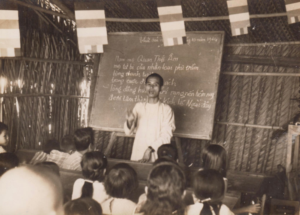
I’m traveling in Vietnam now—the land that gave the world


By Prof. Luis Miguel Gallardo
Founder & President, World Happiness Foundation
Professor of Practice, Shoolini University – Yogananda School of Spirituality and Happiness
What if your most persistent leadership challenge—that recurring pattern of reactivity, that nagging self-doubt, that frustrating blind spot—actually contained the key to your greatest breakthrough?
This isn’t wishful thinking. It’s the central insight of the Integrative Transformation Model (ITM), a comprehensive framework that bridges ancient wisdom with cutting-edge research to guide leaders, coaches, and changemakers through a profound journey of personal and professional evolution.
After decades of working with leaders across the globe, integrating Jungian depth psychology with contemporary neuroscience and consciousness research, I’ve discovered that our shadows—those parts of ourselves we’ve learned to reject, suppress, or deny—are not obstacles to overcome but gateways to our most authentic power.
This article introduces you to a transformative pathway that has helped thousands of leaders move from unconscious reactivity to conscious mastery, from fragmented performance to integrated excellence, from managing problems to embodying wisdom.
The ITM stands on three interconnected pillars, each validated by decades of research and centuries of practice:
Carl Jung’s concept of individuation—the lifelong process of becoming who we truly are—provides the depth psychological foundation. Jung understood that we cannot become whole by rejecting parts of ourselves. Instead, we must integrate our shadow (the disowned aspects of our psyche) to access the Self (our deepest center of wisdom and wholeness).
For leaders, this means recognizing that the qualities you most resist in yourself or others often hold the very capacities your leadership needs to evolve.
The S-G-E framework offers a practical, emotion-centered methodology for transformation:
This isn’t just theory—it’s a proven process used in therapeutic settings, coaching programs, and leadership development worldwide.
Contemporary research in integral theory, positive psychology, and self-determination theory reveals that:
The ITM synthesizes these three pillars into a unified model that is both theoretically rigorous and immediately practical.
Let me walk you through the core components of the ITM using six visual frameworks that map the territory of transformation.
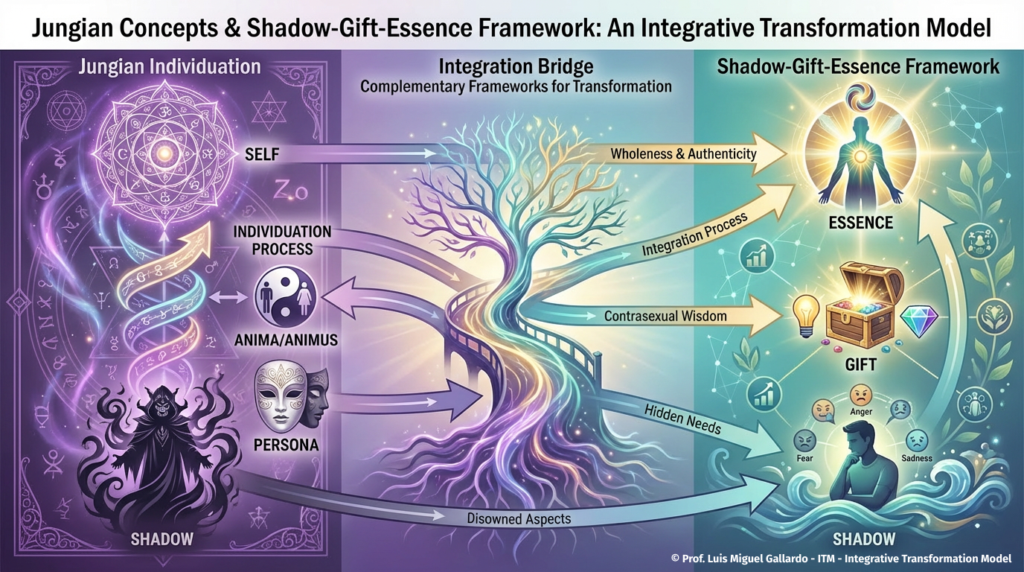
This diagram shows how Carl Jung’s depth psychology aligns perfectly with the contemporary S-G-E framework. On the left, you see Jung’s classical concepts: the Shadow, Persona (our social mask), and the journey toward the Self. On the right, the S-G-E model offers a practical pathway through the same territory.
What this means for you as a leader:
When Jung spoke of “shadow integration,” he was describing the same process the S-G-E framework makes accessible through emotional awareness and compassionate inquiry. Both approaches recognize that:
Practical Application:
Think of a leadership quality you admire in others but judge in yourself (perhaps assertiveness, vulnerability, or ambition). This is shadow material. The S-G-E framework gives you a concrete method to reclaim it.
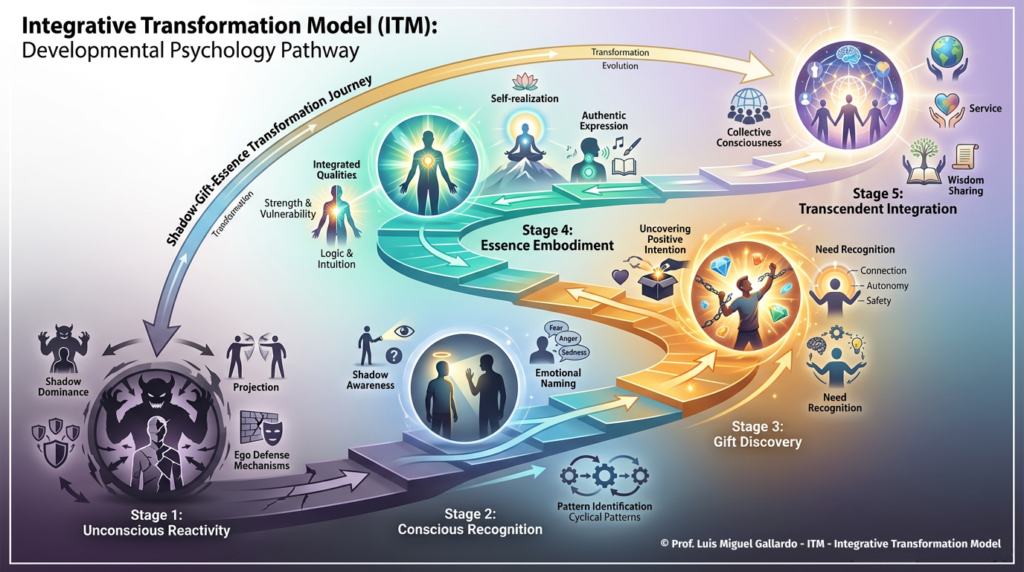
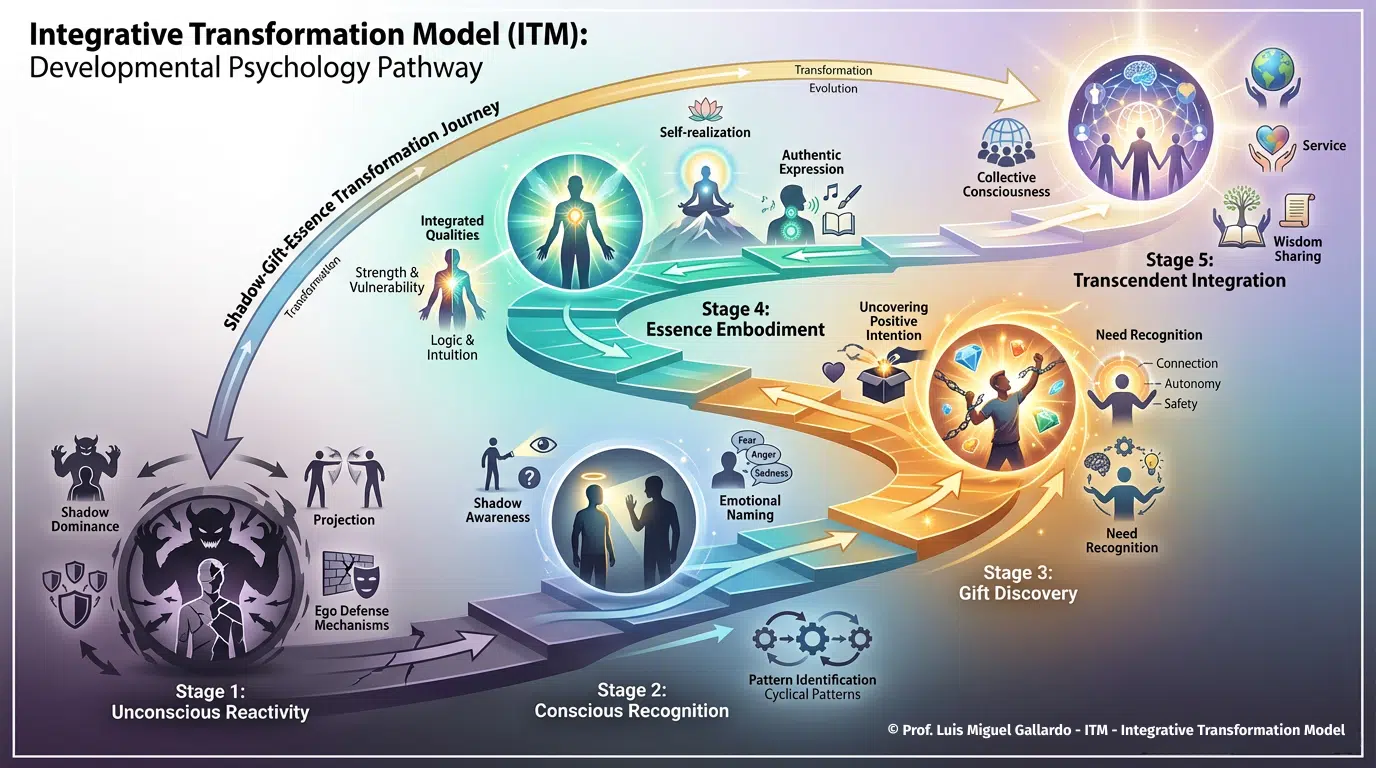
Transformation isn’t random—it follows a developmental arc. This visual maps the five stages of the ITM journey:
Stage 1: Unconscious Reactivity
You’re driven by unexamined patterns. A critical comment triggers defensiveness. A setback spirals into self-doubt. You react before you realize what’s happening.
Stage 2: Conscious Recognition
You begin to notice the patterns. You catch yourself mid-reaction and think, “There I go again.” Awareness emerges, even if you can’t yet change the behavior.
Stage 3: Gift Discovery
You look beneath the reactive pattern and discover its positive intention. That defensiveness? It’s protecting your integrity. That self-doubt? It’s ensuring you maintain high standards. The gift reveals itself.
Stage 4: Essence Embodiment
You integrate the gift consciously. You can now access healthy assertiveness without defensiveness, or maintain standards without punishing self-criticism. You embody a new quality.
Stage 5: Transcendent Integration
The transformation becomes second nature. You move fluidly between perspectives, hold paradox with ease, and access wisdom that transcends your individual psychology. You become a channel for collective intelligence.
For Leaders:
Most leadership development stops at Stage 2 (awareness) or offers behavioral techniques that bypass the shadow entirely. The ITM takes you all the way through to embodied wisdom—the hallmark of truly transformational leadership.
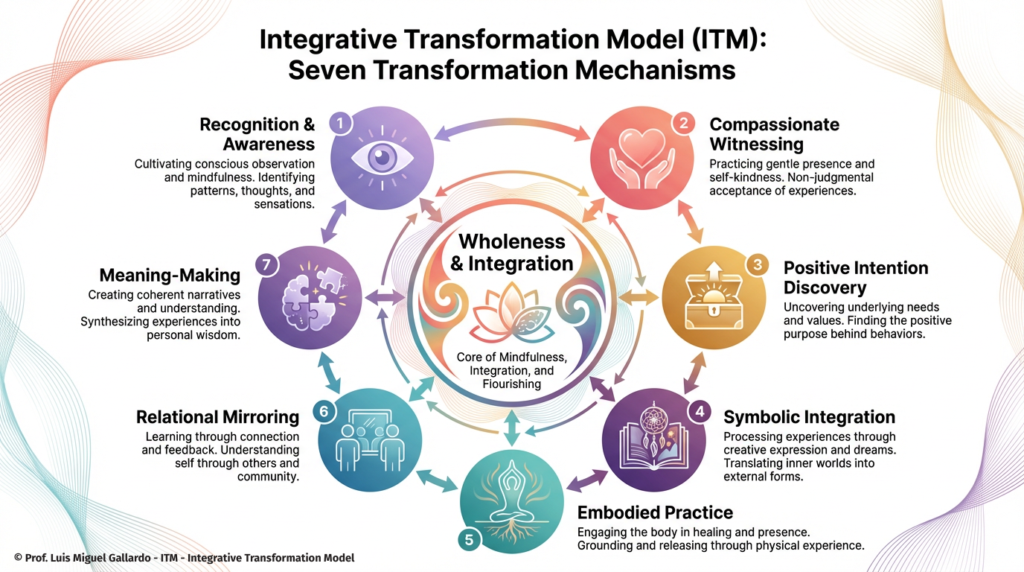
Transformation happens through seven interconnected mechanisms. Unlike linear models, these work synergistically—each strengthens the others:
Why This Matters:
Traditional leadership development often focuses on skill acquisition (mechanism #5) while ignoring the psychological foundations (mechanisms #1-4) and relational/existential dimensions (mechanisms #6-7). The ITM recognizes that sustainable transformation requires all seven.
Real-World Example:
A CEO I worked with struggled with “imposter syndrome” (shadow). Through compassionate witnessing (#2) and positive intention discovery (#3), she recognized this pattern was actually her commitment to excellence and authenticity (gift). By embodying humility and confidence simultaneously (#5), she transformed her leadership presence. The “imposter syndrome” didn’t disappear—it evolved into discernment and genuine curiosity (essence).
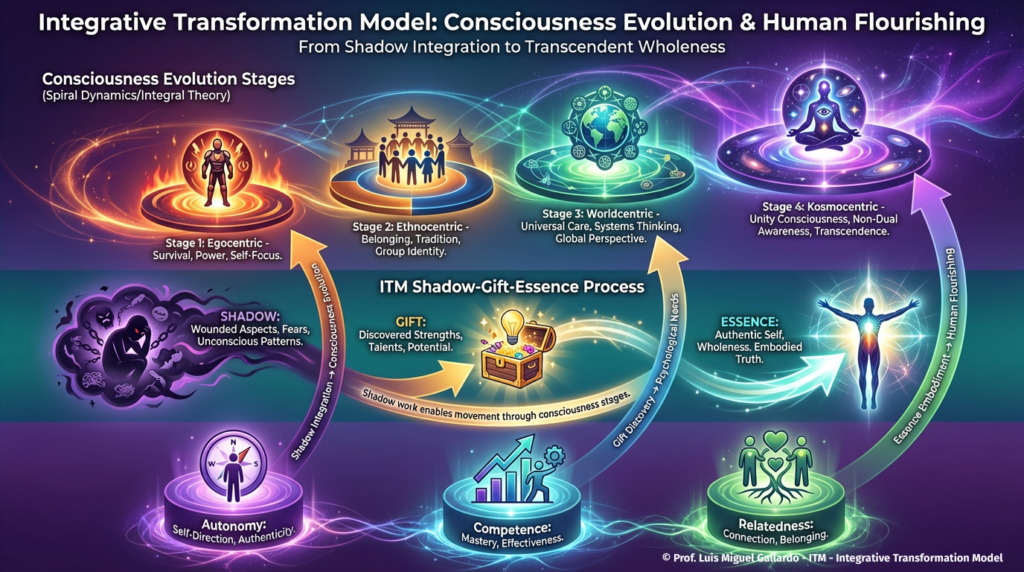
This framework shows how shadow work connects to both consciousness evolution and psychological flourishing.
The Three Levels:
Top Level – Consciousness Stages:
Human consciousness evolves from egocentric (me-focused) → ethnocentric (my group) → worldcentric (all people) → kosmocentric (all beings). Each stage includes and transcends the previous.
Middle Level – The ITM Process:
Shadow-Gift-Essence work creates vertical integration—accessing wisdom from multiple developmental stages simultaneously.
Bottom Level – Flourishing Foundation:
The process satisfies the three core psychological needs identified by Self-Determination Theory:
Leadership Insight:
Leaders who do shadow work don’t just become better managers—they evolve to higher stages of consciousness. They move from “How do I win?” (egocentric) to “How do we succeed?” (ethnocentric) to “How do we serve the whole system?” (worldcentric). This isn’t moral development alone—it’s cognitive, emotional, and spiritual maturation.
The research is clear: leaders operating from worldcentric or kosmocentric stages create more innovative, resilient, and humane organizations.
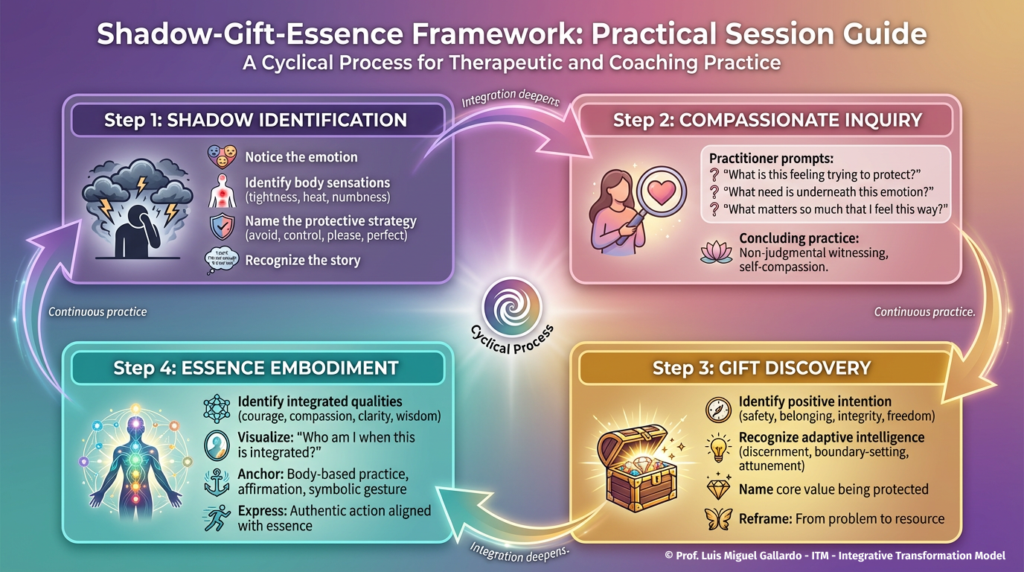
Theory becomes transformation through practice. This flowchart shows the four-step process you can use in coaching sessions, team workshops, or personal reflection:
Step 1: Shadow Identification (Purple)
“What emotion or pattern am I experiencing?”
Notice the reactive feeling without trying to fix it. Name it: frustration, fear, shame, anger, overwhelm.
Step 2: Compassionate Inquiry (Pink)
“What is this pattern protecting or trying to accomplish?”
Get curious instead of critical. Every shadow has a positive intention—find it.
Step 3: Gift Discovery (Gold)
“What capacity or quality is hidden in this pattern?”
Translate the protective mechanism into its essential quality. Control → discernment. People-pleasing → attunement. Perfectionism → excellence.
Step 4: Essence Embodiment (Teal)
“How do I consciously embody this quality?”
Practice the gift in a new way. Feel it in your body. Speak from it. Lead from it.
How to Use This:
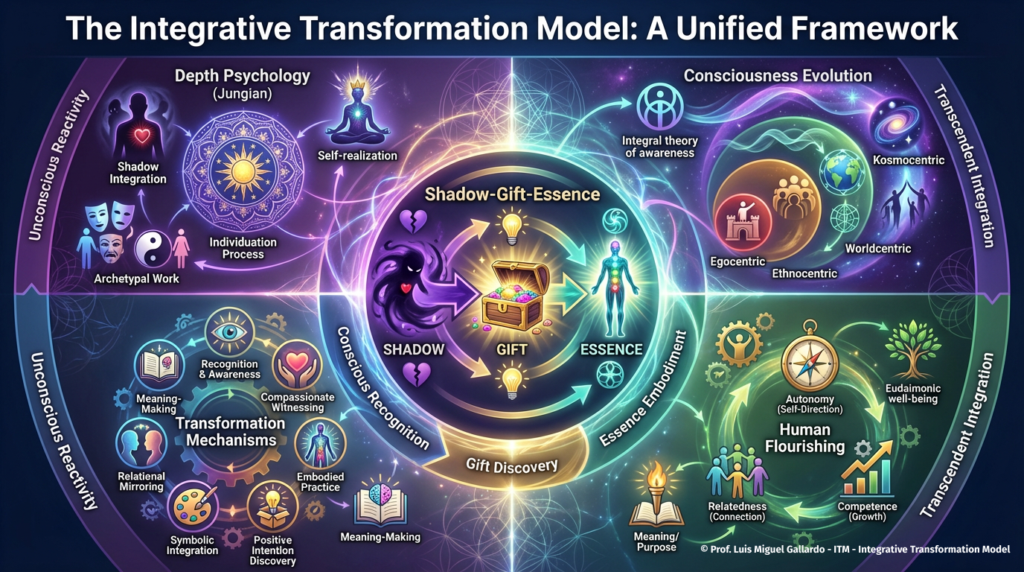
This comprehensive mandala synthesizes everything into one integrated view. At the center, you see the Shadow-Gift-Essence transformation arc. The four quadrants represent:
The outer ring shows the five developmental stages, and the flowing energy patterns illustrate how everything interconnects.
Why This Visual Matters:
Transformation is not linear—it’s holistic. You don’t “do” shadow work and then “do” consciousness evolution. They happen simultaneously. Every time you integrate a shadow, you:
This is the power of an integrative model.
The ITM isn’t just philosophical speculation—it’s grounded in over 90 peer-reviewed studies across:
When you work with the ITM, you’re working with a model that honors both the wisdom of depth psychology and the rigor of contemporary science.
Leaders who engage deeply with the ITM report:
The path from shadow to essence is not easy—but it is the most rewarding journey you can take as a leader. It requires:
But here’s what I’ve learned after three decades of this work: You don’t transform alone, and you don’t transform by accident.
You need:
If this framework resonates with you, here are ways to engage:
The greatest leaders I’ve known aren’t those who’ve eliminated their shadows—they’re those who’ve integrated them. They’ve discovered that:
You are not broken and in need of fixing. You are whole and in the process of remembering.
The Integrative Transformation Model is simply a map for that remembering—a way to consciously navigate the journey from fragmentation to integration, from reactivity to responsiveness, from ego to essence.
Your shadows are not your enemies. They are your teachers, your guides, your gateways to the leader you’re becoming.
The question is not whether you have shadows—we all do.
The question is: Are you ready to discover the gifts they’re holding for you?
Run your own workshop with the Integrative Transformation Model created by Prof. Luis Miguel Gallardo
https://worldhappiness.my.canva.site/itm-model-luis-miguel-gallardo
Access the Research Paper on Integrative Transformation Model created by Prof. Luis Miguel Gallardo
Prof. Luis Miguel Gallardo is the Founder and President of the World Happiness Foundation and Professor of Practice at Shoolini University’s Yogananda School of Spirituality and Happiness. With over three decades of experience integrating depth psychology, contemplative practices, and leadership development, he has worked with thousands of leaders worldwide to facilitate personal and collective transformation.
His work bridges ancient wisdom traditions with contemporary science, offering practical pathways for individuals and organizations to move from survival to thriving, from fragmentation to wholeness, from doing to being.
For more information:
📧 Email: lgallardo@worldhappiness.foundation
🌐 Website: www.worldhappiness.foundation
📚 Research: Published in peer-reviewed journals on consciousness, transformation, and human flourishing
This article draws on comprehensive research detailed in the full academic paper “Integrating Shadow and Essence: A Developmental Model Uniting Jungian Individuation, the S-G-E Framework, and Contemporary Research on Consciousness Evolution and Human Flourishing” (Gallardo, 2026).
Key Sources:
For the complete reference list of 90+ peer-reviewed studies, please refer to the full research paper.
APA Format:
Gallardo, L. M. (2026). From shadow to essence: The Integrative Transformation Model for leaders and changemakers. World Happiness Foundation Blog. https://worldhappiness.foundation/blog/
MLA Format:
Gallardo, Luis Miguel. “From Shadow to Essence: The Integrative Transformation Model for Leaders and Changemakers.” World Happiness Foundation Blog, 2026.
All six visual frameworks presented in this article are available for use in coaching and leadership programs with proper attribution:
Copyright © 2026 Prof. Luis Miguel Gallardo. All rights reserved.
For licensing inquiries for commercial use, please contact: lgallardo@worldhappiness.foundation
“The privilege of a lifetime is to become who you truly are.” — Carl Jung
“Your shadow is not your enemy—it is your invitation to wholeness.” — Luis Miguel Gallardo
I’m traveling in Vietnam now—the land that gave the world

Hanoi has a particular kind of energy in January—quiet streets
In the heart of Vietnam – the homeland of Zen