
You Don’t Find Your Purpose. You Remember It. Why the Deepest Meaning in Your Life Is Already Inside You.
Why the Deepest Meaning in Your Life Is Already Inside
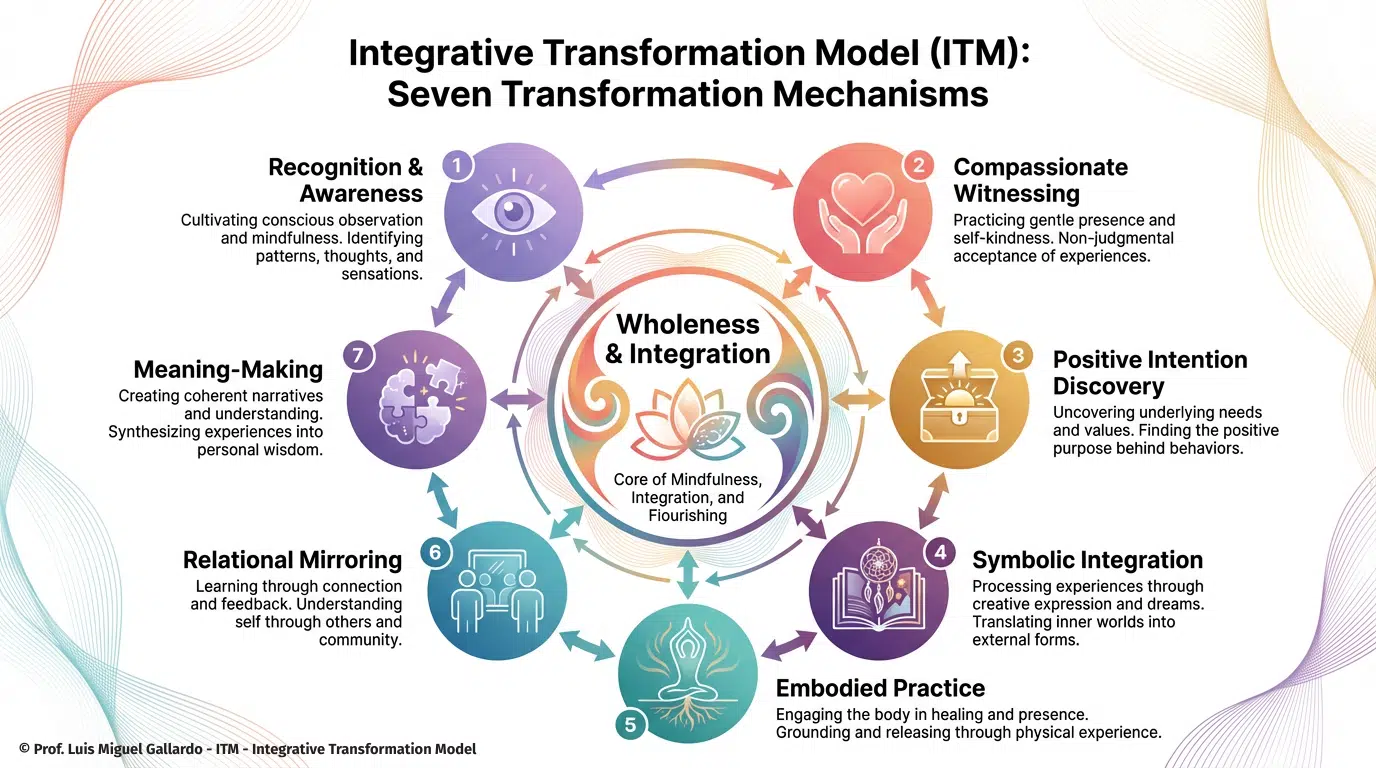
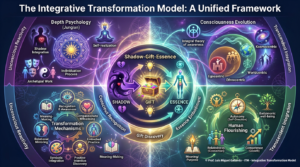
In my Integrative Transformation Model (ITM), I explicitly ground leadership transformation in three pillars: Jungian individuation, the Shadow–Gift–Essence (S‑G‑E) alchemy, and contemporary research on consciousness evolution and human flourishing—including integral theory. (Gallardo, 2026a; Gallardo, 2026b). [1]
Within that third pillar, Ken Wilber’s Integral Theory is one of the most influential “meta-maps” for unifying perspectives that are too often fragmented: inner experience and outer behavior; individual growth and collective systems; state experiences and stage development (Wilber, 2006). [2] When leaders struggle, the failure is rarely a lack of intelligence—it is more often a failure of integration: cognition mismatched to emotion, personal insight unmatched by relational maturity, culture change disconnected from systems design, or peak spiritual states mistaken for stable developmental maturity (Wilber, 1982/2006). [3]
This report’s central finding is that Wilber’s AQAL framework (All Quadrants, All Levels, All Lines, All States, All Types) integrates with ITM in a complementary way:
The constraints are equally important. Integral Theory is a comprehensive meta-framework, but it is not, by itself, a validated clinical intervention. Its evidence base depends largely on the underlying disciplines it integrates (developmental psychology, systems theory, contemplative studies). In peer-reviewed literature, Integral Theory is frequently appreciated for its inclusiveness and criticized for potential overreach, hierarchical bias, and culturally universalist assumptions (Ferrer, 2015; DiZerega, 1996; Daniels, 2004). [6]
To make integration responsible and practical, I propose a three-tier ITM × Wilber program architecture:
Program duration, participant selection criteria, facilitation credentials, and jurisdictional legal requirements are UNSPECIFIED in the prompt; I therefore provide modular designs that can be configured without pretending these parameters are already decided.
For ITM, I treat my World Happiness Foundation blog post “From Shadow to Essence” and the January 25, 2026 ITM PDF as canonical. (Gallardo, 2026a; Gallardo, 2026b). [1] These sources explicitly name integral theory (including Ken Wilber) as part of the consciousness evolution pillar and describe ITM’s five-stage developmental arc and seven transformation mechanisms. (Gallardo, 2026a; Gallardo, 2026b). [1]
For Wilber, I prioritize:
Wilber’s contribution is best understood as an evolving synthesis project: beginning in transpersonal psychology and developmental theory, expanding into a “theory of everything” public narrative, and later refining AQAL with a strong emphasis on states/stages, methodological pluralism, and practice systems (“Integral Life Practice,” “Integral Meditation”). (Wilber, 2006; Ken Wilber Fund, n.d.). [16]
The list below is prioritized (not exhaustive). Publication years are drawn from the Ken Wilber Fund list and publisher bibliographic records. [17]
| Year | Seminal work (prioritized) | Why it is “core canon” for Integral Theory |
| 1977 | The Spectrum of Consciousness[18] | Early synthesis of psychological and contemplative views; seeds the “spectrum” framing behind later levels/stages. [19] |
| 1979 | No Boundary[20] | Bridges Eastern/Western approaches to growth; important for later “clean up / shadow” emphases. [19] |
| 1980 | The Atman Project[21] | Transpersonal developmental narrative; early stage-model influence and pre/trans differentiation groundwork. [22] |
| 1981 | Up from Eden[23] | Evolutionary-cultural development framing (“from archaic to transpersonal” arcs). [19] |
| 1984 | Eye to Eye[24] | Epistemology and “three eyes” style distinctions; often used to justify multi-method inquiry. [19] |
| 1991 | Grace and Grit[25] | Personal narrative of practice, suffering, and meaning-making; bridges theory and lived spirituality. [19] |
| 1995 | Sex, Ecology, Spirituality[26] | Major “Kosmos” synthesis; foundational for holons/holarchies and later AQAL expansions. [27] |
| 1996 | A Brief History of Everything[28] | Accessible synthesis; popularizes stage/state integration and integral worldview. [29] |
| 1998 | The Marriage of Sense and Soul[30] | Science–religion integration; important for Wilber’s later “post-metaphysical” posture debates. [31] |
| 2000 | Integral Psychology[32] | Explicit integral map applied to psychology and human development. [33] |
| 2000 | A Theory of Everything[34] | Concise AQAL overview with applications to business/politics/science/spirituality. [35] |
| 2006 | Integral Spirituality[36] | Deepens the state–stage relationship and integral spirituality; a major focal point for critiques. [37] |
| 2008 | Integral Life Practice[38] | Practice system integrating body, mind, spirit, and shadow; bridges theory to training design. [39] |
| 2016 | Integral Meditation[40] | “Grow up / wake up / show up” applied to meditation and daily life; relevant for leadership practice. [41] |
| 2017 | The Religion of Tomorrow[42] | Mature articulation of developmental spirituality; continues debates about hierarchy and universality. [43] |
| 2024 | Finding Radical Wholeness[44] | Recent synthesis emphasizing wholeness through integral psychology, practice, and shadow work. [45] |
Wilber’s AQAL framework is intentionally presented as a compact set of “fewest possible factors” for a comprehensive account: quadrants, levels, lines, states, and types. (Wilber, 2006). [4] He defines the four quadrants as the inside/outside of the individual and the inside/outside of the collective—often simplified as I (interior individual), It (exterior individual), We (interior collective), Its (exterior collective). (Wilber, 2006). [46]
In leadership terms, the quadrants function as a disciplined warning against “one-quadrant solutions.” For example, if a leader only works the UR quadrant (skills/behavior) while ignoring UL (meaning, fear, shame), the change will often be brittle; if they focus on LL culture without LR system design (structures/incentives), the culture work collapses under structural gravity. This is precisely why my ITM includes both symbolic/somatic integration and relational/systemic mechanisms—because transformation is multi-domain. (Gallardo, 2026a). [47]
Wilber’s contribution is not “stage theory by itself” (many scholars developed stage models before him), but rather the integration of multiple developmental streams—cognitive, moral, affective, interpersonal, needs, and others—into an AQAL meta-map. (Wilber, 2006). [46] In his synthesis, different lines can be at different levels (one can be cognitively advanced and morally immature, for example), and temporary states can occur at any stage (“states are free, structures are earned” is the classic shorthand). (Wilber, 2006). [48]
This also aligns with my ITM critique (in the ITM paper) that consciousness evolution frameworks can neglect emotional and shadow dimensions and treat development as primarily cognitive. (Gallardo, 2026b). [49] Wilber addresses part of that risk by insisting that development is multi-line and by adding “shadow” as a necessary “clean up” dimension in practice systems (Integral Life Practice; Integral Life, 2017). [50]
Wilber’s stage synthesis is often discussed in relation to stage research associated with Jean Piaget[51], Lawrence Kohlberg[52], Jane Loevinger[53], Susanne Cook-Greuter[54], and Robert Kegan[55] (among others). [56]
A central structural idea in Wilber’s synthesis is the holon: a whole that is also a part of larger wholes; reality is modeled as nested holarchies (not merely hierarchies as domination). Official integral teaching materials emphasize that holarchies should be distinguished from “dominator hierarchies,” and that “transcend and include” refers to development that preserves earlier capacities rather than negating them. [57]
From a leadership perspective, this is constructive when it avoids moralism: “higher” should denote greater capacity for complexity, perspective-taking, and integration—not superiority or entitlement. This is also an ITM requirement: Essence embodiment should reduce egoic self-righteousness and increase relational integrity, not inflate the persona. (Gallardo, 2026b). [49]
Wilber’s “pre/trans fallacy” proposes that pre-rational (prepersonal) and trans-rational (transpersonal) states can be confused because both are “non-rational.” In one error, transpersonal realization is reduced to infantile regression; in the opposite error, prepersonal regression is elevated to transpersonal realization. (Wilber, 1982). [5]
This construct matters for leadership development because executives in crisis—and organizations in culture volatility—often oscillate between prepersonal defenses (splitting, projection, magical thinking, scapegoating) and authentic transpersonal openings (deep compassion, unity, service orientation). The pre/trans distinction gives me a practical filter: Is this emergence expanding perspective and ethical capacity, or collapsing capacity and increasing rigidity? (Kasprow & Scotton, 1999). [58]
Integral Theory is not typically testable as a single hypothesis. Its evidentiary claim is closer to a meta-claim: that a comprehensive account must include multiple irreducible perspectives (quadrants) and multiple dimensions of development (levels/lines/states/types). (Wilber, 2006). [4]
Peer-reviewed applications exist, especially in integrative healthcare and mental health frameworks, where AQAL functions as a mapping tool for clinical formulation, intervention planning, and integrative case conceptualization (Duffy, 2020). [59] Scholarship in education and other fields has similarly treated integral theory as a comprehensive heuristic that helps practitioners identify blind spots (Esbjörn-Hargens, 2007). [60]
The strongest empirical support relevant to AQAL comes indirectly through mature literatures on adult developmental stages and meaning-making complexity (constructive-developmental theory), and through contemplative science on states and practices. For example, structural developmental psychology narratives grounded in Kegan’s tradition have been applied to health promotion frameworks (Bauger & Fontaine, 2017). [61] Research on adult-stage generality and transformation has been discussed in integrally oriented venues with explicit engagement with stage theory debates (Hagström & Stålne, 2015). [62] And Cook-Greuter’s empirical work on ego development explicitly situates ego development theory as a vertical growth/meaning-making model that can be related to AQAL’s interior-individual quadrant (Cook-Greuter, 2005). [63]
Critique: hierarchical or culturally universalist bias.
One of the most substantial critiques is that Wilber’s developmental hierarchies can become culturally biased or overly universalist when applied to spiritual goals or “ultimate” claims. Ferrer’s participatory approach argues for plural spiritual ultimates and critiques Wilber’s framing as overly hierarchical and metaphysically presumptive. (Ferrer, 2015). [64] For ITM integration, the guardrail is simple: in leadership programs, I treat spirituality and meaning as participant-led and culturally plural, and I focus on observable outcomes (wisdom, compassion, ethics, integration) rather than asserting a single metaphysical endpoint. (Gallardo, 2026a). [47]
Critique: pre/trans fallacy overextension and counter-fallacies.
Wilber’s pre/trans distinction is widely influential, but it is also contested. Daniels (2004) argues that Wilber can be seen as committing a “trans/trans fallacy” in disputes with other transpersonal theorists (particularly around interpreting experiential data and spiritual development). [65] DiZerega (1996) similarly argues that Wilber’s extension of the pre/trans fallacy beyond appropriate boundaries can itself become a kind of “pre/trans fallacy fallacy.” [66]
For ITM, this means I do not use pre/trans as a rhetorical weapon. I use it as a discernment tool with humility: I check for functional impairment, rigidity, grandiosity, relational rupture, and ethical drift, and I build referral pathways when needed. [67]
Critique: academic reception and peer-review limitations.
Integral theory’s academic reception is uneven: many applications exist, but Wilber himself is often discussed more in transpersonal scholarship and integral venues than mainstream disciplinary journals. A pragmatic way forward is to treat AQAL as a useful heuristic that must remain in dialogue with peer-reviewed domain expertise rather than replacing it. (Duffy, 2020). [59]
Because Wilber-linked practice systems include meditation and shadow work intensification, safety is not optional. Systematic reviews document that meditation and mindfulness practices can be associated with adverse events (anxiety, dissociation, trauma re-experiencing), and that retreat intensity and pre-existing vulnerabilities can increase risk (Farias et al., 2020; Binda et al., 2022). [7] Cross-sectional and clinical literatures report unpleasant or adverse meditation experiences with non-trivial prevalence among meditators, and case series document meditation-associated psychosis in a subset of individuals (Cebolla et al., 2017; Charan et al., 2022). [68]
This evidence informs my tiering: Tier one is broadly safe; Tier two requires basic screening and informed consent; Tier three requires robust governance and clinical referral options.
From my ITM article and ITM paper, the relevant canonical components include:
Correspondences.
Wilber’s AQAL corresponds strongly with ITM’s insistence that transformation is multi-domain. My ITM mechanisms explicitly include Symbolic Integration, Embodied Practice, Relational Mirroring, and Meaning-Making—each of which naturally maps onto AQAL’s quadrants: inner meaning (UL), embodied behavior (UR), cultural/interpersonal mirroring (LL), and systems/structures (LR). (Gallardo, 2026a; Wilber, 2006). [69]
Complementarities.
Wilber adds an exceptionally useful diagnostic: where a leadership problem “lives” (quadrants) and what kind of developmental complexity is involved (levels/lines). (Wilber, 2006). [46] ITM adds what AQAL often lacks in practice: a clean pathway for converting shadow contraction into integrated capacity. In other words, AQAL is often strongest as a map; ITM is explicitly designed as a map-plus-alchemy process (Shadow → Gift → Essence). (Gallardo, 2026a; Gallardo, 2026b). [1]
Tensions.
The primary tension is the risk of “map identification”: leaders becoming fluent in integral language without doing the embodied shadow work necessary for behavioral change. My ITM paper explicitly notes critiques that consciousness evolution models can insufficiently attend to emotional/shadow dynamics (Gallardo, 2026b). [49] A second tension is hierarchical misuse: AQAL developmental language can be weaponized socially (ranking people) rather than used compassionately (supporting growth). The participatory critique also challenges Wilber’s spiritual universalism claims, requiring pluralism in leadership settings (Ferrer, 2015). [64]
Practical leadership applications.
Wilber’s quadrants provide a repeatable executive tool: Quadrant-balanced intervention planning. For example, when a team is stuck: (UL) identify the leader’s shadow emotions and meaning structures (ITM Stage 1–3), (UR) build new embodied habits, (LL) redesign relational norms and feedback loops, and (LR) change incentives and structures that reward the old pattern. (Wilber, 2006; Gallardo, 2026a). [70]
| Wilber concept | ITM element(s) | Correspondence | Complementarity | Tensions | Practical leadership application |
| AQAL quadrants (I / It / We / Its) (Wilber, 2006) [46] | ITM mechanisms (embodied, relational, meaning); leadership applications | Both insist transformation is multi-domain | Adds a clean diagnostic for blind spots | Risk of “quadrant reductionism” if used mechanically | “Quadrant scan” of a conflict: inner meaning, behavior, culture, systems |
| Levels/stages (vertical development) (Wilber, 2006) [46] | ITM stages 1–5 (Gallardo, 2026a) [47] | Both frame growth as developmental, not random | Adds stage/altitude language to calibrate interventions | Stage ranking/elitism risk; misusing hierarchy | Match intervention intensity to developmental readiness |
| Lines of development (multiple intelligences/streams) (Wilber, 2006) [46] | ITM “Gift” as adaptive intelligence; SDT needs focus in ITM paper | Both acknowledge uneven maturity across domains | Helps leaders target weak lines (ethical, interpersonal, emotional) | Can become overly complex; measurement limits | “Line audit”: emotional line vs cognitive line vs moral line |
| States (temporary experiences) (Wilber, 2006) [46] | ITM Stage 5 “Transcendent Integration” (Gallardo, 2026a) [47] | Both value altered states as meaningful | Strong guardrail: states ≠ stages; prevents inflation | Peak experiences mistaken for stable maturity | “State–trait integration”: translate peak insight into weekly behavior |
| Types (styles: personality, gender, etc.) (Wilber, 2006) [46] | ITM personalization of interventions | Both reject “one size fits all” | Adds typological nuance without ranking | Risk of stereotyping | Use types to tailor practices (e.g., introvert vs extrovert integration) |
| Holons/holarchies, “transcend and include” [57] | ITM “integration” emphasis; essence embodiment | Both emphasize integration, not suppression | Strengthens systemic leadership thinking | Can be moralized as superiority | Org-as-holon mapping: team within unit within organization |
| Pre/trans distinction (Wilber, 1982) [71] | ITM safety in transpersonal leadership work | Both value transformation through depth | Adds discernment in crises or “spiritual” language | Critiqued as overextended; requires humility (Daniels, 2004) [65] | Protocol: verify function, ethics, and stability before declaring “transcendent” |
Program duration: UNSPECIFIED
Participant selection criteria: UNSPECIFIED
Target setting (corporate, NGO, public sector, retreat): UNSPECIFIED
Jurisdictional legal requirements: UNSPECIFIED
Because these parameters are UNSPECIFIED, I outline tiered modules as composable units. Each tier includes a stepwise session outline and explicit safety/ethical/legal notes.
Tier one assumes a standard leadership development environment. It uses AQAL as a “lens” and ITM as a transformation pathway, without intensive contemplative or psychologically destabilizing practices.
Micro-intervention A: AQAL × ITM “Quadrant Scan” for a leadership challenge (45–60 minutes).
1) Name the issue in one sentence.
2) Map it across quadrants:
– UL: What meanings, fears, or shadow emotions are active?
– UR: What behaviors/habits are observed (including my own)?
– LL: What cultural norms and relational patterns reinforce it?
– LR: What systems, incentives, or constraints maintain it? (Wilber, 2006). [46]
3) Run S‑G‑E inside UL: Shadow feeling → Gift intention → Essence quality. (Gallardo, 2026a). [47]
4) Define one small intervention per quadrant (a “four-quadrant minimum viable change”).
Micro-intervention B: Pre/trans reality check (20 minutes; usable in coaching).
1) Describe the “non‑ordinary” experience or belief (e.g., “I feel called,” “I am merging with everything,” “I no longer need feedback”).
2) Check functionality: sleep, work, relationships, impulsivity, paranoia, grandiosity, risk-taking.
3) Apply Wilber’s pre/trans question: is capacity expanding (perspective, ethics, compassion), or collapsing (rigidity, impairment)? (Wilber, 1982; Kasprow & Scotton, 1999). [5]
4) If impairment is present: pause deep work and refer (legal and clinical referral protocols UNSPECIFIED).
Screening/contraindications: minimal—yet I still recommend “red flag screening” for acute psychiatric instability and active substance misuse as a boundary between coaching and therapy (UNSPECIFIED jurisdiction). The key ethical move is referral rather than intensification.
Ethical/legal considerations: maintain scope clarity (leadership development vs psychotherapy), informed consent about emotional work, confidentiality boundaries (UNSPECIFIED by jurisdiction), and documentation practices consistent with organizational policy.
Tier two introduces structured practices associated with Wilberian/integral approaches, especially Integral Life Practice modules and integral meditation, while staying conservative about intensity.
Practice module A: Body–Mind–Spirit–Shadow weekly cycle (60–90 minutes weekly; program length UNSPECIFIED).
Derived from ILP’s “module” logic: train multiple dimensions rather than privileging one. (Wilber et al., 2008). [72]
Session structure:
1) Grounding and intention: connect to ITM stage (where am I today: reactivity, recognition, gift discovery, embodiment, integration?). (Gallardo, 2026a). [47]
2) Body: 10–15 minutes movement or somatic regulation practice.
3) Mind: 10–15 minutes meaning-making exercise (values, cognitive reframing via quadrant scan).
4) Spirit: 10–15 minutes contemplative practice (low-intensity mindfulness).
5) Shadow: 15–20 minutes “3–2–1” style perspective shifting (see below) or S‑G‑E inquiry. (Integral Life, 2017). [73]
6) Close: one “show up” behavior commitment in the next 72 hours (integral emphasis on translating insight into action).
Practice module B: 3–2–1 shadow process integrated with S‑G‑E (30–45 minutes).
This integral shadow method uses perspective shifts (3rd person → 2nd person → 1st person) to reclaim projections and integrate disowned aspects. [74]
Stepwise outline:
1) Face it (3rd person): describe the person/situation with emotional charge.
2) Talk to it (2nd person): dialogue with the “shadow image.”
3) Be it (1st person): identify the disowned quality in myself.
4) Translate into S‑G‑E:
– Shadow: what emotion is present?
– Gift: what is it protecting?
– Essence: what integrated capacity is emerging? (Gallardo, 2026a). [47]
Screening/contraindications: Tier two should include mental health screening questions and opt-out options because the peer-reviewed literature is clear that meditation and contemplative practices can produce adverse experiences for some participants—especially those with trauma histories, retreat intensity exposure, or pre-existing vulnerabilities (Farias et al., 2020; Binda et al., 2022). [7]
Safety/ethical/legal considerations:
– Informed consent that includes the possibility of challenging meditation-related experiences and the availability of modifications. [67]
– Clear escalation and referral pathways (UNSPECIFIED jurisdictional requirements).
– Facilitator training to avoid coercion, spiritual bypassing, or “stage shaming.”
Tier three involves intensive retreats, extended contemplative practice, or deep shadow immersion. I only recommend Tier three when governance is strong: trained facilitation, robust screening, and clinical referral options.
Deep module A: Integral retreat with staged intensity (1–3 days; duration UNSPECIFIED).
1) Day 1: quadrant literacy (AQAL) + ITM S‑G‑E foundations. (Wilber, 2006; Gallardo, 2026a). [70]
2) Day 2: longer practice blocks (still conservative): meditation, somatic practice, shadow dialogues, integration circles.
3) Day 3: “show up” integration—turn insights into organizational commitments: decision policies, feedback norms, boundary agreements.
Deep module B: “Grow up / clean up / wake up / show up” leadership lab (multi-week; length UNSPECIFIED).
This module formalizes the integral developmental trope:
– Grow up = vertical development (meaning-making complexity)
– Clean up = shadow integration
– Wake up = state training (meditation/contemplation)
– Show up = action and service
Official integral sources present this framing as central to integral practice culture. [75]
Screening/contraindications:
The peer-reviewed and clinical literature supports conservative exclusions and careful monitoring for intensive meditation. Reports document meditation-related adverse experiences and cases of meditation-associated psychosis, especially in intensive contexts and often with identifiable vulnerabilities (Charan et al., 2022; de Oliveira et al., 2025; Cebolla et al., 2017). [76]
Therefore, Tier three should include at minimum:
– Screening for prior psychosis/mania, severe dissociation, recent suicidality, uncontrolled substance use, and acute PTSD destabilization (exact clinical thresholds UNSPECIFIED). [77]
– A clear informed consent protocol, including “pause and modify” options. [67]
– Active monitoring mechanisms during extended sits (breaks, grounding, access to supportive staff).
Ethical/legal considerations:
– Strong boundaries between coaching and psychotherapy; do not treat or diagnose unless qualified and licensed (UNSPECIFIED jurisdiction).
– Confidentiality and reporting obligations depend on jurisdiction; these requirements are UNSPECIFIED and must be clarified by local counsel and clinical supervisors.
– Duty-of-care policies must be explicit for retreat settings (UNSPECIFIED organizational governance).
All entries are APA 7 style. Links are provided in code. “Paywalled” indicates that the publisher page may require access.
Bauger, L., & Fontaine, M. (2017). Structural developmental psychology and health promotion in older adults. Health Psychology and Behavioral Medicine, 5(1), 313–326. https://pmc.ncbi.nlm.nih.gov/articles/PMC6144771/ [61]
Binda, D. D., Przyrembel, M., & Tausczik, Y. (2022). What are adverse events in mindfulness meditation? Mindfulness, 13, 1310–1326. https://pmc.ncbi.nlm.nih.gov/articles/PMC9024164/ [78]
Cebolla, A., Demarzo, M., Martins, P., Soler, J., & García-Campayo, J. (2017). Unpleasant experiences in meditation: A multicenter survey. PLOS ONE, 12(5), e0183137. https://journals.plos.org/plosone/article?id=10.1371/journal.pone.0183137 [79]
Charan, D., et al. (2022). Meditation practices and the onset of psychosis: Case series and recommendations. Cureus / Psychiatry (Paywalled/preview varies). Open access copy: https://pmc.ncbi.nlm.nih.gov/articles/PMC9896108/ [80]
Daniels, B. (2004). The trans/trans fallacy and the dichotomy debate. International Journal of Transpersonal Studies, 23. https://digitalcommons.ciis.edu/cgi/viewcontent.cgi?article=1233&context=ijts-transpersonalstudies [65]
DiZerega, G. (1996). A critique of Ken Wilber’s account of deep ecology (and the “pre/trans fallacy fallacy”). The Trumpeter. https://trumpeter.athabascau.ca/index.php/trumpet/article/view/268/401 [66]
Duffy, J. D. (2020). A primer on integral theory and its application to mental health. Frontiers in Psychiatry (Open access). https://pmc.ncbi.nlm.nih.gov/articles/PMC8981233/ [59]
Farias, M., Maraldi, E., Wallenkampf, K. C., & Lucchetti, G. (2020). Adverse events in meditation practices and meditation-based therapies: A systematic review. Acta Psychiatrica Scandinavica, 142(5), 374–393. Open access PDF: https://www.j.pucsp.br/sites/default/files/6-10_adverse_events_-_farias_-_maraldi_et_al.pdf [81]
Ferrer, J. N. (2015). Participation, metaphysics, and enlightenment: Reflections on Ken Wilber’s recent work. Approaching Religion, 5(2), 42–55. https://journal.fi/ar/article/view/67573/27869 [64]
Gallardo, L. M. (2026a, January 25). From Shadow to Essence: The Integrative Transformation Model (ITM) for Leaders and Changemakers. https://worldhappiness.foundation/blog/consciousness/from-shadow-to-essence-the-integrative-transformation-model-itm-for-leaders-and-changemakers/ [47]
Gallardo, L. M. (2026b, January 25). Integrating Shadow and Essence: A Developmental Model Uniting Jungian Individuation, the S‑G‑E Framework, and Contemporary Research on Consciousness Evolution and Human Flourishing (ITM PDF). https://worldhappiness.foundation/wp-content/uploads/2026/01/integrative_transformation_model_Luis_Miguel_Gallardo.pdf [49]
Hagström, T., & Stålne, K. (2015). The generality of adult development stages and transformations. Integral Review, 11(3). https://integral-review.org/issues/vol_11_no_3_hagstroom_and_staalne_the_generality_of_adult_development_stages_and_transformations.pdf [62]
Integral Life. (2014). The five elements of AQAL. https://integrallife.com/five-elements-aqal/ [82]
Integral Life. (2017). The 3‑2‑1 shadow process: Face it, talk to it, be it. https://integrallife.com/the-3-2-1-shadow-process/ [83]
Integral Life. (2022). Holons: The building blocks of the universe. https://integrallife.com/holons-the-building-blocks-of-the-universe/ [84]
Integral Institute. (n.d.). Integral Institute homepage and history pages. https://integralinstitute.org/ [85]
Kasprow, M. C., & Scotton, B. W. (1999). Transpersonal theory and its application to psychotherapy. Western Journal of Medicine, 171(3), 168–173. https://pmc.ncbi.nlm.nih.gov/articles/PMC3330526/ [58]
Ken Wilber Fund. (n.d.). Books by Ken Wilber (bibliographic list). https://www.kenwilberfund.org/books-by-ken-wilber/ [19]
de Oliveira, M. G., et al. (2025). Psychosis triggered by intensive meditation: A case report and literature review. European Journal of Case Reports in Internal Medicine (Open access). https://pmc.ncbi.nlm.nih.gov/articles/PMC12260811/ [86]
Wilber, K. (1982). The pre/trans fallacy. Journal of Humanistic Psychology, 22(2), 5–43. (Paywalled on publisher site.) https://journals.sagepub.com/doi/10.1177/0022167882222002 [71]
Wilber, K. (2006). IOS basic and the AQAL map. Journal of Integral Theory and Practice, 1(1), 1–40. (Open access PDF copy.) https://www.ubiquityuniversity.org/wp-content/uploads/2018/03/Homework-Module-1-Ken-Wilber-Introduction-to-Integral-Theory.pdf [46]
Wilber, K. (2024). Finding radical wholeness: The integral path to unity, growth, and delight. Shambhala Publications[87]. (Publisher page; paywalled purchase). https://www.shambhala.com/finding-radical-wholeness-9781645473909.html [88]
[1] [20] [21] [42] [47] [69] https://worldhappiness.foundation/blog/consciousness/from-shadow-to-essence-the-integrative-transformation-model-itm-for-leaders-and-changemakers/
[2] [3] [4] [11] [16] [34] [44] [46] [48] [54] [55] [70] https://www.ubiquityuniversity.org/wp-content/uploads/2018/03/Homework-Module-1-Ken-Wilber-Introduction-to-Integral-Theory.pdf
[5] [36] [71] [87] The Pre/Trans Fallacy – Ken Wilber, 1982
https://journals.sagepub.com/doi/10.1177/0022167882222002?utm_source=chatgpt.com
[6] [14] [23] [40] [51] [52] [64] https://journal.fi/ar/article/view/67573/27869
https://journal.fi/ar/article/view/67573/27869
[7] [15] [77] [81] https://www.j.pucsp.br/sites/default/files/6-10_adverse_events_-_farias_-_maraldi_et_al.pdf
https://www.j.pucsp.br/sites/default/files/6-10_adverse_events_-_farias_-_maraldi_et_al.pdf
[8] [76] [80] https://pmc.ncbi.nlm.nih.gov/articles/PMC9896108/
https://pmc.ncbi.nlm.nih.gov/articles/PMC9896108
[9] [73] [74] [83] The 3-2-1 Shadow Process: Face It, Talk to It, Be It
[10] [88] https://www.shambhala.com/finding-radical-wholeness-9781645473909.html?srsltid=AfmBOopOySHu5y8Hz58MZhfOgIJoPHb4GYCfKy8Ru8kx8TLa8XHi2lwe
[12] [35] A Theory of Everything: An Integral Vision for Business, …
[13] [17] [19] [22] [27] [29] [31] [33] Books by Ken Wilber
[18] [59] A Primer on Integral Theory and Its Application to Mental …
https://pmc.ncbi.nlm.nih.gov/articles/PMC8981233/?utm_source=chatgpt.com
[24] [26] [49] https://worldhappiness.foundation/wp-content/uploads/2026/01/integrative_transformation_model_Luis_Miguel_Gallardo.pdf
[25] [50] [72] https://www.terrypatten.com/wp-content/uploads/2018/03/ILP_Book_Preview.pdf
https://www.terrypatten.com/wp-content/uploads/2018/03/ILP_Book_Preview.pdf
[28] [32] [57] [84] https://integrallife.com/holons-the-building-blocks-of-the-universe/
[30] [38] [56] https://www.shambhala.com/integral-psychology-816.html?srsltid=AfmBOoqFlIKdjyFrrfO7QUsm8-MDdFjS-_JYMWTKGONcpW1GFUGvcNYx
[37] https://www.amazon.com/Integral-Spirituality-Startling-Religion-Postmodern/dp/1590303466
[39] https://www.amazon.com/Integral-Life-Practice-21st-Century-2008-09-09/dp/B01FKRSQNU
[41] https://www.amazon.com/Integral-Meditation-Mindfulness-Grow-Wake/dp/1611802989
[43] https://www.amazon.com/Religion-Tomorrow-Traditions-More-Inclusive-Comprehensive/dp/1611803004
[45] Ken Wilber
https://kenwilber.com/?utm_source=chatgpt.com
[53] [67] [78] https://pmc.ncbi.nlm.nih.gov/articles/PMC9024164/
https://pmc.ncbi.nlm.nih.gov/articles/PMC9024164
[58] Transpersonal Theory and Its Application to Psychotherapy
https://pmc.ncbi.nlm.nih.gov/articles/PMC3330526/?utm_source=chatgpt.com
[60] Applying Integral Theory to Educationi
[61] Structural developmental psychology and health promotion in …
https://pmc.ncbi.nlm.nih.gov/articles/PMC6144771/?utm_source=chatgpt.com
[62] The generality of adult development stages
[63] Ego Development: Nine Levels of Increasing Embrace
[65] The Trans/Trans Fallacy and the Dichotomy Debate
[66] View of A Critique of Ken Wilber’s Account of Deep Ecology …
https://trumpeter.athabascau.ca/index.php/trumpet/article/view/268/401?utm_source=chatgpt.com
[68] [79] https://journals.plos.org/plosone/article?id=10.1371%2Fjournal.pone.0183137
https://journals.plos.org/plosone/article?id=10.1371%2Fjournal.pone.0183137
[75] https://integrallife.com/wake-grow-edge-unknown-human-being/
[82] https://integrallife.com/five-elements-aqal/
[85] Integral Institute
https://integralinstitute.org/?utm_source=chatgpt.com
[86] https://pmc.ncbi.nlm.nih.gov/articles/PMC12260811/
Why the Deepest Meaning in Your Life Is Already Inside
Executive summary I wrote the Integrative Transformation Model (ITM) to

I want to tell you about a conversation that changed