
THE ROAD MAP TO SUPRACONSCIOUSNESS: From the Diagnosis of a World in Crisis to the Conscious Evolution of Humanity
A Framework for Systemic Transformation Through the Wisdom of Hawkins,



We stand at a threshold. As we enter 2026, it feels like “a deeper turning of the page: an invitation to return to what is essential, to release what no longer serves, and to remember who we are when fear is not in the driver’s seat.” Upheavals around the world have revealed the weaknesses in our leadership and systems. Many leaders and change-makers carry unseen wounds from trauma, stress, and social fragmentation—beneath every behavior is an entire landscape of histories, nervous system responses, inherited patterns, and unmet needs. Old patterns of urgency, disconnection, and fear have constrained our capacity to lead authentically and compassionately. We now temper a sense of urgency with an even greater call to hope. The theme of “Rebirth and Freedom” is not just a slogan; it is a call to awaken a profound inner liberation that can spread contagiously through our organizations and communities. It asks, What must we become to build the world we wish to see?
To answer this call, we must embrace an alchemical path of transformation—dissolving the old, fragmented self and emerging in an integrated, empowered form. This essay proposes a visionary yet practical framework for that journey, synthesizing the ROUSER–Koshas leadership model with healing-centered principles of awareness and agency. The ROUSER model outlines six pillars of conscious leadership: Relations, Openness, Understanding, Self-Awareness, Empowerment, and Reflection. These pillars align with the ancient yogic koshas—the five layers of our being (from the physical body, annamaya, to the blissful core, anandamaya)—ensuring that well-being and growth occur at every level of our existence. In essence, this holistic approach “marries” modern leadership wisdom with timeless spiritual truth, encouraging us to apply conscious principles at each layer of body, heart, mind, and spirit. It also resonates with a healing-centered view of change: rather than focusing solely on surface behavior, we honor the hidden narratives, ancestral histories, physiological patterns, and needs that shape how we present ourselves in the world. Freedom is not only political. It is emotional. Relational. Spiritual. Structural. And rebirth is not only personal. It is systemic. In the spirit of this understanding, what follows is a journey through each ROUSER principle and each layer of being—a path to inner and outer transformation that can lead us, like a phoenix rising, to rebirth and freedom.
Rebirth begins with relationships—the rich soil in which the seeds of transformation take root. In the ROUSER framework, Relations (or relationships) come first for a reason. Human connection is the foundation of well-being and leadership: strong relationships create safety, trust, and a supportive environment for growth. This corresponds to the physical layer (annamaya kosha)—our bodily existence and basic needs. Just as a garden needs healthy soil and roots, people need solid relationships and communities to flourish. When leaders nurture meaningful, trust-filled connections, they address a fundamental truth: we are social beings, and belonging is a basic human need.
In too many organizations, old leadership paradigms treated relationships as merely transactional. “People shrink to fit into spaces that do not honor them,” stifling their voices to maintain an uneasy peace. The result has been isolation, loneliness, and cultures of fear. By contrast, conscious leadership recognizes that community is strength. It values each person as a whole being rather than a “pair of hands” fulfilling a role. Leaders who prioritize relationships create a garden of belonging: they tend to their teams with compassion and respect, knowing that when individuals feel seen and supported, they can truly thrive. On a very physical level, this means fostering environments where people feel safe—where stress levels drop and nervous systems can relax out of survival mode. It means acknowledging that our bodies carry stress and even intergenerational trauma that cannot be ignored. By promoting genuine social connection and care, leaders help heal those hidden fractures. In practice, cultivating this garden might look like open listening sessions, peer support circles, or mentoring programs that strengthen community bonds. The simple act of showing care—asking, “How are you really doing?”—can begin to dissolve old patterns of alienation.
Relationships thus become the roots of rebirth. Grounded in friendship, trust, and solidarity, individuals and organizations gain the stability to transform. When relational soil is rich, ideas and people grow strong. In this space, the seeds of change—new ideas, collaborations, and personal growth—can germinate. A leader committed to relational well-being will celebrate teamwork over individual ego, empathy over intimidation. They recognize that freedom is collective: as we liberate each other through kindness and inclusion, we all become freer. By fortifying the physical and social foundation of connection, we prepare the ground for deeper change. In the words of one leadership manifesto, “Healing is not peripheral to leadership. It is the soil from which life-affirming leadership grows.” When we tend to this soil, we are already beginning the alchemy of rebirth at the most basic level of our being.
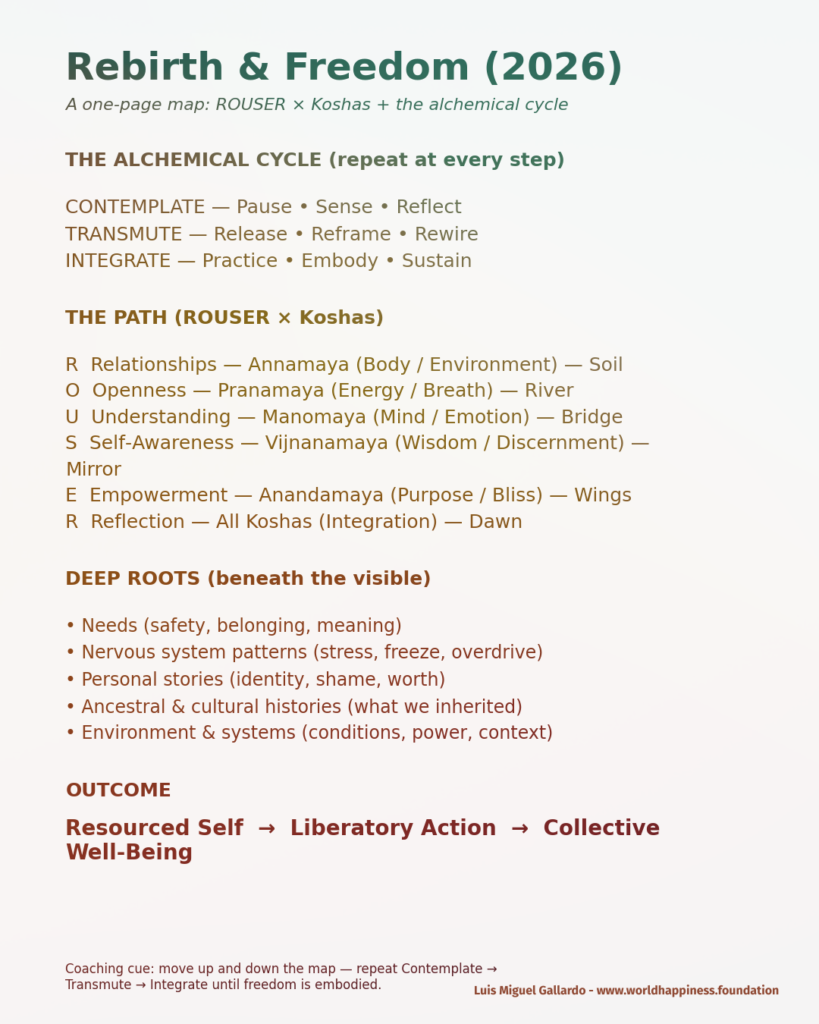
From the solid ground of relationships, the journey of transformation moves into Openness, the second pillar of ROUSER. Openness asks us to keep our hearts and minds wide open – to new ideas, to honest communication, and to the full flow of emotion. This principle aligns with the energy/emotional layer (pranamaya kosha), the life-force that pulses through us in breath, feeling, and intuition. If relationships are the soil, openness is the river that waters the garden, ensuring nourishment reaches every root. It is a commitment to transparency and a willingness to be vulnerable. Just as a river must remain open and flowing to sustain life, organizations and individuals must allow a continuous flow of ideas and emotions to sustain growth.
Old paradigms of leadership often prized control and stoicism over openness. Feelings were suppressed; information was siloed. Many of us were “praised for pushing through when our spirits [were] begging for realignment”. In workplaces, numbness was mistaken for professionalism—showing stress or emotion was seen as weakness. Such closed environments eventually stagnate, like a river dammed up until the water runs foul. In contrast, conscious leadership understands that openness is strength. By being transparent and encouraging others to voice their ideas and feelings, a leader creates a culture of innovation and trust. When people do not have to hide their truth, creativity and collaboration surge. Problems come to light before they become crises. Team members feel empowered to share concerns, preventing small issues from festering. Openness also means embracing change itself – being willing to let go of old habits and entertain new ways of doing things. This flexibility is the current that carries us forward.
Crucially, openness involves emotional attunement – listening to the currents of one’s own nervous system and the emotions of others. A leader practicing openness will notice the subtle tension in a meeting, or the unspoken ideas in a junior colleague’s eyes. This is the art of attunement, akin to dropping from the head to the heart to “notice and attune to signals around us”. It includes being aware of our body’s signals (racing heart, tight chest) as valuable information. Neuroscience reminds us that our bodies and senses constantly shape our inner experience – an open leader pays attention to this somatic wisdom. For example, if a discussion in a team meeting triggers anxiety (a quickened pulse, a flush of heat), an attuned leader will pause and address the emotional undercurrent rather than plow ahead. By doing so, they model vulnerability and help the team navigate feelings in a healthy way.
Practically, cultivating openness might involve establishing norms of psychological safety – where team members can speak truth to power without fear. Leaders can institute regular check-ins or “open floor” sessions where anyone can share feedback or new ideas. Even a simple practice of starting meetings with a breathing exercise or an emotion check (“one word for how you’re feeling right now”) can signal that the whole human being is welcome in this space, not just the work persona. These practices keep the energy flowing freely. Openness is the river of possibility: it sweeps away the debris of outdated assumptions and irrigates the mind with fresh perspectives. In the open flow, people feel alive and heard. This creates an environment where transformation becomes not only possible but inevitable – because stagnation has given way to movement and life. In the rushing waters of openness, the rigid structures of the past begin to soften, dissolving old patterns so that something new can take shape.
As openness invites us to flow with new ideas and emotions, Understanding becomes the third pillar – a conscious bridge between minds and hearts. In ROUSER, understanding means cultivating deep empathy and insight into the needs and motivations of others. It corresponds to the mental layer (manomaya kosha), the realm of thoughts, beliefs, and basic consciousness. We can picture understanding as a bridge of empathy: it links our intellect with compassion, allowing us to truly connect with perspectives beyond our own. If openness is a river, understanding is the sturdy bridge that lets us cross into each other’s worldviews. It is built on active listening, curiosity, and a willingness to see through another’s eyes.
Under the old ways, leadership too often failed to cross that bridge. People focused on tasks and results, neglecting to understand why someone was struggling or what unspoken need was driving a conflict. Without understanding, we remain on separate islands, prone to misjudgment and division. We may label an employee “difficult” without grasping the pressures in their life, or we might dismiss a community’s protests without hearing the history behind their pain. A healing-centered perspective reminds us that “rather than focusing on behavior alone,” we must look at the unseen narratives and wounds beneath the surface. Every behavior – even the “bad” or puzzling ones – arises from some context. Conscious leaders therefore ask: What story is behind this action? What need is this person trying to meet? This compassionate inquiry is the essence of understanding. It transforms judgment into connection.
Building the empathy bridge involves stepping out of our ego and into shared humanity. Leaders who practice understanding often start by checking their assumptions. Instead of reacting to a colleague’s outburst by thinking “they’re unprofessional,” the leader might recall that “beneath that behavior could lie stress, fear, or a feeling of being unheard.” With that insight, they can respond with care: maybe a private conversation to ask if everything is alright, or adjusting a workload if someone is overwhelmed. Such responses honor the deep structures shaping our responses rather than just the surface behavior. In a larger sense, understanding requires cultural humility – recognizing that our own background is not universal. Different cultures, generations, or departments may have distinct ways of expressing needs. When leaders cultivate understanding, they pay attention to these differences. They learn about their team members’ contexts and listen for what is unspoken as much as what is said. They seek to “see the suffering in oneself and others without judgment” as a basis for action.
In practice, fostering understanding can mean training in active listening and empathy. Leaders might encourage storytelling within their teams – inviting members to share personal experiences or the values that shape them. Workshops on emotional intelligence or bias awareness can also expand a team’s capacity to empathize. On a structural level, policies that allow flexibility (for family needs, mental health days, etc.) demonstrate an understanding that people have complex lives beyond work. When people feel deeply understood, they experience a profound validation – a sense that “my whole self is acknowledged here.” This strengthens trust and loyalty. It also creates alignment: once we understand each other’s needs and values, we can align our collective efforts more coherently. The team or community can find common purpose because the bridge of empathy has connected their once-separate shores. In this aligned state, much like tuning multiple instruments, we create harmony. Understanding thus dissolves the walls of “us vs. them” and builds a bridge to unity. It is an essential step in the alchemy of change – turning isolated individuals into an integrated “we,” capable of moving together toward a shared vision.
Deep transformation also demands that we turn the light of understanding inward. This is the role of Self-Awareness, the fourth ROUSER pillar, aligned with the wisdom layer (vijnanamaya kosha) – the layer of intuition, insight, and inner truth. If understanding is a bridge to others, self-awareness is a mirror we hold up to ourselves. In that mirror we seek an undistorted view of our own beliefs, emotions, strengths, shadows, and values. Cultivating self-awareness means becoming conscious of the patterns that drive us – especially those operating below the surface of daily awareness. It is learning to pause and honestly observe our reactions: to ask why a certain comment made us defensive, or why we consistently shy away from certain opportunities. This introspective wisdom is what allows a leader (or any person) to grow beyond old limitations. In many ways, self-awareness is the heart of rebirth: it’s the moment the caterpillar becomes aware of its impending metamorphosis, the instant the phoenix feels the heat and knows it will be reborn.
For too long, our culture has encouraged self-distraction over self-awareness. We are taught to wear masks – the tough boss, the perfect parent, the self-sacrificing caregiver – often losing sight of our authentic self. We charge ahead “on autopilot,” achieving goals but sometimes at the cost of our inner voice. Yet ignoring our internal landscape has consequences: unacknowledged fears and desires can sabotage even our best intentions. Rebirth requires that we dissolve these inner illusions. We must, in effect, confront our own ego and pain with compassion. As the 2026 manifesto declares, “Rebirth begins when we stop asking for permission to be whole.” Self-awareness is precisely that act of wholeness – reclaiming all parts of ourselves, even those we have denied or forgotten. It involves venturing into the deeper layers of our identity: questioning, for example, “Is this belief truly mine, or was it inherited?”. We all carry beliefs handed down by family, culture, or past trauma. A leader committed to growth will reflect on which narratives no longer serve them or their team. They will bravely examine their biases and inherited assumptions: Am I leading from fear of failure instilled in me long ago? Do I unconsciously mimic an authoritarian style I once endured? Such reflections are the fire in which the dross of false identity is burned away.
This level of self-inquiry touches the very terrain of our ancestry and inner wiring. Modern science has shown that trauma and stress can imprint on our bodies and even our genes (a field known as epigenetics). We may carry anxieties that are not purely our own, but echoes of an ancestor’s hardship or of collective social trauma. Likewise, our fundamental human needs – for respect, autonomy, love—drive much of our behavior unconsciously. Thus, exploring self-awareness leads us into what one model calls “the terrain of ancestry, epigenetics, cultural narratives, and fundamental human needs” that underlie our identity. By bringing gentle awareness to these underpinnings, we begin to heal and integrate them. For example, a leader might realize that their perfectionism stems from a childhood need to earn love—an awareness that allows them to finally show themselves (and their team) more compassion. Another might discover that their discomfort with conflict comes from generations of avoiding tension in their family—understanding this can help them consciously practice courageous conversations rather than shut down. Each insight is a piece of the old skin shed, making way for new growth.
To cultivate self-awareness, leaders can engage in mindfulness and reflective practices. This could be daily meditation, journaling about one’s triggers and triumphs, or seeking feedback from peers and coaches. It might include somatic practices (like yoga or breathwork) that connect the mind and body, helping reveal where stress or emotion lodges in the physique. In organizational settings, encouraging a culture of reflection – such as after-action reviews that ask “what did I learn about myself?”—normalizes self-awareness at all levels. As individuals deepen their self-awareness, something beautiful happens: they reconnect with their inner wisdom and purpose. In yogic terms, they tap into the vijnanamaya (wisdom) and even glimpse the anandamaya (bliss) – a state of alignment where one’s actions, values, and essence are in harmony. This is often experienced as a profound clarity or a sense of coming home to oneself. Decisions become easier because they align with one’s true north. The leader no longer feels split between their role and their soul; they become an integrated presence. In this state of inner alignment, rebirth is well underway—the old self-concept has melted, revealing a more authentic being who is free to lead from truth, not from projection or fear. As one healer put it, “It is the return to the wisdom of wholeness.”
Having tilled the soil of relationships, opened the flow of emotion, built empathy and insight, and ignited inner awareness, the stage is set for Empowerment—the fifth pillar of ROUSER. Empowerment is about turning insight into action. It corresponds to the embodied level of agency, where all the layers of our being unite in purposeful movement. We can liken empowerment to the moment the phoenix spreads its wings—transformed on the inside, it now acts in the world with renewed strength. In leadership terms, empowerment means enabling oneself and others to take meaningful action with confidence and ownership. It’s not just feeling powerful; it’s translating that feeling into concrete change. An empowered leader creates conditions for others to also feel capable and resourced. This is where personal rebirth fuels collective liberation.
In traditional top-down leadership, empowerment was scarce. Power was hoarded at the top, and people were expected to obey rather than originate. Many individuals today still feel disempowered – stuck in survival mode, afraid to take initiative due to systemic constraints or internalized doubts. But as one strategist bluntly observed, “We cannot build liberatory systems with bodies stuck in survival.” If people are chronically stressed, oppressed, or living in fear, their creative and leadership capacities shrink. Breaking out of this state is critical. We need to activate the “resourced self” – a self that has access to inner and outer resources, from emotional resilience to community support. When a leader emboldens their team members to contribute ideas, make decisions, and learn from failures without retribution, they are essentially saying, “You are powerful. I trust you.” This releases a tremendous positive force. Team members move from compliance to commitment. They feel a sense of ownership and pride in the collective mission. The whole organization becomes more adaptive and innovative, because people at every level are engaged and initiative-taking.
True empowerment is holistic: it draws from the insights of self-awareness and understanding (so actions are wise and empathetic), and it is fueled by the energy of openness and the support of relationships. In yogic terms, one might say empowerment draws from the vitality of the body (anna/pranamaya), the focus of the mind (manomaya), and the inspiration of the spirit (vijnanamaya/anandamaya). When all these layers are aligned, a leader acts with what can be called integrity in the purest sense – an action that has the integrity of being whole and congruent. The Healing-Centered leadership view describes this as acting from our resourced essence: “Agency emerges when leaders act from their Resourced Self, grounded in ancestral wisdom, communal wisdom, and earth wisdom.” In other words, an empowered action respects the past (the lessons and strengths of those who came before us), honors the present community (considering the well-being of all stakeholders), and remains in harmony with the planet and natural rhythms. This kind of empowered leadership is far from the old image of the high-powered executive bulldozing through agendas. It is power with rather than power over. It moves “slowly enough to be in right relationship” with people and nature, but also boldly enough to break new ground when the moment calls.
In practice, fostering empowerment might involve delegating authority and flattening hierarchies so that people can be decision-makers in their realm. It definitely involves a culture that reframes mistakes as learning opportunities – freeing people from the paralysis of perfectionism. Mentorship and coaching are tools to empower, as they develop others’ confidence and skills. On a personal level, a leader empowers themselves by cultivating self-efficacy: setting and achieving small goals that build the “muscle” of trust in one’s abilities, and by surrounding themselves with mentors or peers who uplift and challenge them. Moreover, empowerment has a contagion effect. As individuals feel more capable and valued, they tend to empower others in turn. A manager who has been trusted with flexibility will likely trust their team with the same; an executive who has experienced the freedom to innovate will advocate for their employees’ creative agency. Over time, this creates a culture of empowerment where everyone from the intern to the CEO feels responsible for and capable of leading positive change. In such a culture, the old coercive patterns – fear-based compliance, helplessness, cynicism – recede. What emerges is a collective of people who are resilient, proactive, and free. They are like a flock of phoenixes, each having come through their own fire, now rising together to light the sky. When empowerment pervades an organization or community, rebirth is no longer a one-time event; it becomes a continuous process of renewal and innovation fueled by shared power.
At the culmination of this journey comes Reflection, the sixth pillar of ROUSER and the practice that ties all the others together. Reflection corresponds especially to the subtlest layers of our being – the intellectual and bliss bodies (vijnanamaya and anandamaya koshas). It is through reflective practices that we integrate our experiences and distill wisdom from them, touching the quiet joy and peace at our core. If self-awareness is a mirror for the self, reflection is the act of polishing that mirror continuously, so that we can see truth with ever-greater clarity. It is both a closing of the loop and the beginning of a new cycle of growth: by reflecting on what we have experienced and learned, we become ready to start the journey anew at a higher level. In the metaphor of alchemy, reflection is like the cooling and settling of the concoction after the fire – the stage where the transformed gold solidifies and shines. It is also akin to a phoenix pausing at dawn, after the night of rebirth, to survey the new day with wisdom gleaned from its trials.
In practical terms, reflection means making space for mindfulness, learning, and gratitude amid the busyness of life. A leader who never pauses to reflect may charge from project to project but miss the deeper lessons of their experiences. Lack of reflection was a hallmark of the old “move fast and break things” mentality – but what if we keep moving fast and end up breaking ourselves or our relationships? Conscious leadership urges us to regularly pause and take stock. This could be as simple as a daily quiet moment to mentally scan one’s feelings and thoughts, or as structured as a monthly team reflection meeting to ask “What’s working? What’s not? What are we learning about ourselves?” Such habits prevent burnout and “autopilot” stagnation by ensuring we attune to our inner state and realign as needed. Reflection is also a powerful antidote to the urgency culture. As the saying goes, we should “slow down to speed up” – by taking time to reflect, we ultimately make better decisions and evolve faster, because we’re not repeating mistakes blindly.
On the deepest level, reflection nourishes the blissful core of our being. When we meditate or engage in profound contemplation, we often experience moments of peace, connection, and even joy that arise from simply being present. These moments are not trivial; they are touches of the anandamaya kosha – the bliss body that “pervades the other bodies” and infuses them with happiness and love. In leadership, a reflective practice (like mindfulness meditation, journaling, or prayer, according to one’s inclination) can help leaders remain centered and calm amid chaos. It connects them to their higher purpose and to a sense of gratitude. For instance, a leader might end each day by reflecting on three things that went well and why – a practice which research has shown boosts resilience and optimism. Or an organization might begin meetings with a minute of silence to allow everyone to arrive fully and remember the shared mission. These reflective rituals create a collective pause, a breath in which wisdom can emerge. The ROUSER–Koshas model specifically emphasizes instilling reflection through meditation, journaling, and dialogue to “nourish the intellect and bliss body with insight and peace.” When insight and peace are present, the atmosphere of a team changes. People become more thoughtful, patient, and creative. Conflicts are approached more calmly, because reflection has taught them to respond rather than react.
Crucially, reflection completes the cycle of rebirth by ensuring that our transformations are conscious and sustained. In the alchemy of personal growth, it’s not enough to have a powerful experience or breakthrough; one must integrate it, or the change can be fleeting. Reflection is the integration process. It’s where we ask: “What did this challenge teach me? How have I been changed? What remains to be learned?” In doing so, we harvest the gold from each experience and weave it into our being. Organizations too can institutionalize reflection by celebrating lessons learned from projects (not just successes but failures as well). This creates a learning culture where the organization itself is continually rebirthing into a wiser form. Over time, a reflective community becomes self-correcting and self-renewing. It catches misalignments early (because people are attuned to tensions) and adapts intelligently. Thus, reflection is not a passive gazing at one’s navel; it is an active alchemy—the continuous transmutation of experience into wisdom, and wisdom into future action. In embracing reflection, we ensure that each cycle of growth leaves us “more integrated, resourced, and free.” We attain the freedom of knowing that whatever life throws our way, we can learn from it and begin again with greater insight.
Rebirth and freedom, ultimately, are not distant ideals but lived experiences we can cultivate daily. Through conscious, whole-being leadership, we dissolve the old and allow the new to emerge at every level—physically, by creating communities of care; energetically, by staying open and attuned; mentally, by fostering understanding and shared meaning; intuitively, by aligning with our deepest truth; and actively, by empowering each other to act with courage and compassion. This holistic transformation is alchemical: like base metal transmuted into gold, our pains and patterns are transmuted into purpose and power. Individuals and organizations that walk this path become what we call “Conscious Catalysts of Well-Being”—people who “drive positive change while caring for the human needs of themselves and those around them.” They understand that inner work and outer change go hand in hand. Their very presence becomes a catalyst for growth because they have freed themselves internally and can unlock possibilities in the world around them.
Such leadership is urgently needed in our times. The challenges we face – from workplace burnout to social injustice and ecological crisis – are asking for a new breed of leaders who can marry urgency with empathy, and vision with wisdom. We are being called to, in the words of the World Happiness Foundation’s manifesto, build a “freedom that is not only individual, but shared… not only inspiring, but implementable”. This means we each must do the inner work of rebirth so that we can participate in the outer work of systemic change. Fortunately, the journey of transformation is as rewarding as its destination. As we reflect, heal, and grow, we experience moments of profound liberation: the freedom of not being ruled by old fear, the freedom of feeling our inherent worth, and the freedom of genuine connection. These moments, multiplied across teams and communities, generate an unstoppable momentum for positive change.
By embracing the ROUSER principles across the layers of our being, we create a leadership ethos in which freedom is a return to our true nature and rebirth is a reconnection to what has always been alive within us. We learn, as the manifesto says, to stop pretending the old way is working—and instead, we pioneer new ways rooted in wholeness and well-being. Each of us, whether a CEO, a teacher, an activist, or a parent, can be an alchemist in our own sphere—turning fear into courage, division into unity, and pain into meaning. The hour is late, and the need is immense, but the promise of rebirth is real. When we commit to this path of conscious leadership, we ignite a flame of hope. We become like the mythic phoenix: no longer afraid of the fires of change, for we know these fires are our ally—burning away what no longer serves, clearing the way for our higher selves to rise, integrated, resourced, and free. And as we rise, we carry others with us, lighting up the sky with the dawn of a freer, more joyful world.
Sources:
RebirthAndFreedom #WorldHappinessFoundation #WorldHappiness #Happiness2026 #RouserLeadership #ROUSER #ConsciousLeadership #HumanCenteredLeadership #WellbeingAtWork #OrganizationalWellbeing #HolisticLeadership #LeadershipCoaching #ExecutiveCoaching #TransformationalLeadership #InnerWorkOuterImpact #CollectiveWellbeing #SystemsChange #CultureTransformation #PurposeDrivenLeadership #SpiritualLeadership #EmbodiedLeadership #EmotionalIntelligence #MindfulLeadership #SelfAwareness #Empowerment #ReflectionPractice #HealingCenteredLeadership #Koshas #Anandamaya #Happytalism
A Framework for Systemic Transformation Through the Wisdom of Hawkins,
A Comprehensive Global Mapping of Authoritarianism, Armed Conflict, and Violations
Joseph Campbell gave the modern world a powerful language for