

You Don’t Find Your Purpose. You Remember It. Why the Deepest Meaning in Your Life Is Already Inside You.
Why the Deepest Meaning in Your Life Is Already Inside
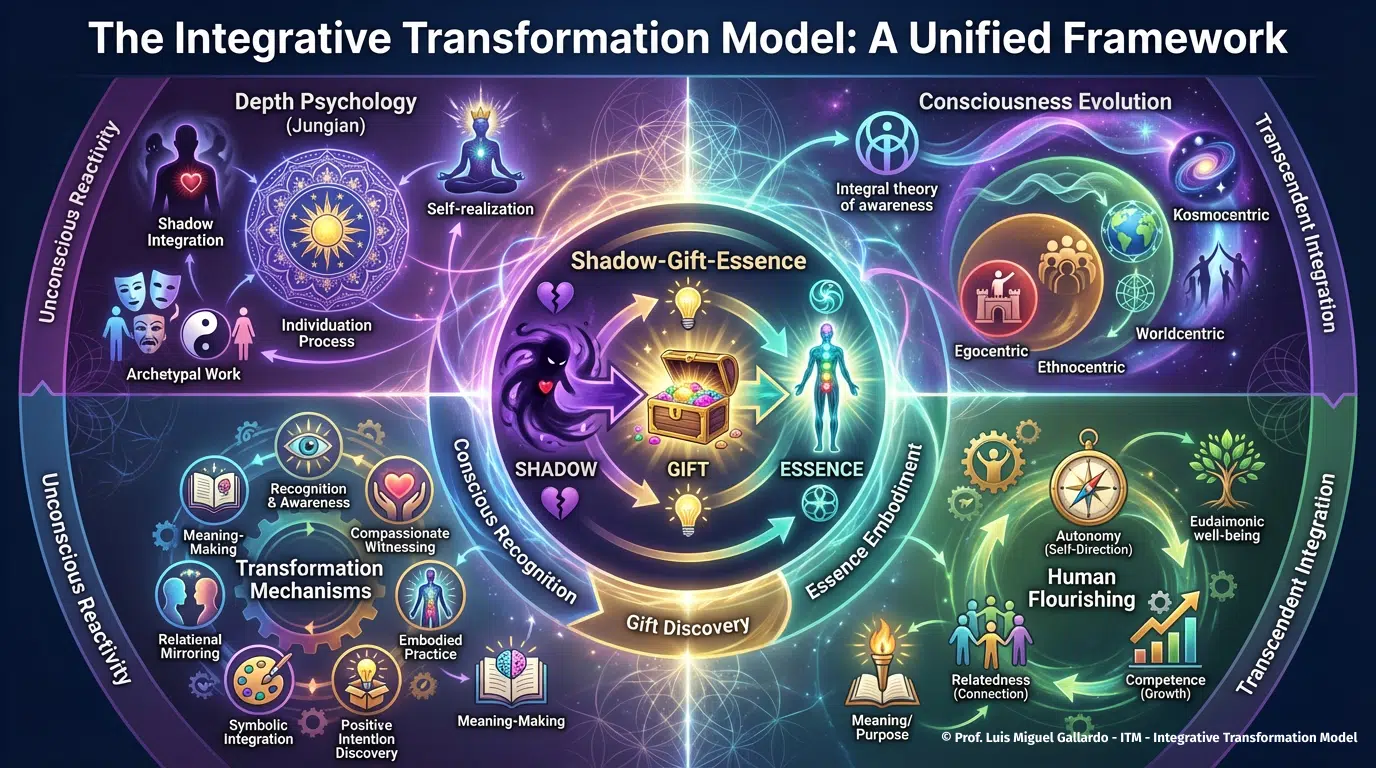
I wrote the Integrative Transformation Model (ITM) to bridge Jungian individuation, my Shadow–Gift–Essence (S‑G‑E) methodology, contemporary consciousness-development frameworks, and human flourishing research into a practical developmental map for leaders and changemakers. [1] In this report, I examine Stanislav Grof’s foundational contributions to research on non-ordinary states of consciousness—especially his cartography of the psyche (biographical, perinatal, transpersonal), holotropic states, COEX systems, Basic Perinatal Matrices (BPM I–IV), and spiritual emergency—and I translate their most defensible insights into concrete, safety-forward applications inside ITM-based leadership development. [2]
The central integration I propose is this: Grof offers a high-resolution depth map of how transformative experiences can reorganize meaning, identity, and somatic-emotional patterning—while ITM offers a developmental staging and mechanism framework for turning difficult material into integrated capacities (Gift) and stable qualities of being (Essence). [3] I treat Grof’s strongest leadership-relevant contribution as a disciplined way to work with non-ordinary states as “accelerators” of shadow integration—provided the setting, screening, and integration practices are ethically and clinically responsible. [4]
On evidence: the peer‑reviewed empirical base for holotropic breathwork specifically remains modest—mostly observational, quasi-experimental, and non-placebo-controlled—yet it is no longer “absent.” Studies suggest changes in self-awareness and certain psychological measures after repeated sessions, and careful phenomenological work supports that the practice can induce measurable altered-state profiles. [5] More recent breathwork science (broader “high-ventilation breathwork” literature) strengthens the physiological plausibility: hyperventilation reliably perturbs CO₂/O₂ balance, autonomic activation, and cerebral perfusion, which correlates with altered-state intensity in controlled research. [6] The clearest scientific critique of Grof’s most controversial claims centers on literal interpretations of perinatal memory: mainstream autobiographical-memory research consistently finds “infantile/childhood amnesia” for episodic recall before ~3–4 years, which creates tension with strong readings of “birth memory as explicit recall.” [7] At the same time, modern work on latent early-life memory traces and implicit influence keeps open a narrower possibility: very early experiences can shape later affective and behavioral patterns even when they cannot be narratively remembered. [8]
Practically, I propose a three-tier integration architecture for leaders:
Several operational parameters required for real-world implementation are UNSPECIFIED in the prompt (e.g., program duration, participant selection criteria, jurisdictional legal requirements, whether sessions occur in workplaces vs. retreats, whether clinicians are embedded, and what credentialing system is used). I therefore present modular designs that can be configured without assuming these variables.
I treated my ITM sources as canonical: the World Happiness Foundation[12] blog article introducing ITM for leaders/changemakers and the January 2026 ITM PDF (Integrating Shadow and Essence). [1] For Grof’s side, I prioritized (a) Grof primary texts and primary PDFs hosted on Stan Grof’s site, (b) official holotropic resources including “Principles of Holotropic Breathwork” and ethics agreements, and (c) GROF® Legacy Project[13] safety materials (medical form/contraindications). [14]
For peer-reviewed research, I prioritized open-access sources on: (1) holotropic breathwork outcomes and phenomenology, (2) high-ventilation breathwork mechanisms/physiology, (3) spiritual emergency and the DSM “Religious or Spiritual Problem” category, and (4) infantile amnesia and early autobiographical memory development. [15] When key sources were paywalled, I used available open-access versions (e.g., author-posted PDFs) and noted paywall status in References where relevant.
Grof’s work spans early psychopharmacology and LSD psychotherapy, the emergence of transpersonal psychology, and the development of holotropic breathwork as a non-drug method for inducing “holotropic” (toward-wholeness) states. A key throughline is his claim that non-ordinary states mobilize an intrinsic “inner healer” (inner healing intelligence) that can guide psychological reorganization when supported in a safe setting. [16]
| Year | Work or milestone | Why it is seminal in Grof’s system | Relevance for ITM integration |
| 1958–1964 | Early scientific publications and psychedelic/psychopharmacology work (publication list) | Establishes Grof’s early clinical-research orientation and long arc into non-ordinary states | Grounds ITM integration in “methods matter”: rigorous framing, not only spirituality [17] |
| 1970 | Peer-reviewed LSD psychotherapy paper (JAMA) | Documents psychedelic psychotherapy methods in mainstream medical literature with Grof as coauthor | Historical precedent for carefully structured set/setting + integration protocols [18] |
| 1973 | LSD-assisted psychotherapy in terminal cancer (peer-reviewed) | Extends psychedelic therapy into existential/thanatology domain | Links to ITM meaning-making, mortality salience, leadership purpose work [19] |
| 1975 | Realms of the Human Unconscious[20] | Introduces observations from LSD research and seeds the expanded cartography | Early articulation of multi-level psyche framing that later maps well to ITM shadow-work tiers [21] |
| 1980 | LSD Psychotherapy[22] | Systematizes psychedelic psychotherapy technique and theory from decades of work | Offers template for “non-ordinary-state facilitation as container + integration” (transpose into ITM practices) [23] |
| 1985 | Beyond the Brain[24] | Consolidates the biographical–perinatal–transpersonal cartography and challenges reductionism | Gives ITM a depth-psychology-compatible “expanded psyche” lens but intensifies epistemic tensions with mainstream science [25] |
| 1988 | The Adventure of Self-Discovery[26] | Elaborates experiential psychotherapy and consciousness dimensions; often cited as a core synthesis | Bridges Grofian experiential work with the ITM mechanisms emphasis on embodiment and symbolic engagement [27] |
| 1989 | Spiritual Emergency[28] | Frames spiritual crisis as potentially developmental rather than purely pathological | Offers ITM leaders a robust “crisis-to-growth” framing, but demands strong risk triage and referral pathways [29] |
| 1992 | The Holotropic Mind[30] | Popularizes the “three-level” model of consciousness for broader audiences | Useful translation layer for leadership audiences, but includes claims that require careful epistemic hygiene [31] |
| 1998 | The Cosmic Game[32] | Advances metaphysical framing of transpersonal experiences | Can support ITM “meaning integration” for spiritual leaders; also a high-risk area for overclaiming in secular contexts [33] |
| 2000 | Psychology of the Future[34] | Mature statement of Grof’s cartography and therapeutic strategy; widely cited | Most useful “capstone” framework for mapping into ITM stages and mechanisms [35] |
| 2006 | When the Impossible Happens[36] (plus The Ultimate Journey) | Expands into anomalous experiences and death/transcendence | Leadership integration possible but high tension with evidence standards in many organizations [37] |
| 2010 | Holotropic Breathwork[38] | Definitive overview of the method and integration practices (music, bodywork, mandalas, sharing) | Most direct “how-to” bridge for ITM programs; must be paired with screening/ethics frameworks [39] |
| 2019 | The Way of the Psychonaut[40] | Encyclopedic mapping of inner experiences; synthesizes decades of work | Rich resource for ITM symbolic engagement and meaning-making; risk of overwhelm and non-falsifiable claims [41] |
Note on completeness: Grof’s published output is far larger than this table; I used his official publications list to avoid implying this is exhaustive. [17]
Grof argues that standard psychology’s focus on postnatal biography is insufficient to account for experiences observed in “holotropic states” (deep non-ordinary states). He proposes an expanded cartography with three key domains: (1) biographical/recollective material, (2) a perinatal domain related to the trauma of biological birth, and (3) a transpersonal domain in which identity can expand beyond ordinary boundaries of time, space, and the embodied ego. [42]
Within this model, Grof introduces COEX systems (systems of condensed experience) as organizing structures: clusters of emotionally charged memories across life periods that share a central theme and can shape perception, symptoms, and behavior. [43] He explicitly links COEX systems to deeper roots: he describes them as anchored in perinatal dynamics and (in his model) sometimes extending into transpersonal motifs. [44]
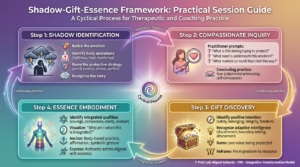
My ITM translation: COEX systems function like an experiential “shadow network” generating repeatable reactivity loops—exactly the kind of pattern ITM targets in Stage 1–3 movement (reactivity → recognition → gift discovery). The added value is depth: COEX offers a concrete hypothesis for why recurring leadership triggers feel disproportionate and “older than the story.” [45]
Grof describes four “Basic Perinatal Matrices” (BPM I–IV) as dynamic constellations associated with biological birth that recur in holotropic experiences and can function as organizing principles for material from other levels (biographical and transpersonal). [46] In his 2000 synthesis, he characterizes BPM I as “primal union”/amniotic universe, BPM II as “no exit”/cosmic engulfment/hell, BPM III as the death-rebirth struggle (including intense energies, aggression, and transformative ordeal), and BPM IV as the death-rebirth experience (emergence and resolution). [47]
What I treat as high-confidence vs. low-confidence here:
– High-confidence: as a phenomenological map, BPMs describe recurring experiential patterns in non-ordinary states, and these patterns often mirror universal human themes (constriction, struggle, liberation). [48]
– Low-confidence: as literal episodic memory. Grof’s framing can be interpreted as implying access to birth events as memory. Mainstream memory research strongly supports infantile/childhood amnesia for explicit autobiographical recall before ~3–4 years, making literal “birth memory = episodic recall” scientifically implausible in a straightforward sense. [49]
A tighter reconciliation sometimes proposed in contemporary memory science is that early experiences can persist as implicit, non-declarative influence even if they are not narratively accessible; reviews and animal work show mechanisms for latent traces and later reinstatement under some conditions. [8] That supports a restrained ITM-friendly reading: “perinatal” content may be symbolic encoding or implicit pattern traces rather than literal replay.
Grof’s transpersonal domain includes experiences of identification beyond the individual self (e.g., archetypal imagery, mythic motifs, unity experiences). He holds that these experiences are widespread across cultures and history and are a major source of spiritual cosmologies and ritual technologies. [50] He also argues that psychiatry often misclassifies spontaneous holotropic episodes as pathology, rather than differentiating developmental spiritual states from disorders. [51]
My ITM translation: ITM Stage 5 (“Essence‑Embodied/Transpersonal” in the PDF; “Transcendent Integration” in the blog version) parallels Grof’s claim that identity can reorganize toward a broader-than-ego center—yet ITM adds a critical constraint: development is “transcend-and-include,” not bypassing. [52] This is a leadership-critical safeguard against spiritual bypassing (seeking transpersonal states to avoid shadow integration).
In Grof’s framework, some crises involving non-ordinary experiences are not simply illnesses but “spiritual emergencies”—difficult stages of transformation that can resolve with appropriate support and lead to healing and growth. Grof articulates this directly in his core synthesis. [53]
A key peer-reviewed bridge to mainstream psychiatry is the DSM category “Religious or Spiritual Problem” (V62.89 in DSM‑IV), which acknowledges that distressing spiritual experiences can be the focus of clinical attention without being a mental disorder. [54] In a clinical paper, David Lukoff[55] (2007) emphasizes diagnostic differentiation based on factors such as duration, controllability, functional impairment, and whether the episode resolves without residual deterioration—rather than mere spiritual content. [56]
Leadership translation: organizations routinely mis-handle “transformational crises” (burnout collapse, existential disorientation, moral injury, identity unraveling). Grof + Lukoff provide a vocabulary for non-pathologizing support and a triage frame for when leaders must be referred to clinical care.
Grof’s two signature “psyche-activating” approaches are:
LSD psychotherapy (historical): Grof participated in and helped shape LSD-assisted psychotherapy in the mid‑20th century research era, documenting methods in peer-reviewed outlets and later in his book LSD Psychotherapy. [57] In leadership development contexts today, LSD therapy is generally outside the scope of conventional workplace programs and is jurisdiction-dependent; I include it primarily for historical and theoretical context, not as an implementation recommendation. [58]
Holotropic breathwork (HB): developed as a non-drug method to induce holotropic states using accelerated/deeper breathing, evocative music, focused bodywork, creative expression (mandalas), and sharing. [59] The Principles document is explicit that the unfolding is “entirely internal,” largely nonverbal, and that facilitators avoid imposing interpretations from intellectual analysis; it also stresses screening for contraindications and ethical awareness of projection dynamics in non-ordinary states. [60]
A historically notable contextual detail is that holotropic breathwork was developed at Esalen Institute[61] in mid‑1970s California, linking the method to the human potential movement’s experiential-psychotherapy wave. [62]
Evidence base for holotropic breathwork outcomes
The best available peer-reviewed studies remain limited in size and design strength, but they provide signal-level findings:
What this supports for ITM: I treat these findings as justification for (a) including breathwork as an optional adjunct in developmental programs, and (b) building evaluation and safeguard infrastructure, because the promise is real but the certainty is not.
Physiology and mechanism evidence from the broader breathwork literature
A major open-access overview of high-ventilation breathwork (HVB), Guy W. Fincham[72] et al. (2023), consolidates the known physiology (hypocapnia, alkalosis, cerebral blood flow effects, autonomic shifts) and emphasizes both potential clinical applications and safety considerations—especially for individuals with comorbidities and when practices are performed without monitoring. [73]
More recent controlled mechanistic work by Amy Amla Kartar[74] et al. (2025) links the intensity of altered states induced by HVB (with music) to sympathetic activation and cerebral perfusion changes in regions associated with interoception and emotional memory processing (including insula-related and amygdala/hippocampal clusters). [75] This strengthens one of the most leadership-relevant plausibility claims: breathwork can reliably perturb interoceptive/emotional-memory systems such that psychological material becomes more available for processing—without assuming any particular metaphysical interpretation.
Infantile amnesia and perinatal claims
Mainstream developmental and cognitive neuroscience consistently finds that adults’ earliest autobiographical memories cluster around 3–4 years of age, with a sparse distribution before that (childhood amnesia). [76] Mechanistic reviews frame infantile amnesia as a developmental phenomenon tied to brain maturation, encoding/retrieval transformations, and the evolving architecture of memory systems. [77] A concise review emphasizes that “forgotten” early memories may nonetheless leave traces that can influence later behavior; this supports the possibility of early experience shaping later patterns without implying literal episodic recall. [78]
My stance for ITM: I treat BPM language as a powerful symbolic/phenomenological map for working with “constriction → struggle → release” dynamics in leaders, not as a claim that leaders will literally retrieve accurate birth events. If a program invites perinatal interpretations, it must explicitly warn about memory fallibility and avoid suggestive framing.
Empirical limitations and methodological critiques
Across HB studies, common limitations include small samples, lack of randomization, self-selection of participants motivated for breathwork, inadequate control conditions (e.g., expectancy/placebo), attrition in follow-ups, and reliance on self-report outcomes. [79] Fincham et al. (2023) similarly highlight a need for rigorous clinical testing and careful delineation of safety profiles for high-ventilation practices. [73]
Safety critiques
Physiologically, accelerated/deep breathing can drive hypocapnia and alkalosis and alter cerebral blood flow; these mechanisms can be part of the altered-state pathway but also imply risk for vulnerable individuals. [80] This is why official Grof-related programs stress screening and contraindications. [81]
Epistemic critiques of transpersonal claims
Grof’s work includes claims that extend beyond what mainstream psychological science can adjudicate (e.g., certain paranormal or metaphysical interpretations). [82] In ITM-based leadership settings—especially pluralistic or secular environments—I treat these as optional meaning frames rather than program assumptions, and I recommend an explicit “multiple-interpretation policy” during integration: experiences can be held psychologically, symbolically, culturally, and spiritually without premature literalization.
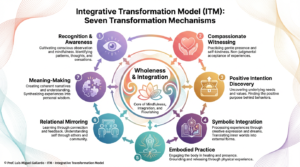
From my canonical ITM sources, the relevant components include:
Correspondences (direct alignments)
– COEX ↔ ITM Shadow patterns: recurring emotional themes across life periods map cleanly to “shadow triggers” that generate reactive leadership behavior; COEX gives a depth-structure hypothesis for patterned reactivity and projection. [45]
– “Inner healer” ↔ ITM Essence intelligence: Grof’s principle that non-ordinary states mobilize intrinsic healing forces parallels my ITM thesis that Essence is not manufactured but revealed as defenses dissolve and needs are met. [85]
– Holotropic states ↔ ITM symbolic + somatic engagement: Grof’s emphasis on nonverbal, embodied, imagistic work closely matches ITM mechanisms that require symbolic language and somatic integration, not cognition alone. [86]
– Spiritual emergency ↔ ITM “developmental challenge” framing: both approaches treat certain crises as potentially developmental; Grof provides diagnostic differentiation tools and cautions about mislabeling. [87]
Complementarities (what Grof adds to ITM, and what ITM adds to Grof)
– Grof adds depth range: perinatal/transpersonal content and the mapping of intense affective states to archetypal patterns offers language for “why the shadow feels existential.” [88]
– ITM adds developmental staging and accountability: it prevents “peak experience inflation” (leaders chasing breakthroughs) by grounding growth in stage-appropriate mechanisms and action that satisfies needs (autonomy/competence/relatedness/meaning). [89]
– Grof adds container technology (music arc, sitter role, non-interpretive facilitation); ITM adds integration technology (shadow→gift→essence translation into behavior and culture). [90]
Tensions (where I apply constraints or “translation rules”)
– Perinatal memory vs. infantile amnesia: ITM cannot assume literal birth-memory recall; BPM content must be treated as symbolic/phenomenological unless independently corroborated (which is usually not available). [91]
– Epistemic pluralism: Grof’s metaphysical interpretations can alienate secular contexts; ITM must ensure meaning-making is participant-led and culturally sensitive, not facilitator-imposed. [92]
– Risk management: high-ventilation methods carry physiological and psychiatric risks; ITM programs must include screening, contraindications, and referral pathways, not only inspirational framing. [93]
Leadership applications (where this becomes practical)
– Leaders commonly operate from “Persona‑Identified” or “Shadow‑Aware” stages; Grofian methods (used carefully) can accelerate movement by surfacing implicit emotional material and reorganizing meaning around service, ethics, and belonging. [94]
– Non-ordinary states can be leveraged ethically for leadership development only when coupled with post-session integration into decisions, relationships, and culture—otherwise they risk becoming private peak experiences with minimal organizational benefit. [95]
| ITM element (canonical) | Grof concept(s) that correspond | Complementarity (value-add) | Tension/risk to manage | Practical leadership application |
| Shadow (S‑G‑E) | COEX systems; biographical material becoming activated in holotropic states | Explains patterned triggers as organized constellations, not isolated “issues” | Risk of over‑pathologizing or over‑historicizing normal stress responses | “Trigger → theme → COEX map” to reduce projection in teams [45] |
| Gift (S‑G‑E) | “Inner healer” guiding the process; symptom-as-signal framing in experiential work | Shifts from control to curiosity; supports leader humility and learning orientation | Risk of passivity (“the process will do it”) without accountability | Gift extraction protocols: What did this reaction protect? What value is hidden? [90] |
| Essence (S‑G‑E) | Holotropic wholeness orientation; transpersonal states; unity/meaning experiences | Helps stabilize values-based leadership and purpose | Risk of bypassing shadow or privileging spiritual narratives | “Essence translation”: convert insight into behaviors aligned with autonomy/relatedness/meaning [96] |
| Developmental stages | Grof’s idea of consciousness evolution through holotropic processes | Provides intensity-based accelerator for stage transitions | Danger of “stage skipping” via peak experiences | Use ITM stage check-ins and staged practices; match intensity to stage readiness [97] |
| Compassionate awareness | Non-judgmental observation; non-interpretive facilitation stance | Reinforces psychological safety and reduces shame | Facilitator power dynamics and projection risk | Train leaders in witnessing/containment before any deep methods [60] |
| Symbolic engagement | Mandalas; imagery; archetypal material in holotropic states | Accelerates meaning-making and integration | Cultural appropriation or forced archetypal interpretations | Symbol practice with “multiple valid interpretations” policy [86] |
| Somatic integration | Bodywork; physiological arousal as gateway | Helps leaders embody change, not only understand it | Hyperventilation risks; contraindications | Somatic tracking + titrated breath practices; avoid HVB unless fully screened [98] |
| Relational mirroring | Sitter role; group container; sharing circles | Creates accountability and community integration | Boundary violations; confidentiality | Use formal agreements, confidentiality limits, referral pathways [99] |
| Meaning-making | Death–rebirth motifs; existential reframing | Supports resilient, ethical decision-making | Spiritual inflation or certainty illusions | Translating experience into mission, ethics, stakeholder care [100] |
Table basis: ITM components drawn from my canonical ITM sources; Grof concepts drawn from Grof’s cartography synthesis and official holotropic principles/ethics materials. [101]
Program duration: UNSPECIFIED
Participant selection criteria: UNSPECIFIED
Delivery context (workplace, retreat, clinical setting): UNSPECIFIED
Jurisdictional legal requirements: UNSPECIFIED
Because these are UNSPECIFIED, I present modular designs that can be “snapped together” and governed by tier-specific screening and referral rules. Across all tiers, I recommend adopting Grof-and-Grof process principles where appropriate: strong preparation, a safe container, participant-led unfolding, and integration without imposed interpretation. [102]
These practices are designed to be low-risk, broadly applicable, and suitable for leadership cohorts without inducing intense altered states. They primarily operationalize Grof’s concepts through ITM mechanisms: compassionate awareness, emotional inquiry, symbolic engagement, relational mirroring, and meaning-making. [103]
Goal: Convert “reactive moments” into organized thematic insight and Gift extraction.
Session outline (60–90 minutes; duration UNSPECIFIED):
1) ITM stage check-in: “Where am I on the five-stage arc today?” (self-assessment) [104]
2) Trigger capture: identify one recent leadership trigger (meeting, email, feedback, crisis).
3) COEX clustering: list at least 3 earlier memories that share the same emotional quality or bodily sensation; name the theme (e.g., humiliation, suffocation, abandonment). [43]
4) Gift discovery: ask “What was this pattern trying to protect or secure?” (competence, autonomy, belonging, meaning). [105]
5) Essence translation: identify the integrated leadership capacity (e.g., calm authority, discernment, courageous vulnerability) and one behavior to practice in the next week. [104]
6) Relational mirroring: share in pairs with a confidentiality agreement and non-interpretive listening.
Screening/contraindications: minimal; however, participants currently reporting acute psychiatric instability or active crisis should be referred to professional support rather than asked to deepen trauma work (UNSPECIFIED clinical governance). This aligns with Grof legacy screening priorities even when no breathwork is used. [106]
Grofian practice includes mandala drawing and group sharing as integration supports. [107] I adapt this as a leadership-safe symbolic engagement exercise:
Session outline (45–75 minutes):
1) Guided “arriving” (mindfulness/compassionate awareness). [108]
2) Draw a mandala representing the current shadow theme + its potential gift + the essence quality already present. [102]
3) Three prompts: “What is the image protecting?” “What does it want me to know?” “What commitment does it ask of me as a leader?”
4) Share without interpretation; the group asks clarifying questions, mirroring Grof’s non-impositional stance. [102]
Ethics: do not “diagnose” or claim therapy. Maintain confidentiality policies consistent with local law (UNSPECIFIED jurisdiction) and establish boundaries that prevent role confusion. [109]
This tier uses breath intentionally but aims at regulation, emotional access, and integration rather than deliberate high-ventilation altered-state induction. The rationale is evidence-based caution: HVB can induce powerful effects and also carries risk; Fincham et al. (2023) emphasize safety considerations and the need for monitoring, especially for those with comorbidities. [73]
Goal: evoke enough arousal and interoceptive clarity to work with shadow activations without pushing into extremes.
Session outline (75–120 minutes):
1) Preparation: intention framed in ITM terms (shadow pattern → gift hypothesis → desired essence). [84]
2) Breathing practice: moderate, steady breath rhythm (no forced hyperventilation; exact pattern UNSPECIFIED).
3) Music arc: evocative → intensifying → settling, borrowing the Grofian insight that music scaffolds the unfolding, but keeping the overall intensity bounded. [110]
4) Somatic tracking: where in the body does the shadow live? What happens if I soften attention, or amplify sensation slightly? [111]
5) Integration writing: 10 minutes: “What changed in my relationship to the trigger?” “What decision or conversation is now possible?”
6) Closing: orient back to present; hydrate; grounding practice.
Screening/contraindications (minimum): even in moderate breathwork, I recommend using a simplified version of Grof legacy exclusions as a conservative baseline (pregnancy; serious cardiovascular disease; recent surgery/fracture; seizure disorders; acute infectious illness; some psychiatric conditions; active spiritual emergency). [112]
Ethical/legal: participants must receive clear statements that the practice is personal growth and not a substitute for psychotherapy or medical care; this language echoes Grof legacy policy and should be adapted to organizational context and law (UNSPECIFIED). [106]
This tier is an “opt-in deep process.” I only recommend it if the program can satisfy: (a) formal screening and contraindications review, (b) trained facilitation consistent with Grof-and-Grof principles, (c) explicit ethics agreements and boundary protections, (d) emergency procedures, and (e) robust ITM-based integration afterward. [11]
Pre-work (timeframe UNSPECIFIED):
– Written informed consent that describes risks, non-therapy status, and participant responsibility to seek outside support if needed. [113]
– Medical and psychological screening using contraindication categories consistent with Grof legacy programs (cardiovascular disease, hypertension, seizure disorders, recent injuries/surgery, pregnancy, some psychiatric diagnoses, active spiritual emergency). [112]
– Teach the participant/sitter roles and emphasize non-intrusive, responsive support. [102]
Session day (2–3+ hours; duration UNSPECIFIED):
1) Opening circle: agreements, confidentiality boundaries, “multiple interpretations” stance, consent protocols for any touch/bodywork. [60]
2) Breather/sitter pairing: clarify responsibilities, safety signals. [102]
3) Breathing induction: deeper and accelerated breathing; minimal “how to breathe” micromanagement, consistent with Grof principles. [102]
4) Music arc: stimulating → dramatic/dynamic → breakthrough → quiet/meditative, adapted to group energy. [102]
5) Facilitation stance: nonverbal, non-interpretive; intervene only for safety/management, excessive pain/fear threatening continuation, or explicit request. [102]
6) Bodywork/energy release: offered post-peak to support completion, following participant cues and explicit consent, mindful of projection dynamics. [60]
7) Mandala drawing: immediate creative integration. [102]
8) Sharing circle: facilitator avoids imposed interpretation; uses clarification questions; may use Jungian amplification cautiously as optional meaning support. [102]
This is where I believe ITM adds decisive leadership value. I structure integration into “translation layers”:
1) Phenomenology → Shadow: What emotions, sensations, images, or relational patterns emerged as unresolved “shadow activations”? [114]
2) Shadow → Gift: For each activation: what need/value was being protected (autonomy, competence, relatedness, meaning)? [105]
3) Gift → Essence: Identify the stable quality the leader is invited to embody (e.g., courage, compassion, clarity, boundary integrity). [84]
4) Essence → Practice: choose one concrete behavioral commitment in a real leadership arena (a conversation, a policy, a delegation pattern, a conflict repair).
5) Practice → Culture: where does this leader’s shadow show up systemically (team norms, incentives, silence, ethics)? Move from individual insight to collective impact. [115]
References
Gallardo, L. M. (2026, January 25). From Shadow to Essence: The Integrative Transformation Model (ITM) for Leaders and Changemakers. https://worldhappiness.foundation/blog/consciousness/from-shadow-to-essence-the-integrative-transformation-model-itm-for-leaders-and-changemakers/ (Open access). [104]
Gallardo, L. M. (2026, January 25). Integrating Shadow and Essence: A Developmental Model Uniting Jungian Individuation, the S‑G‑E Framework, and Contemporary Research on Consciousness Evolution and Human Flourishing (ITM PDF). https://worldhappiness.foundation/wp-content/uploads/2026/01/integrative_transformation_model_Luis_Miguel_Gallardo.pdf (Open access). [118]
Grof, S. (2000). Psychology of the future: Lessons from modern consciousness research. State University of New York Press[119]. (Paywalled/preview varies). https://utpdistribution.com/9780791446225/psychology-of-the-future/ [120]
Grof, S. (n.d.). Psychology of the Future: Lessons from Modern Consciousness Research (PDF). https://www.stangrof.com/images/joomgallery/ArticlesPDF/Psychology_of_the_Future_Stan_Grof_long.pdf (Open access). [121]
Grof, S. (1975). Realms of the human unconscious: Observations from LSD research. Viking Press. (Paywalled/preview varies). https://books.google.com/books/about/Realms_of_the_Human_Unconscious.html?id=Ll99AAAAMAAJ [21]
Grof, S. (1980). LSD psychotherapy. Hunter House. (Paywalled/preview varies). https://www.ncbi.nlm.nih.gov/nlmcatalog/8100827 [23]
Grof, S. (1985). Beyond the brain: Birth, death, and transcendence in psychotherapy. SUNY Press. (Paywalled/preview varies). https://openlibrary.org/books/OL24745035M/Beyond_the_brain [25]
Grof, S. (1988). The adventure of self-discovery: Dimensions of consciousness and new perspectives in psychotherapy and inner exploration. SUNY Press. (Paywalled/preview varies). https://catalog.nlm.nih.gov/discovery/fulldisplay?docid=alma996315583406676 [122]
Grof, S., & Grof, C. (Eds.). (1989). Spiritual emergency: When personal transformation becomes a crisis. Tarcher. (Paywalled/preview varies). https://www.penguinrandomhouse.com/books/349562/spiritual-emergency-by-stanislav-grof/ [123]
Grof, S. (1992). The holotropic mind: The three levels of human consciousness and how they shape our lives. HarperSanFrancisco. (Paywalled/preview varies). https://openlibrary.org/works/OL14855168W/The_Holotropic_Mind [124]
Grof, S. (1998). The cosmic game: Explorations of the frontiers of human consciousness. SUNY Press. (Paywalled/preview varies). https://books.google.com/books/about/The_Cosmic_Game.html?id=V9z-z6wwaJsC [33]
Grof, S. (2006). When the impossible happens: Adventures in non-ordinary realities. Sounds True / St. Martin’s Essentials. (Paywalled/preview varies). https://us.macmillan.com/books/9781591794202/whentheimpossiblehappens/ [125]
Grof, S., & Grof, C. (2010). Holotropic breathwork: A new approach to self-exploration and therapy. SUNY Press. (Paywalled/preview varies). https://books.google.com/books/about/Holotropic_Breathwork.html?id=L9aLxAEACAAJ [126]
Grof, S. (2019). The way of the psychonaut: Encyclopedia for inner journeys (Vols. 1–2). MAPS / Synergetic Press (editions vary). (Paywalled/preview varies). https://maps.org/news/bulletin/the-way-of-the-psychonaut-encyclopedia-for-inner-journeys-2/ [127]
Grof, S., & Grof, C. (1990). Principles of Holotropic Breathwork (PDF). https://www.holotropic.com/wp-content/uploads/2017/12/Principles-of-Holotropic-Breathwork.pdf (Open access). [102]
Holotropic Breathwork practitioners community. (n.d.). Ethical Agreements of Holotropic Breathwork Practitioners (PDF). https://www.holotropic.com/wp-content/uploads/2020/05/Ethical-agreements.pdf (Open access). [116]
GROF® Legacy Project. (n.d.). Medical Form and health considerations (webpage). https://groflegacyproject.org/programs/medical-form/ (Open access). [106]
Fincham, G. W., Kartar, A., Uthaug, M. V., Anderson, B., Hall, L., Nagai, Y., Critchley, H., & Colasanti, A. (2023). High ventilation breathwork practices: An overview of their effects, mechanisms, and considerations for clinical applications. Neuroscience & Biobehavioral Reviews, 155, 105453. https://doi.org/10.1016/j.neubiorev.2023.105453 (Open access). [73]
Kartar, A. A., Horinouchi, T., Örzsik, B., Anderson, B., Hall, L., Bailey, D., Samuel, S., Beltran, N., Bouyagoub, S., Racey, C., Nagai, Y., Asllani, I., Critchley, H., & Colasanti, A. (2025). Neurobiological substrates of altered states of consciousness induced by high ventilation breathwork accompanied by music. PLOS ONE, 20(8), e0329411. https://doi.org/10.1371/journal.pone.0329411 (Open access). [75]
Holmes, S. W., Morris, R., Clance, P. R., & Putney, R. T. (1996). Holotropic breathwork: An experiential approach to psychotherapy. Psychotherapy: Theory, Research, Practice, Training, 33(1), 114–120. (Open access copy). https://paulineroseclance.com/pdf/PR/holotropicbreathwork.pdf [64]
Miller, T., & Nielsen, L. (2015). Measure of significance of holotropic breathwork in the development of self-awareness. Journal of Alternative and Complementary Medicine, 21(12), 796–803. (Open access). https://pmc.ncbi.nlm.nih.gov/articles/PMC4677109/ [67]
Rhinewine, J. P., & Williams, O. J. (2007). Holotropic breathwork: The potential role of a prolonged, voluntary hyperventilation procedure as an adjunct to psychotherapy. Journal of Alternative and Complementary Medicine, 13(7), 771–776. https://doi.org/10.1089/acm.2006.6203 (Paywalled on publisher site; open PDF copies exist). https://pubmed.ncbi.nlm.nih.gov/17931070/ [128]
Rock, A. J., Denning, N. C., Harris, K. P., Clark, G. I., & Misso, D. (2015). Exploring holotropic breathwork: An empirical evaluation of altered states of awareness and patterns of phenomenological subsystems with reference to transliminality. Journal of Transpersonal Psychology, 47(1). (Open access PDF). https://www.atpweb.org/jtparchive/trps-47-15-01-3.pdf [69]
Uthaug, M. V., Mason, N. L., Havenith, M. N., Vancura, M., & Ramaekers, J. G. (2021). An experience with holotropic breathwork is associated with improvement in non-judgement and satisfaction with life while reducing symptoms of stress in a Czech-speaking population. Journal of Psychedelic Studies, 5(3), 176–189. https://doi.org/10.1556/2054.2021.00193 (PDF accessible). [71]
Lukoff, D. (2007). Visionary spiritual experiences. Southern Medical Journal, 100(6), 635–641. (Open access PDF). https://www.spiritualcompetency.com/pdfs/smjvision.pdf [56]
Lukoff, D. (1998). The transpersonal roots of the new DSM-IV category. (Paywalled). https://journals.sagepub.com/doi/10.1177/00221678980382003 [129]
Bauer, P. J., & colleagues. (2013). The onset of childhood amnesia in childhood: A prospective investigation. (Open access article). https://pmc.ncbi.nlm.nih.gov/articles/PMC4025992/ [76]
Alberini, C. M., & colleagues. (2017). Infantile amnesia: A critical period of learning to learn and remember. (Open access article). https://pmc.ncbi.nlm.nih.gov/articles/PMC5473198/ [130]
Li, S., & colleagues. (2014). Infantile amnesia: Forgotten but not gone. (Open-access PDF copy). https://sanlab.psych.ucla.edu/wp-content/uploads/sites/215/2019/07/Li_2014_infantile_amnesia.pdf [131]
Bache, C. M. (1996). Expanding Grof’s concept of the perinatal. (Open access PDF copy). https://archive.galileocommission.org/wp-content/uploads/2018/10/Expanding-Grofs-concept-of-the-perinatal.pdf [132]
[1] [61] [66] [70] [83] [84] [101] [104] [114] https://worldhappiness.foundation/blog/consciousness/from-shadow-to-essence-the-integrative-transformation-model-itm-for-leaders-and-changemakers/
[2] [3] [9] [13] [14] [16] [32] [42] [43] [44] [45] [46] [47] [48] [50] [51] [53] [55] [63] [82] [88] [100] [117] [121] https://www.stangrof.com/images/joomgallery/ArticlesPDF/Psychology_of_the_Future_Stan_Grof_long.pdf
https://www.stangrof.com/images/joomgallery/ArticlesPDF/Psychology_of_the_Future_Stan_Grof_long.pdf
[4] [11] [12] [28] [59] [60] [81] [85] [86] [90] [92] [102] [107] [110] https://www.holotropic.com/wp-content/uploads/2017/12/Principles-of-Holotropic-Breathwork.pdf
https://www.holotropic.com/wp-content/uploads/2017/12/Principles-of-Holotropic-Breathwork.pdf
[5] [15] [20] [67] [79] https://pmc.ncbi.nlm.nih.gov/articles/PMC4677109/
https://pmc.ncbi.nlm.nih.gov/articles/PMC4677109
[6] [10] [73] [80] [93] [98] https://storage.prod.researchhub.com/uploads/papers/2024/09/20/1-s2.0-S0149763423004220-main_2.pdf
https://storage.prod.researchhub.com/uploads/papers/2024/09/20/1-s2.0-S0149763423004220-main_2.pdf
[7] [49] [76] [91] https://pmc.ncbi.nlm.nih.gov/articles/PMC4025992/
https://pmc.ncbi.nlm.nih.gov/articles/PMC4025992
[8] [26] [34] [77] [130] https://pmc.ncbi.nlm.nih.gov/articles/PMC5473198/
https://pmc.ncbi.nlm.nih.gov/articles/PMC5473198
[17] https://www.stangrof.com/images/joomgallery/ArticlesPDF/List_of_Publications_rev.pdf
https://www.stangrof.com/images/joomgallery/ArticlesPDF/List_of_Publications_rev.pdf
[18] [57] https://pubmed.ncbi.nlm.nih.gov/5467681/
https://pubmed.ncbi.nlm.nih.gov/5467681
[19] https://pubmed.ncbi.nlm.nih.gov/4140164/
https://pubmed.ncbi.nlm.nih.gov/4140164
[21] https://books.google.com/books/about/Realms_of_the_Human_Unconscious.html?id=Ll99AAAAMAAJ
https://books.google.com/books/about/Realms_of_the_Human_Unconscious.html?id=Ll99AAAAMAAJ
[22] [35] [38] [74] [120] https://utpdistribution.com/9780791446225/psychology-of-the-future/
https://utpdistribution.com/9780791446225/psychology-of-the-future
[23] [30] https://www.ncbi.nlm.nih.gov/nlmcatalog/8100827
https://www.ncbi.nlm.nih.gov/nlmcatalog/8100827
[24] [27] [122] https://catalog.nlm.nih.gov/discovery/fulldisplay?adaptor=Local+Search+Engine&context=L&docid=alma996315583406676&lang=en&mode=advanced&offset=40&query=lds56%2Ccontains%2CSelf+Concept%2CAND&tab=LibraryCatalog&vid=01NLM_INST%3A01NLM_INST
[25] [68] https://openlibrary.org/books/OL24745035M/Beyond_the_brain
https://openlibrary.org/books/OL24745035M/Beyond_the_brain
[29] [123] https://www.penguinrandomhouse.com/books/349562/spiritual-emergency-by-stanislav-grof/
https://www.penguinrandomhouse.com/books/349562/spiritual-emergency-by-stanislav-grof
[31] [124] https://openlibrary.org/works/OL14855168W/The_Holotropic_Mind
https://openlibrary.org/works/OL14855168W/The_Holotropic_Mind
[33] https://books.google.com/books/about/The_Cosmic_Game.html?id=V9z-z6wwaJsC
https://books.google.com/books/about/The_Cosmic_Game.html?id=V9z-z6wwaJsC
[36] [69] https://www.atpweb.org/jtparchive/trps-47-15-01-3.pdf
https://www.atpweb.org/jtparchive/trps-47-15-01-3.pdf
[37] [125] https://us.macmillan.com/books/9781591794202/whentheimpossiblehappens/
https://us.macmillan.com/books/9781591794202/whentheimpossiblehappens
[39] [126] https://books.google.com/books/about/Holotropic_Breathwork.html?id=L9aLxAEACAAJ
https://books.google.com/books/about/Holotropic_Breathwork.html?id=L9aLxAEACAAJ
[40] [75] https://journals.plos.org/plosone/article/file?id=10.1371%2Fjournal.pone.0329411&type=printable
https://journals.plos.org/plosone/article/file?id=10.1371%2Fjournal.pone.0329411&type=printable
[41] [127] https://maps.org/news/bulletin/the-way-of-the-psychonaut-encyclopedia-for-inner-journeys-2/
[52] [89] [94] [95] [96] [97] [103] [105] [108] [111] [115] [118] https://worldhappiness.foundation/wp-content/uploads/2026/01/integrative_transformation_model_Luis_Miguel_Gallardo.pdf
[54] [129] https://journals.sagepub.com/doi/10.1177/00221678980382003
https://journals.sagepub.com/doi/10.1177/00221678980382003
[56] [87] https://www.spiritualcompetency.com/pdfs/smjvision.pdf
https://www.spiritualcompetency.com/pdfs/smjvision.pdf
[58] https://www.sciencedirect.com/science/article/pii/S002839081730638X
https://www.sciencedirect.com/science/article/pii/S002839081730638X
[62] https://www.transpersonaljournal.com/pdf/vol6-issue1/Stanislav%20Grof.pdf
https://www.transpersonaljournal.com/pdf/vol6-issue1/Stanislav%20Grof.pdf
[64] [72] https://paulineroseclance.com/pdf/PR/holotropicbreathwork.pdf
https://paulineroseclance.com/pdf/PR/holotropicbreathwork.pdf
[65] [99] [109] [116] https://www.holotropic.com/wp-content/uploads/2020/05/Ethical-agreements.pdf
https://www.holotropic.com/wp-content/uploads/2020/05/Ethical-agreements.pdf
[71] https://storage.prod.researchhub.com/uploads/papers/2023/07/05/article-p176.pdf
https://storage.prod.researchhub.com/uploads/papers/2023/07/05/article-p176.pdf
[78] [131] https://sanlab.psych.ucla.edu/wp-content/uploads/sites/215/2019/07/Li_2014_infantile_amnesia.pdf
https://sanlab.psych.ucla.edu/wp-content/uploads/sites/215/2019/07/Li_2014_infantile_amnesia.pdf
[106] [112] [113] [119] https://groflegacyproject.org/programs/medical-form/
[128] https://pubmed.ncbi.nlm.nih.gov/17931070/
https://pubmed.ncbi.nlm.nih.gov/17931070
[132] https://archive.galileocommission.org/wp-content/uploads/2018/10/Expanding-Grofs-concept-of-the-perinatal.pdfhttps://archive.galileocommission.org/wp-content/uploads/2018/10/Expanding-Grofs-concept-of-the-perinatal.pdf
Why the Deepest Meaning in Your Life Is Already Inside
Executive summary In my Integrative Transformation Model (ITM), I explicitly

I want to tell you about a conversation that changed