
THE ROAD MAP TO SUPRACONSCIOUSNESS: From the Diagnosis of a World in Crisis to the Conscious Evolution of Humanity
A Framework for Systemic Transformation Through the Wisdom of Hawkins,
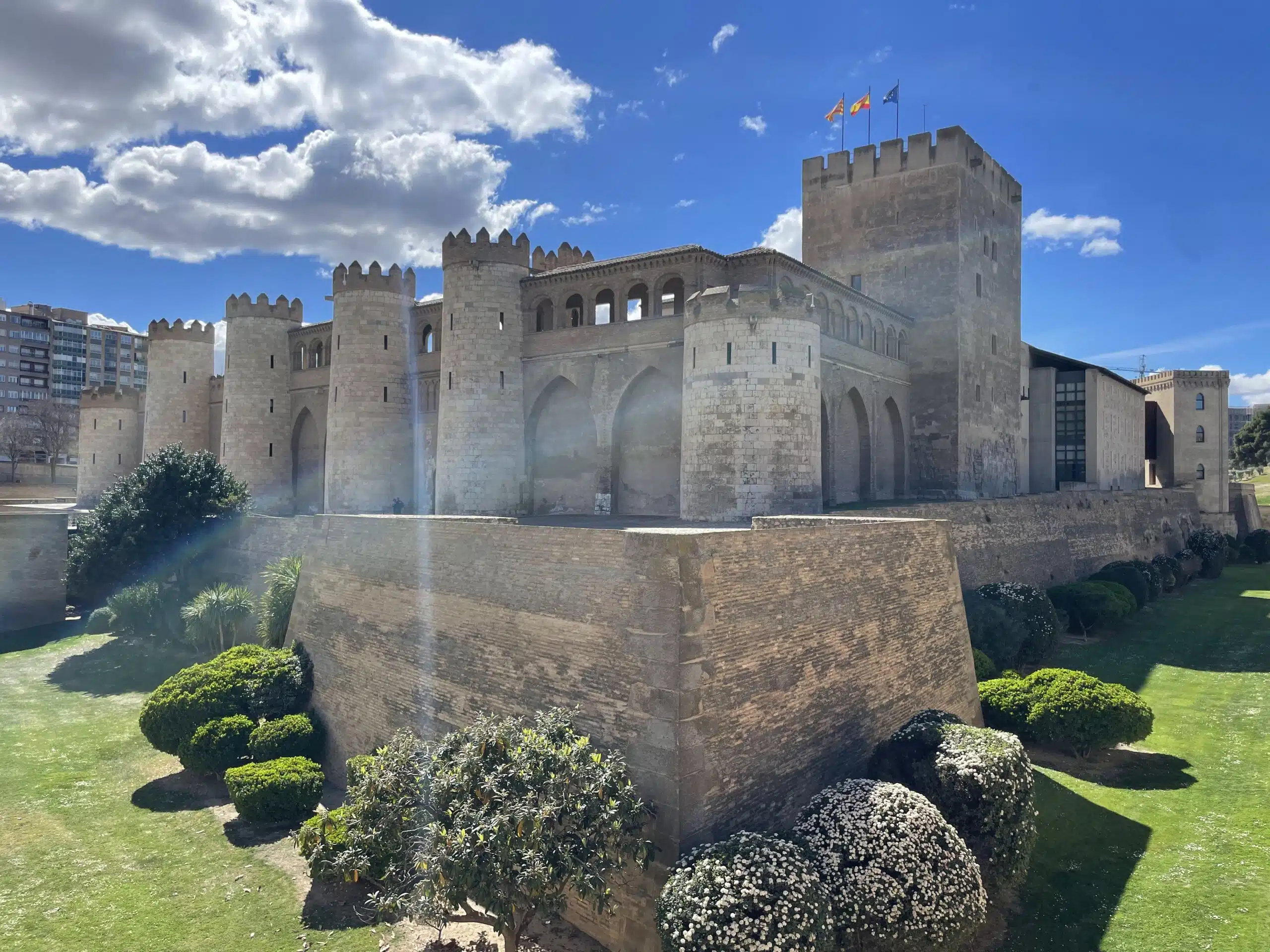
I am writing this from Zaragoza, Spain.
It is early morning. The Ebro is doing what the Ebro always does — moving quietly, indifferently, magnificently past everything that city life insists is urgent. There is a man fishing on the bank who has been there, I suspect, for hours. He is not catching anything visible. He is catching something else entirely.
I think about GDP.
I think about how that man — in this moment of complete aliveness, of belonging to a river, to a morning, to himself — registers in the national accounts as zero. Nothing produced. Nothing consumed. Nothing counted.
And I think: we have built a civilization that cannot see him.
A civilization that cannot measure what matters will inevitably optimize for what it can count — and wonder why it feels so empty.
In my last piece, I wrote about the Belonging Revolution — about Schools, Cities, and Hospitals of Happiness as the new architecture of human connection. Readers wrote back to ask the harder question: all of this is beautiful, but how do you fund it? How do you convince a government, a finance ministry, a World Bank economist that belonging is worth investing in?
You convince them by changing what you measure.
Because what you measure is what you manage. And what you manage is what you become.
GDP — Gross Domestic Product — was invented in the 1930s by Simon Kuznets, who himself warned that it should never be used as a measure of welfare. He was right. GDP counts a car crash as a gain (emergency services, hospital visits, repairs). It counts depression as a gain (pharmaceuticals, therapy, sick days). It counts the clearcutting of a forest as a gain (timber sales) and ignores entirely the loss of ecosystem, beauty, and belonging that the forest embodied.
GDP is not evil. It is simply the answer to a question we stopped asking properly: What are we producing? When what we needed to ask — what we still need to ask — is a different question entirely:
Are we flourishing?
These are not the same question. A country can produce a great deal and flourish very little. Several do.
And a country can produce modestly and flourish enormously. Some of those exist too — and they are worth paying very close attention to.
Bhutan introduced Gross National Happiness as a constitutional framework in 2008. The world mostly smiled politely and kept counting dollars. But something happened in Bhutan that the economists could not fully explain: a country of 800,000 people in the Himalayas built one of the most stable, literate, environmentally protected, and spiritually alive societies on Earth — while maintaining one of the lowest ecological footprints per capita of any developing nation.
They were not measuring the wrong thing and getting lucky. They were measuring the right thing, on purpose.
Costa Rica, a country that abolished its military in 1948 and redirected those funds into healthcare and education, consistently ranks among the happiest countries in the world while generating roughly a quarter of the carbon emissions of high-GDP nations. When we take our Discovery Expeditions there, participants don’t encounter a perfect society. They encounter a conscious one — a society that has made visible choices about what it is trying to become.
These are not anomalies. They are previews.
Bhutan didn’t stumble into happiness. Costa Rica didn’t accidentally disarm. They chose a different question — and then built the metrics to answer it.
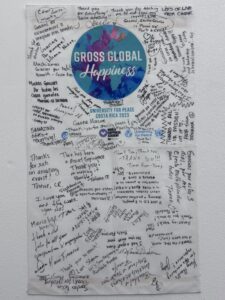
The World Happiness Foundation has been developing, alongside partners at UPEACE and with the support of contemplative researchers, educators, and economists across five continents, what we call the Gross Global Happiness (GGH) framework. It is our response to the GDP question — not a replacement born of naïveté, but a complement born of necessity.
GGH asks governments, cities, and institutions to account for seven dimensions of flourishing:
Notice what is in that list that GDP cannot see. Community vitality. Cultural resilience. Time sovereignty. Meaning.
These are not soft outcomes. They are the structural conditions for everything else. A society with high community vitality has lower healthcare costs, lower crime rates, faster disaster recovery, and higher innovation. Not as a side effect — as a direct consequence of people who feel they belong to each other.
The man fishing on the Ebro? He is building community vitality in himself, so that when he returns to his family, his neighborhood, his workplace, he carries something that the economy will benefit from but will never adequately credit.
In the Integrative Transformation Model — the ITM — I have written about the shadow as the unacknowledged part of the self that drives behavior from below the surface of awareness. What we cannot see in ourselves, we cannot change. We manage the symptom while the cause deepens.
Nations have shadows too.
The shadow of GDP-worship is this: it allows us to feel like we are winning while people are suffering. It provides a number that looks like progress and conceals the texture of actual lives. It lets governments say ‘the economy grew by 3.2%’ in the same year that loneliness rates doubled, that topsoil eroded, that children’s anxiety spiked — and call it a good year.
Moving to GGH-style metrics is not just a technical change. It is an act of shadow work at civilizational scale.
It is asking: what have we been refusing to look at? What have we been calling ‘not our problem’ because we didn’t have a line item for it? What would we have to change — really change — if we honestly measured whether human beings in our care were flourishing?
That question is uncomfortable. It is supposed to be. Transformation always begins where comfort ends.
Shadow work at civilizational scale asks: what have we been refusing to measure — because measuring it would demand we change?
Thích Nhất Hạnh taught that peace is not a destination but a practice — that it must be present in the step, not just the arrival. I carry that teaching now not only as a personal practice but as an economic principle.
Fundamental Peace — as I have been developing it through Vietnam, Kolkata, and now back here in Zaragoza — is the inner ground from which genuine action becomes possible. Not the peace of withdrawal. The peace of full presence.
An economy rooted in Fundamental Peace does not chase growth as an end. It asks, before every policy decision, every budget allocation, every infrastructure investment: does this contribute to the peace — the deep aliveness, the dignified flourishing — of every being this touches?
That is Happytalism in practice. Not a utopia. A direction.
Freedom, consciousness, and happiness — the three pillars — are not values to aspire to after we have achieved economic security. They are the very conditions that make sustainable economies possible. Societies with high inner freedom innovate more. Societies with high collective consciousness waste less. Societies that prioritize happiness as a genuine policy goal produce fewer externalities, require less enforcement, generate more voluntary cooperation.
Happiness is not soft. It is, in the deepest sense, productive.
You do not have to wait for the UN to adopt GGH. You do not have to wait for a national government to mandate well-being reporting. Change in this direction has always begun locally — in a city, a school, a hospital, a company — and spread upward.
Here is where to begin:
I looked up from my notes a moment ago and the man on the Ebro is still there.
The sun is higher now. A child has appeared beside him — a grandchild, maybe — and they are doing nothing together with extraordinary competence.
I want an economy that sees that.
I want governance that protects it. Education that prepares for it. Healthcare that sustains it. Cities that are designed around the possibility that this moment — two humans, a river, a fishing line that doesn’t need to catch anything — is not a break from the valuable parts of life.
This is the valuable part.
The Belonging Revolution we are building at the World Happiness Foundation is, at its core, a revolution in accounting. Not a rejection of prosperity — an expansion of what prosperity means. Not a war on growth — an insistence that the only growth worth pursuing is the kind that makes us more human, not less.
Sarada Devi, the great mother of the Ramakrishna lineage I wrote about recently, said that she had never met a stranger. Every person who came to her, she saw as her own.
What would a GDP that saw no strangers look like?
I think it would look like a civilization worth building.
Let’s build it.
About the Author
Luis Miguel Gallardo is the Founder & President of the World Happiness Foundation, creator of Happytalism, and Professor of Practice at Shoolini University’s Yogananda School of Spirituality and Happiness. He writes from the road — tracing the living edge where inner transformation and civilizational change meet.
A Framework for Systemic Transformation Through the Wisdom of Hawkins,
A Comprehensive Global Mapping of Authoritarianism, Armed Conflict, and Violations
Joseph Campbell gave the modern world a powerful language for