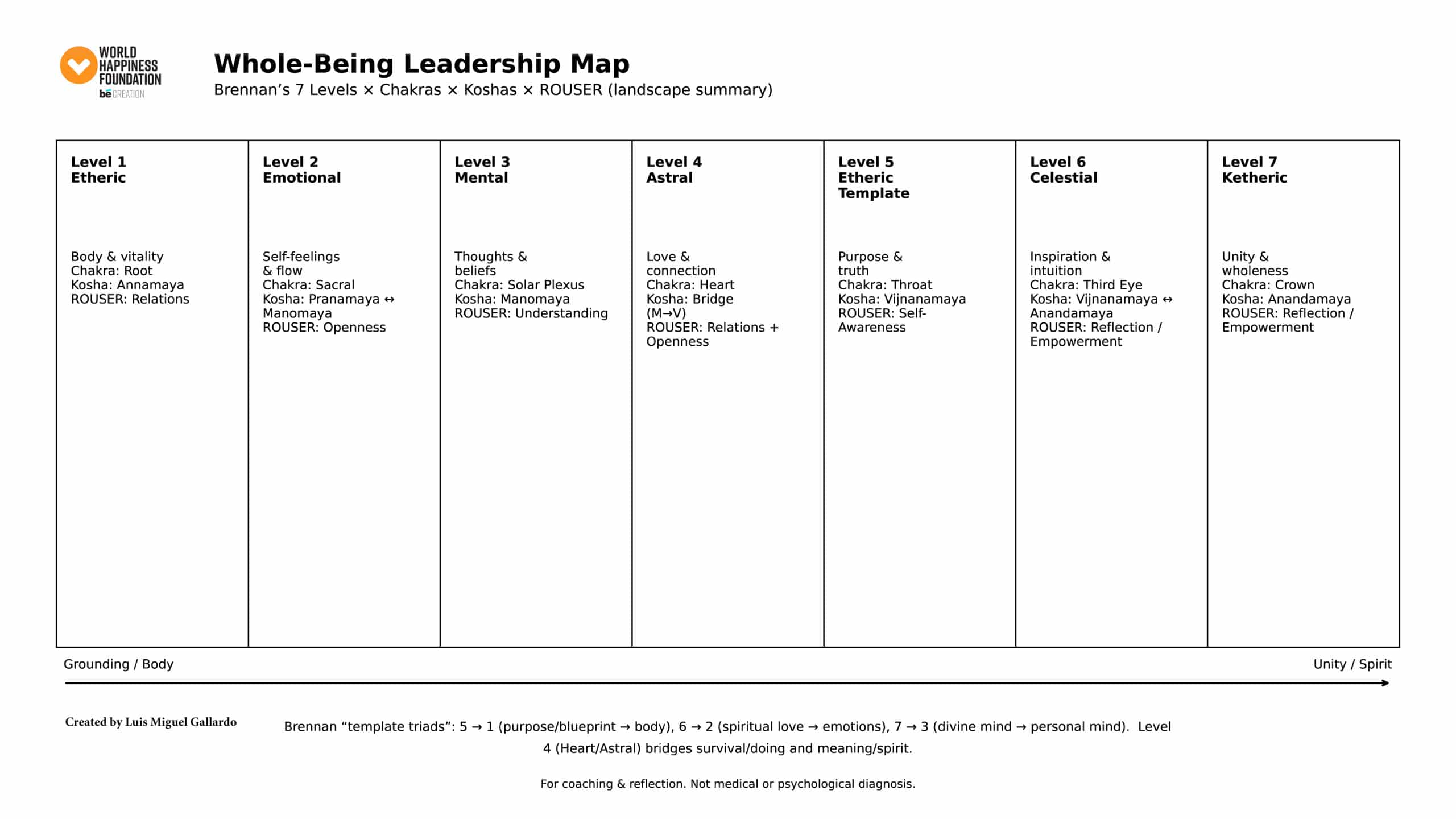
In today’s transformational leadership coaching, ancient spiritual models are finding fresh relevance. Frameworks like Barbara Brennan’s seven levels of the human energy field, the yogic Koshas (five sheaths of being), and the Chakra system offer multidimensional lenses on human experience. These models don’t just provide spiritual insight – they illuminate practical pathways for personal growth and authentic leadership. When integrated (as in the World Happiness Foundation’s ROUSER–Koshas approach), they map how body, mind, heart, and spirit all contribute to a leader’s development. This article explores the first seven levels of the Brennan model and compares them with the Koshas and Chakras. We will highlight synergistic patterns and show how these frameworks can be applied in leadership coaching for deeper self-integration and more conscious, “whole-being” leadership.
The Brennan Model: Seven Levels of the Human Energy Field
Barbara Ann Brennan, a former NASA physicist turned healer, developed a detailed model of the human energy field (aura). In her model, the aura has seven layers (or levels), each extending through and beyond the physical body. Each layer vibrates at a higher frequency than the one within it, interpenetrating each other rather than stacking like an onion. Brennan observed that the odd-numbered layers are structured (like standing grids of light), while the even-numbered layers are more fluid and formless. Importantly, each auric level is associated with one of the seven major chakras (the body’s energy centers) in order. In other words, the first aura layer corresponds to the first (root) chakra, the second layer to the second chakra, and so on up to the seventh layer and crown chakra. This one-to-one mapping links the aura’s layers to classic chakra qualities, which we’ll explore shortly.
Seven Aura Levels and Qualities: Brennan’s first seven levels (the focus of her healing science) correspond to different dimensions of human experience. Below is a summary of each level, its key qualities, and its parallel in chakras and yogic koshas for comparison:
Brennan Energy Level
Key Qualities (Brennan) / Corresponding Chakra
Related Kosha (Sheath)
1. Etheric Body (Level 1) – The energy blueprint of the physical body. It is a structured web of light lines that underlies physical form. All physical sensations (pleasure or pain) are felt through this layer, and its strength reflects one’s bodily health and vitality (exercise and care energize it).
Root Chakra (Muladhara) – vitality, survival, grounding. The root chakra draws life force into the body and governs the physical foundation.
Annamaya Kosha (Physical Body) – the dense physical sheath: the body’s structure, muscles, posture, and basic needs.
2. Emotional Body (Level 2) – A fluid, cloud-like layer where feelings and emotions about oneself reside. Its colorful energies flow along the template of the first layer. Bright, clear colors indicate positive self-feelings, whereas stagnant, dark “clouds” indicate suppressed or negative emotions about self. Free emotional flow in this layer is vital for self-love and emotional balance.
Sacral Chakra (Svadhisthana) – emotions, desire, self-image. The sacral center processes feelings, sensuality, and how we value ourselves, aligning closely with the emotional body’s self-emotions.
Manomaya Kosha (Mental-Emotional Body) – in practice, this sheath includes the mind and emotional faculty. (Notably, some interpretations also link emotional energy to Pranamaya Kosha, the breath/life-force layer, since emotion and breath are intertwined. The ROUSER–Koshas model, for example, treats the emotional layer as part of the energy body.)
3. Mental Body (Level 3) – A level of thoughts, beliefs, and mental processes. It appears as a luminous, structured layer of fine yellow lines, vibrating at high speed. This layer stores our linear thinking, ideas, and rational mind. When healthy, it supports clarity and an agile intellect; when negative or clouded, it contains “thought-forms” of worry or limiting beliefs that can loop endlessly. Harmonizing this layer brings mental balance and helps align reason with intuition.
Solar Plexus Chakra (Manipura) – intellect, personal power, and identity. The third chakra governs the mental domain of thoughts, judgments, and our sense of personal power, corresponding to the aura’s mental layer. When Manipura and the mental body are balanced, one has confidence and clear, focused thinking.
Manomaya Kosha (Mental-Emotional Body) – (again, covers the realm of mind and reactive emotions). The mental aspect of manomaya encompasses our thoughts, stories, and mental narratives – precisely the content of Brennan’s third level.
4. Astral Body (Level 4) – The bridge of love, relationship, and connection. This central layer is the gateway between the “lower” three physical levels and the “higher” spiritual levels. It is associated with the heart and “I-Thou” relationships: our feelings toward others, capacity for love, and patterns in relationships. Its substance is fluid, like flowing streams of colored light extending out to others when we interact. When healthy, it emanates warmth, compassion, and joy in connection; when distorted or clogged (“auric mucus”), it manifests relationship pain, loneliness, or heartache.
Heart Chakra (Anahata) – love, compassion, and connection. The heart chakra is the center of the chakra system and integrates the lower and upper chakras, just as the astral layer connects our physical and spiritual aspects. A strong Anahata and astral body enable empathy, healthy bonds, and unconditional love.
Manomaya Kosha, transitioning toward Vijnanamaya – The heart sits at the crossroads of emotion and spiritual insight. While traditional kosha models don’t single out a “relationship sheath,” the heart’s capacity could be seen as the culmination of the mental-emotional sheath purified by love, opening into the wisdom of deeper interconnection. (In other words, it’s where manomaya begins to transcend into the intuitive wisdom of vijnanamaya through love and empathy.)
5. Etheric Template Body (Level 5) – The layer of divine will and blueprint. This structured level contains the template or original form for the etheric (physical) layer. Brennan describes it as an inverse image: what appears empty at the physical level is visible as cobalt-blue light here. It holds the perfect pattern for our form and life purpose, like a cosmic blueprint for growth. This is the realm of higher will, order, and purpose. Experientially, aligning with the fifth layer feels like attunement to “perfect order” and a personal sense of purpose within the larger divine plan. An individual with a strong fifth layer is orderly, lives with integrity, and feels guided by a clear purpose or calling. Misalignment or weakness here can manifest as a lack of direction, chaos in life, or discomfort with structure and commitment.
Throat Chakra (Vishuddha) – communication, truth, and creative will. The throat chakra is said to “speak” our reality into being and is linked to our personal will and expression. It correlates with the etheric template layer, which “holds the divine blueprint” for our existence. Thus, Vishuddha and the fifth aura level together involve expressing one’s inner truth and aligning personal will with higher (divine) will or life pattern. In leadership, this means speaking and acting from a place of purpose and authenticity.
Vijnanamaya Kosha (Wisdom/Identity Body) – the sheath of intellect, intuition, dharma (life purpose), and inner guidance. The fifth layer’s focus on divine will and life plan aligns with the vijnanamaya kosha’s domain of deep insight, values, and identity. It is about meaning-making – understanding one’s place in the larger order. A leader operating at this layer makes decisions guided by core values and a sense of mission.
6. Celestial Body (Level 6) – The layer of spiritual love, intuition, and bliss. It is an unstructured expanse of fine, opalescent light radiating about two to three feet from the body. When activated, the sixth level is experienced as divine love, profound peace, joy, and connectedness with all life. It is the seat of inspiration, intuition, and ecstatic spiritual experience – for example, deep meditation or communion can flood this layer with light. Brennan notes that “sitting in this level of awareness brings great calm and healing… experienced as spiritual love, joy, elation, and bliss”. A healthy celestial body enables one to see the divine in others and in creation (a source of compassion and inspiration). If undercharged or closed, one may feel spiritually dry, uninspired, or skeptical of anything beyond the material, cut off from the joy of spirit. Strengthening this layer (through practices like meditation, prayer, music, or anything that opens the heart to love) brings a sense of oneness and inspiration.
Third Eye Chakra (Ajna) – intuition, insight, and vision. The third eye governs inner vision and spiritual perception. It connects to the celestial layer, which “contains the vision of the soul”. When Ajna and the sixth aura layer are active, a leader has foresight, creative imagination, and an inspired, compassionate outlook. They can “see” possibilities and intuit guidance beyond logic. (Some also associate the sixth layer with the Heart and Third Eye combined, as it is love fused with vision.)
Vijnanamaya and Anandamaya Kosha – here the boundary between wisdom and bliss sheaths blurs. The surge of unconditional love and insightful unity belongs to the higher wisdom aspect of vijnanamaya, but also approaches the bliss of anandamaya. In essence, the celestial body reflects the state where wisdom and love yield a blissful realization of spiritual truth. For leadership, this might manifest as visionary creativity guided by compassion and higher purpose – a state of flow where decisions are imbued with love and insight.
7. Ketheric Template (Causal Body) (Level 7) – The cosmic mind or spirit level. This highest auric layer appears as a brilliant gold lattice of light, extending about three feet out and forming a golden “egg” around the body. The outer boundary of this egg is strong and resilient, protecting the entire energy field. The seventh layer holds our individual soul essence and its complete history, and it “contains” and interweaves all the lower layers in perfect order. It is the level of Divine Mind or Unity consciousness – where one experiences an understanding of the grand design and one’s place in it. In this state, a person directly “knows” the interconnectedness of all life and perceives universal truth. When healthy, the ketheric body gives a profound sense of security and wholeness: knowing “we are part of the great pattern of life… perfection within our imperfections”. It is the seat of creativity and spiritual illumination – from here, original ideas and clear knowing emerge, as if downloading from the universal mind. A strong seventh layer correlates with being open to divine guidance, having broad understanding, and the ability to integrate complex ideas into wisdom. If this layer is damaged or weak, one may feel isolated, existentially uncertain, or unable to see meaning in challenges, often striving for an impossible perfection due to feeling disconnected from the greater whole.
Crown Chakra (Sahasrara) – consciousness, unity, and connection to the divine. The crown chakra corresponds directly to the seventh level of the aura. It is our link to higher consciousness and the feeling of oneness with creation. When Sahasrara and the ketheric template are open, a leader operates from a place of wisdom, universal awareness, and faith. This can manifest as grace, open-mindedness, and an inner knowing beyond intellectual reasoning.
Anandamaya Kosha (Bliss Body) – the subtlest sheath, representing the core of our being where we experience unity, joy, and the “Self” beyond roles. The seventh layer of the aura, with its experience of divine mind and connectedness, aligns with Anandamaya’s blissful, transcendent awareness. Functionally, this is the causal body in yoga terms – the reservoir of latent impressions and the bridge to the universal Self. In leadership terms, tapping this level could mean operating from a sense of fundamental peace and trust in one’s purpose, inspiring others through presence and clarity.
Table: Correspondences between Brennan’s seven energy field levels, the chakra system, and the yogic koshas. Each model acknowledges a spectrum from the dense physical plane to the subtlest spiritual essence.
Brennan’s model underscores that all seven layers are interrelated. No layer works in isolation – in fact, the state of one level influences the others “holographically”. If a particular level is weak or distorted, the aspects of life governed by that level will suffer, limiting one’s overall experience. Conversely, the more developed and energized all levels are, the fuller and more balanced one’s life becomes. Brennan also observed a fascinating pattern: each of the three higher spiritual levels serves as a template for the corresponding lower level (separated by three). Specifically, Level 5 (divine will) provides the blueprint for Level 1 (physical form); Level 6 (divine love) patterns Level 2 (emotional self); and Level 7 (divine mind) patterns Level 3 (intellect). In other words, our spiritual essence “clothes” itself in these lower aspects. This template relationship suggests that by working on the higher level (for example, reconnecting to love and spirit at Level 6), one can heal and transform issues in the lower counterpart (Level 2 emotional wounds). It’s a synergy of “as above, so below” built into the human energy anatomy.
The Koshas: Five Sheaths of Consciousness
In yogic philosophy (particularly Vedanta), the Pancha Koshas are five layers or “sheaths” that encase the Atman, or true Self. They form another holistic model of the person, from gross to subtle. These five koshas are:
Annamaya Kosha – The Food/Physical Body: This is the outermost sheath, corresponding to the physical body composed of matter (anna, “food”). It includes our muscles, bones, organs, and physical senses – essentially the tangible flesh-and-blood aspect. In leadership or daily life, this is the level of physical health, stamina, posture, and even nonverbal presence. Leaders first meet the world through the annamaya kosha via their physical energy and body language.
Pranamaya Kosha – The Energy/Breath Body: The second sheath is the vital energy that animates the physical form. Prana means life-force – this kosha encompasses the breath, the flow of energy in the nervous system, and the subtle vital currents that correspond to the acupuncture meridians or nadis. It’s the invisible battery that powers our bodily functions and connects mind with body. In practical terms, pranamaya kosha shows up as breathing patterns, arousal or calm, and overall vitality. For instance, a shallow, rapid breath and jittery energy indicate an agitated pranamaya; a deep, slow breath reflects calm energy. Coaches often address this layer through breathwork or somatic practices to help leaders manage stress arousal.
Manomaya Kosha – The Mind/Emotion Body: The third sheath is the domain of the mind (manas) – not just rational thoughts but also our emotions, instincts, and immediate mental reactions. It is sometimes called the “mental-emotional” sheath because it encompasses our feelings, basic thought patterns, and conditioned responses or stories we tell ourselves. This kosha is active when we experience fear, joy, anger, or when our mind chatters with worries and narratives. In a leadership context, manomaya kosha is at play when a leader’s subconscious beliefs or emotional triggers drive their behavior (e.g. catastrophizing a setback, or feeling defensive when receiving feedback). As Gallardo notes, under stress “thoughts, feelings, fears, stories, reactivity” all emerge from this layer. Cultivating awareness of manomaya kosha (through mindfulness or coaching reflection) helps leaders move from reactive habits to conscious responses.
Vijnanamaya Kosha – The Wisdom/Identity Body: The fourth sheath is more subtle – often described as the intellect or intuition layer, it’s associated with deep insight (vijnana means knowledge or discernment). Vijnanamaya encompasses our higher mind: our sense of meaning, values, and identity. It is the home of our conscience, inner compass, and the awareness that witnesses the mind. In this kosha lie the guiding principles and understanding that shape who we believe we are (ego identity, roles) as well as glimpses of the transpersonal (soul identity). In leadership, tapping vijnanamaya kosha means engaging with questions of purpose, ethics, and vision – it’s the layer where a leader reflects on “Who am I? What truly matters? What is my role in the larger scheme?”. It’s notable that identity is placed in this wisdom sheath: this suggests that true wisdom includes understanding the narratives we hold about ourselves. Practices like self-inquiry, values clarification, and coaching around mindset and perspective all work at this layer. Strengthening vijnanamaya kosha helps a leader act from wisdom rather than ego, making choices aligned with their higher values and intuitive knowing.
Anandamaya Kosha – The Bliss/Essence Body: The innermost sheath is a still, blissful layer – the subtle veil closest to the soul. Ananda means bliss or joy. This is not bliss in the sense of a passing emotion, but a profound sense of wholeness, peace, and love that is said to underlie our true nature. When a person touches this layer, they experience themselves beyond the usual identifications – there is unity, contentment, and connection to the divine or universal Self. In practical leadership terms, anandamaya kosha might manifest as a leader’s deep calm, resilience, and presence that inspire others. It’s the quiet confidence that comes from being aligned with one’s core (often developed through meditation, spiritual practice, or moments of “flow” and transcendence). This sheath is the source of creativity and authentic leadership presence – it’s what some might call the spirit of a leader. Gallardo describes it as the layer of “Essence” – the Self beyond roles, where one feels “stillness, wholeness”. When coaching addresses this layer, it involves fostering a connection to something greater – be it through mindfulness, reflection, or aligning work with one’s heartfelt purpose, thereby evoking joy and inspiration.
Koshas in Context: The five koshas can be grouped into three broad levels of existence often cited in yogic literature: the physical body (annamaya), the subtle body (pranamaya, manomaya, vijnanamaya collectively), and the causal body (anandamaya, the seed of the soul). This layered model reminds us that a human being is not just a mind driving around a body, but a complex, interwoven spectrum from gross matter to subtle spirit. Notably, when a leader faces a challenge, usually multiple koshas are involved. For example, public speaking anxiety might show up as sweaty palms and shaking (physical), knotted stomach (energy/breath), racing thoughts of failure (mental), a blow to confidence (identity/wisdom), and a feeling of disconnection from one’s true voice or purpose (bliss/essence). As Gallardo insightfully puts it, “when leaders struggle, it’s rarely just mental. It’s usually a multi-layer disruption: tight chest (body), shallow breath (energy), catastrophic thinking (mind), identity threat (wisdom), disconnection from essence (Self)”. The kosha model helps pinpoint where the disruption lies and suggests corresponding remedies – perhaps physical relaxation and breathwork for the body and energy, reframing thoughts for the mind, coaching on values for the wisdom layer, or reconnection practices for essence. In sum, the koshas offer a comprehensive map for coaches to ensure they address the whole person, not just the cognitive level, when facilitating growth.
The Chakra System: Seven Energy Centers
No discussion of energy anatomy is complete without the chakras – a concept from yoga and tantric traditions that has permeated modern wellness and psychology. Chakras are often described as spinning wheels or vortices of energy aligned along the spine, from the tailbone (root chakra) to the crown of the head. Each chakra corresponds to nerve plexuses and endocrine glands in the physical body, and each governs specific psychological themes and life areas (such as survival, creativity, love, communication, intuition, etc.). The chakras can be seen as organs of the energy body, responsible for taking in, assimilating, and expressing life-force energy (prana). They draw energy from the universal field around us and distribute it through the body via the nadis or meridians (energy channels). Each chakra vibrates at a different frequency, has its own color and symbol in traditional lore, and a different number of “petals” or segments (from 4 at the root to 1,000 at the crown, symbolizing increasing complexity of consciousness).
Briefly, the seven major chakras and their core qualities are:
1st, Root (Muladhara): Base of spine. Themes of physical survival, safety, grounding, and trust in life. (“Do I have the right to be here and have my needs met?”)
2nd, Sacral (Svadhisthana): Lower abdomen. Themes of emotion, sexuality, pleasure, creativity, and self-worth. (“Can I allow myself to feel and want, and do I deserve joy?”)
3rd, Solar Plexus (Manipura): Upper abdomen. Themes of personal power, will, autonomy, and intellectual identity. (“Can I act, choose, and be effective in the world?”)
4th, Heart (Anahata): Center of chest. Themes of love, compassion, relationship, and integration. (“Am I connected? Can I give and receive love freely?”)
5th, Throat (Vishuddha): Throat area. Themes of communication, self-expression, truth, and purpose. (“Can I speak my truth and align my life with my voice and mission?”)
6th, Third Eye (Ajna): Forehead/brow. Themes of intuition, insight, inner vision, and wisdom. (“What do I perceive and intuit beyond the physical? Can I see the big picture?”)
7th, Crown (Sahasrara): Top of head. Themes of pure consciousness, unity, and spiritual connection. (“What is my connection to the divine? Can I surrender to the larger Whole?”)
Each chakra is associated with a corresponding aura layer, as noted earlier, and thus the chakra system interlocks with the Brennan model. For instance, the throat chakra (communication/will) interfaces with the 5th auric layer (divine will blueprint), and the heart chakra (love) interfaces with the 4th layer (astral love body). Importantly, imbalance or blockages in a chakra can manifest as issues in its associated life domains. A leader with a blocked throat chakra may struggle to communicate clearly or feel “out of sync” with their purpose, reflecting a possible distortion in the 5th layer blueprint. Likewise, an overburdened heart chakra might show up as compassion fatigue or difficulty with relationships, hinting at astral layer congestion. Brennan healers are trained to perceive chakra health and unblock or re-balance these centers because “the freer energy can flow through our chakras, the healthier we are”. In leadership coaching, while not all practitioners explicitly reference chakras, many implicitly work with these themes: helping clients ground and feel safe (root), manage emotions (sacral), build confidence (solar plexus), lead with empathy (heart), find their voice (throat), trust their intuition (third eye), and feel connected to a bigger purpose (crown). Thus, the chakra system provides a useful shorthand for diagnosing and addressing personal growth areas, complementary to the koshas and aura levels.
Mapping the Models: Correspondences and Synergies
Despite arising from different traditions, the Brennan aura model, the Koshas, and the Chakra system are remarkably synergistic. They all describe multiple layers of the human being, from the most material to the most transcendent. When overlaid, several clear correspondences emerge (as outlined in the earlier table). To summarize key alignments:
Physical/Foundation Layer: Brennan’s Level 1 (Etheric) aligns with the Root Chakra and the Annamaya Kosha. All three frameworks recognize the importance of the physical foundation – the body and its health, the feeling of safety and rootedness in the world. In leadership, this corresponds to a leader’s groundedness and ability to satisfy basic needs (rest, nutrition, calm). Without this foundation, higher capacities are unstable (“strong roots are needed for the tree to grow”). The World Happiness Foundation’s ROUSER model similarly starts with Relations at the physical layer, emphasizing that human connection and trust require nervous system regulation and a sense of safety in the body. (Their guidance: “Relations ↔ Body+Breath (Annamaya/Pranamaya): Connection improves when we regulate the nervous system first”.)
Energy & Emotion Layer: Brennan’s Level 2 (Emotional self) and Level 4 (Astral relational) together cover the terrain of emotions – personal feelings and love towards others. These correspond to the Sacral and Heart Chakras (emotional flow and love) and involve aspects of Pranamaya (energy) and Manomaya (emotional mind) koshas. The kosha model collapses these into one broad mental-emotional layer, but Brennan’s model usefully splits emotional energy into two bands: one about self (Level 2) and one about relationship (Level 4). This nuance can help a coach discern whether a client’s emotional block is internally directed (e.g. self-esteem, self-compassion) or interpersonal (e.g. difficulty trusting others or maintaining boundaries). Both need healing for emotional intelligence. The chakra model, for its part, distinguishes between the lower emotional urges of the sacral chakra (desire, fear, self-image) and the higher emotions of the heart chakra (love, empathy, grief). Yet it’s understood that the heart integrates the personal and transpersonal love. Synergy point: All models see emotional openness as pivotal. In fact, Openness is the second ROUSER pillar, mapped to the “energy/emotional layer (pranamaya kosha), the life-force that pulses through us in breath, feeling, and intuition”. This acknowledges that freeing one’s breath and emotions (prana and emotion are tightly linked) enables adaptability and authenticity in leadership. Suppressing emotion – whether it’s a leader stifling vulnerability or ignoring their gut feelings – is like damming a river; eventually, flow and creativity stagnate. Thus, cultivating openness at this layer (through psychological safety, somatic awareness, emotional literacy) is a shared emphasis in these frameworks.
Mental Layer: Brennan’s Level 3 (Mental) corresponds directly with the Solar Plexus Chakra and the mental aspect of Manomaya Kosha. All describe the domain of thoughts, beliefs, and the intellect’s light. A healthy mental layer brings clarity, focus, and positive “self-talk,” whereas a distorted one yields negative thought-forms and limiting beliefs. In leadership, this is about mindset. A leader stuck in a mental loop of doubt or cynicism will radiate that to their team. All three models suggest clearing and reprogramming negative mental patterns is crucial – whether through energy healing at the aura level, meditation and study at the kosha level, or chakra work to balance Manipura’s sense of self-worth. Notably, Brennan’s model and yoga both teach that higher influences can uplift the mind: for instance, Brennan noted Level 7 (divine mind) is the template for Level 3 (personal mind) – meaning if one connects to spiritual truth, it reshapes one’s everyday thinking. Likewise, yogic practice aims to still the lower mind (manomaya) so that buddhi (higher intellect) and eventually Atman can be realized, which then permanently changes one’s thought patterns. This reveals a pattern of top-down integration: growth is not only about managing thoughts from within the mind, but also about bringing in wisdom from higher levels. Coaches facilitate this by helping clients question old assumptions (inviting higher wisdom in) and by introducing broader perspectives (akin to tapping into vijnanamaya insight to reorganize manomaya’s narratives). In ROUSER terms, the pillar Understanding sits here – it aligns with the “mental layer (manomaya kosha), the realm of thoughts, beliefs, and basic consciousness”. Cultivating understanding is like building a bridge of empathy that links head and heart – it requires mental clarity and an opening to wisdom beyond one’s ego.
Wisdom/Purpose Layer: Brennan’s Level 5 (Etheric template) aligns with aspects of the Throat Chakra (expressing one’s truth, following one’s calling) and the Vijnanamaya Kosha (intuitive wisdom and identity). This is where personal will can either align with or diverge from divine will. All models recognize an element of personal purpose or truth emerging at this stage. For example, the throat chakra’s connection to the etheric template suggests that speaking truth and acting authentically actually help manifest the soul’s blueprint in the physical world. In yogic terms, when vijnanamaya is purified, one’s ego identity gives way to one’s dharma – you start to live your truth. In Brennan’s observations, someone aligned with the 5th layer is orderly and lives “in synch” with a higher pattern. For leaders, this could mean they carry a clear sense of mission and integrity – their actions are congruent with their core values and a felt sense of destiny. It’s the difference between a manager who is just meeting quarterly targets and a leader who feels “called” to a meaningful cause. All frameworks suggest practices to strengthen this layer: e.g. meditation on one’s purpose, visualization (since this layer is blueprint and symbol – even sound work, as some say the throat chakra is where sound creates form). The ROUSER model captures this in the pillar Self-Awareness, which it aligns to the “wisdom/identity layer (vijnanamaya kosha)”. Self-awareness at this deeper level means seeing the stories of the ego and instead identifying with one’s deeper values and conscience – it’s a leader “observing their inner world without being hijacked by it”. By strengthening vijnanamaya, leaders loosen rigid ego roles and reconnect with their authentic self (for example, realizing “I am more than the Controller or Pleaser persona I’ve been playing”). This opens the door to purpose-driven leadership, where decisions are made in alignment with one’s true guiding principles.
Spiritual/Bliss Layer: Brennan’s Levels 6 and 7 (Celestial and Ketheric) together correspond with the Third Eye and Crown Chakras and the Anandamaya Kosha. These are the layers of spiritual fulfillment – love, joy, unity, enlightenment. All three systems agree that the pinnacle of human development is a transcendent awareness that perceives wholeness. Brennan’s 6th layer (divine love) and 7th (divine mind) are essentially two facets of the soul’s highest expression – love and wisdom – which in chakra terms are the awakened Ajna and Sahasrara, and in kosha terms are the bliss sheath connecting to the Atman. In practical coaching terms, this might sound esoteric, but it has concrete effects: a leader tapped into these layers exhibits grace, compassion, creativity, and an expansive vision. They inspire rather than coerce. They find meaning in both successes and failures, viewing them as part of a greater unfolding. Cultivating these top layers might involve encouraging leaders to develop reflective or spiritual practices (meditation, journaling, prayer, time in nature, acts of service) – anything that nourishes the “intellect and bliss body with insight and peace”. Indeed, the ROUSER pillar Reflection is said to correspond especially to the subtlest koshas (vijnanamaya and anandamaya). Through reflection – be it mindfulness meditation or honest self-inquiry – leaders integrate experience into wisdom and touch that blissful core of stillness. This reflective practice is what “ties all the others together”, ensuring that every layer of being learns and aligns. Gallardo emphasizes this by instilling reflection through meditation and dialogue to “nourish the intellect and bliss body with insight and peace.” When leaders do so, “people become more thoughtful, patient, and [centered]” – essentially, the organizational culture shifts towards one of thoughtful awareness rather than knee-jerk reaction. This exemplifies how activating the highest layers in individuals can positively influence the collective (as the seventh layer’s golden grid “knits together” not just the person but groups).
Integration and Wholeness: A critical synergy pattern across these models is the emphasis on integration – the notion that true well-being or effective leadership arises when all layers are recognized and harmonized. Brennan’s model explicitly states that all levels interpenetrate and influence each other holographically. Yogic philosophy (and the WHF content) likewise stresses that neglecting any sheath leads to imbalance: “if even one pillar is missing, true balance is impossible”, and the outer chaos in life is often a mirror of inner disharmony across these layers. In leadership, this means a problem showing up in one area (say, poor decision-making) might not be solved by a rational skills training alone – it could trace back to a fear (emotional kosha) or misalignment with values (wisdom kosha) that needs addressing for the decision-making to improve. All three frameworks encourage a whole-person approach: by healing and empowering each layer, the next naturally benefits. For example, a leader who works somatically to release chronic tension (physical, annamaya) may suddenly find their emotions flow more freely (pranamaya/manomaya) and their thinking clears (manomaya) – a domino effect of alignment. In Brennan’s terms, charging and clearing one level often helps adjacent levels return to healthy movement. In yogic terms, practices like yoga or pranayama simultaneously condition multiple koshas (body, energy, mind), bringing them into sync. And chakra balancing is believed to restore the smooth ascent of Kundalini (consciousness) through all centers, yielding integrated health.
Another beautiful synergy is how each model positions love and the heart as the bridge. The heart chakra (4th) sits in the middle of the seven, linking the lower three and upper three; Brennan’s astral level (4th) is literally the bridge between physical and spiritual experience; and in the kosha context, one might say that when manomaya (mind/emotion) is suffused with love, it opens into vijnanamaya (wisdom). Love, in leadership too, is a bridge – it humanizes intellectual strategy and brings higher purpose down into real relationships. This is why conscious leadership models often highlight compassion and empathy as keys to moving from egocentric management to people-centric leadership.
Finally, all models assert that our subtle inner alignment shapes our outer reality. Brennan’s concept of higher levels templating lower levels echoes the Hermetic idea of “inner state creates outer experience,” which leadership thinkers also echo: “as within, so without” – leaders who conquer their inner “demons” of greed or anger contribute to a more just and peaceful world. The kosha and chakra frameworks, applied to leadership, teach that a leader’s inner coherence (peace among their own body, heart, and mind) will naturally manifest as better teams and systems. A concrete example is how a leader’s calm presence (regulated body and energy) can de-escalate conflict in a meeting, or how their clarity of purpose (strong vijnanamaya/crown connection) can steer an organization through chaos with confidence.
Applying Energy Models in Leadership Coaching
Translating these spiritual and energetic models into practical leadership development is both an art and an emerging science. The World Happiness Foundation (WHF) provides one roadmap in its ROUSER–Koshas model, which intentionally integrates the ROUSER leadership pillars with the five kosha layers. Luis Gallardo, the WHF founder, describes this as marrying modern leadership wisdom with timeless spiritual truth, “ensuring that well-being and growth occur at every level of our existence” – body, heart, mind, and spirit. Let’s break down how such integration can look, and how adding Brennan’s seven-level perspective might enhance it:
ROUSER at a Glance: The six ROUSER pillars are Relations, Openness, Understanding, Self-Awareness, Empowerment, and Reflection. They form a sequential journey from more reactive, ego-driven leadership to more conscious, authentic leadership. By aligning these pillars to koshas, Gallardo creates a whole-being leadership map so that interventions and growth opportunities target the appropriate layer of the person. For example, the first pillar Relations is tied to the physical and breath layers (annamaya and pranamaya) – recognizing that building trust and connection starts with a leader’s ability to be physically present and regulate stress responses. Tactics here might include ensuring leaders get enough sleep and exercise (physical), and teaching breath techniques to stay calm and centered in tough conversations (pranic). Indeed, “connection improves when we regulate the nervous system first” is a guideline in this model – a leader who is physiologically in fight-or-flight cannot truly connect or listen.
Openness, the second pillar, is linked to the emotional layer (manomaya kosha, influenced by prana). Coaches foster openness by helping leaders acknowledge and express their feelings, stay curious rather than defensive, and create psychologically safe environments. This correlates with healing the 2nd and 4th aura layers (self-emotions and relational heart) – for instance, a coach might use techniques like emotional labeling, empathy exercises, or even heart-centered meditations to help a leader “open up.” Gallardo notes that when openness is embraced, it’s like “a river that must remain flowing to sustain life” – ideas and emotions can circulate and nourish the team rather than stagnate in secrecy.
Understanding, aligned with the mental layer (manomaya, and touching vijnanamaya), involves cognitive empathy and pattern recognition. Here coaching may use cognitive-behavioral techniques or systemic thinking tools. In energy terms, it’s about clarifying the third aura layer (clearing mental confusion) and drawing insight from the seventh (big-picture understanding). A practical method might be reflective journaling to identify recurring thought patterns (addressing the mental body) and guided visualization to invite intuitive insight (tapping the wisdom body). This corresponds to helping the leader build that “bridge of empathy” where intellect serves compassion – for example, mentally stepping into a colleague’s shoes to understand their motivations (an exercise of both mind and heart).
Self-Awareness, mapped to the wisdom/identity layer (vijnanamaya), is about seeing oneself objectively – one’s triggers, biases, and also higher aspirations. Techniques include 360° feedback, mindfulness meditation, or values assessment. This pillar is where leaders learn to witness their thoughts and emotions rather than be engulfed by them, much like a meditator observing the mind. By strengthening the 5th auric layer (alignment with one’s higher intent) and 6th (compassion towards oneself), a leader can loosen identification with ego roles. For instance, through coaching, a leader might realize, “A part of me is the Controller, but it’s not my whole Self; I can choose a different response”. Such realization is a direct expression of vijnanamaya (discernment) gaining the upper hand over manomaya (habitual mind). Brennan’s template concept adds that if the leader aligns with their “true design” (divine will) at this stage, it will automatically re-order many lower-level behaviors. We see this when a leader undergoes a personal values epiphany – say, realizing their purpose is to foster collaboration – suddenly their tone of voice, their listening skills, even their body language might shift to align with that new inner blueprint. Coaches often witness this kind of quantum shift when a client “gets it” at a deep level; it’s as if a tangled situation resolves once the person’s perspective clicks into alignment with a higher principle.
Empowerment, the fifth pillar, is tied to an integration of layers – Gallardo links it with breath, values, and essence (pranamaya + vijnanamaya + anandamaya). In other words, true empowerment (as opposed to mere ego-force or “hype”) is a byproduct of coherence across the layers. When a leader’s energy (prana and action), intellect (values and purpose), and soul (essence/bliss) are in agreement, they naturally act with confidence, integrity, and impact. This is empowerment born from alignment, not from external authority alone. Practically, coaching for empowerment might involve somatic practices that energize the body, visioning exercises that clarify the leader’s “why,” and spiritual or creative practices that connect them to joy. One can also see this as activating the throat, third eye, and crown chakras in unison – expressing one’s truth (throat) guided by insight (third eye) and in tune with spirit (crown). Brennan’s model supports this: e.g., when the 5th layer (will) and 7th (divine mind) are strong, the person often feels guided and empowered to act, while a robust 6th (divine love) ensures those actions come from a place of compassion. An empowered leader thus “spreads their wings” like a phoenix, as Gallardo metaphorically describes – having transformed on the inside, they can now move on the outside.
Reflection, the final pillar, wraps around to the highest koshas (intellect and bliss) and in fact touches all layers. Reflection is both a practice (e.g. meditation, journaling, after-action reviews) and a state of being (open, curious, learning-oriented). It allows continuous integration: digesting experiences into wisdom and updating one’s mental models. In terms of energy bodies, reflection keeps the crown chakra open (to insight), the third eye and throat linked (to articulate those insights), the heart clear (to remain humble and connected), and so on all the way down to the root (grounding insights into action). Brennan’s celestial and ketheric layers (6 and 7) are particularly engaged during deep reflection or prayer – one might literally feel “enlightened” or “guided by a higher mind” when in a reflective moment. Bringing this into leadership, a reflective leader will take time to pause and learn from both successes and failures. They might ask their team after a project, “What worked and what didn’t?” (mental analysis) but also “How did we feel and what did we learn about our values?” (emotional and wisdom insight). Such practices ensure that the whole being evolves, not just the tactical skills. It’s through reflection that a leader continually realigns their actions with their purpose and principles – effectively tuning up all koshas/aura layers regularly.
How Brennan’s Model Enriches Coaching: While the ROUSER–Koshas integration provides an excellent blueprint, Brennan’s seven-level model can add further nuance for coaches or practitioners inclined to energy work. Here are a few ways the Brennan perspective can connect with and deepen the ROUSER–Koshas approach:
Targeted Energy Diagnostics: Brennan practitioners train to sense which aura level has imbalances (e.g., a constriction in the second level versus the fourth). A leadership coach informed by this model might better discern whether a leader’s “emotional block” is primarily self-directed (Level 2 issue – perhaps low self-worth or shame) or other-directed (Level 4 issue – difficulty trusting others or unresolved grief in relationships). Both manifest as “emotional issues,” but the coaching approach might differ. The former might require inner child work or self-compassion practices, while the latter might involve forgiveness work or relationship-focused empathy development. Knowing the distinction can make interventions more precise. It also maps to chakra insight: a sacral chakra imbalance (self-image, one’s own emotions) vs a heart chakra imbalance (love towards others) are different, though they interact.
Emphasizing the Heart Bridge: The Brennan model’s clear identification of the heart layer as the bridge between physical and spiritualunderscores for coaches the importance of addressing relational issues as a gateway to deeper transformation. Many leadership programs focus on cognitive or behavioral training; the energy models remind us that healing the heart – fostering genuine compassion, belonging, and emotional safety – can unlock growth upwards (toward purpose and vision) and downwards (toward stability and execution). In practical terms, this might mean prioritizing team trust-building, emotional vulnerability in leadership development workshops, or even heart-centered meditation in coaching sessions to literally “open the heart chakra.” Once the heart is open, learning and change flow more readily to all levels. As one manifesto cited by Gallardo says, “Healing is not peripheral to leadership. It is the soil from which life-affirming leadership grows.” By healing heart-level wounds (whether through difficult conversations, empathy circles, or counseling), leaders become more whole and effective.
Linking Purpose to Manifestation: Brennan’s fifth layer (divine will template) being the pattern for the first layer (physical) offers a powerful lesson: when inner purpose aligns, outer results follow. Coaches often see clients set intentions that falter in execution; energy anatomy suggests checking for alignment at the blueprint level. Is the leader internally convinced and aligned with this goal (5th layer coherence)? If not, their efforts (1st layer actions) might misfire or feel forced. Working at the blueprint level could involve techniques like guided imagery to envision the ideal outcome, working through inner resistance (altering the template), or using voice (throat chakra) to declare one’s commitment. Sound or affirmation can be remarkably powerful – in energy terms, literally vibrating the etheric template to reshape reality. Leadership rituals like speaking vision statements aloud or storytelling can be seen as ways to strengthen the template and thus galvanize the physical layer into action. For a team, this means that a compelling shared vision (clear etheric template for the group field) will lead to coordinated action more readily than a disjointed or uninspiring vision.
Maintaining Energy Hygiene: Brennan healers emphasize clearing and charging the aura to prevent “energy leakage” or foreign energies intruding. Coaches and leaders can take a cue from this by establishing practices for energy hygiene. For instance, after a draining meeting (say a conflict that may leave “auric mucus” in one’s field), a leader could do a quick reset – maybe a few minutes of mindfulness or a walk outside to clear their head and heart. Visualization techniques borrowed from energy healing, like imagining a golden egg of light (strengthening the 7th layer’s boundary), can help leaders maintain their sense of self and not absorb others’ negativity – useful for empathic leaders who risk burnout. This doesn’t need to be mystical; it can be framed as psychological boundary setting or resilience visualization, which is quite acceptable in coaching contexts. The idea is to intentionally release stress and not carry emotional debris from one context to another. Leaders who do this report feeling “lighter” and more present – effectively confirming the Brennan insight that a robust, clean aura at all levels makes one feel whole and energized.
Fostering Fundamental Peace: Ultimately, the goal of integrating these models is to help leaders (and their organizations) achieve what WHF calls Fundamental Peace – “a peace attained when body, mind, and soul are in sync, a state of total harmony”. By working through the layers – whether you call them levels, koshas, or chakras – coaches guide leaders toward this inner balance. For example, a coaching engagement might start with stress management (body, breath), then move to emotional intelligence, then to reframing limiting beliefs, then to clarifying values, and perhaps finally to exploring meaning or spirituality in leadership. This mirrors a journey through annamaya → pranamaya → manomaya → vijnanamaya → anandamaya. Each step builds on the previous, and blockages are addressed in sequence. If done well, the leader experiences what Brennan described: a sense of safety and belonging (heart and root strong), personal power (solar plexus bright), creativity (sacral flowing), truth and purpose (throat clear), vision (third eye open), and oneness (crown connected). Such a leader “falls to the level of their integration” (to paraphrase a saying). In crunch moments, instead of collapsing into old fear-based habits, they draw on the resilience of an integrated body-mind-spirit. They remain calm yet energized, empathetic yet wise – basically, conscious leadership in action.
Practical Tools: Coaches can incorporate many tools to operationalize these ideas. For instance:
Body-layer interventions: mindful breathing exercises at the start of sessions, progressive muscle relaxation, or grounding techniques (feeling feet on the floor, using physical metaphors like “roots into the earth” during coaching). These help settle annamaya and pranamaya koshas so the coachee is present.
Emotion-layer interventions: feeling identification (naming feelings), emotional release techniques (journaling, somatic experiencing, even therapeutic crying in a safe space), or heart-focused practices (loving-kindness meditation to expand the astral layer). These build openness and empathy.
Mental-layer interventions: cognitive reframing, mental models mapping, or simply the classic coaching questions that challenge assumptions (“What evidence is there for that belief? What might another perspective be?”). This clears and re-patterns the mental field.
Wisdom-layer interventions: values elicitation, purpose definition exercises, narrative coaching (re-authoring one’s leadership story), and visualization of one’s best future self or ideal legacy. Also, encouraging decisions that align with declared values to strengthen identity coherence.
Spiritual-layer interventions: encouraging a reflective practice (daily meditation, journaling prompts like “What did I learn today?”), connecting with awe (through nature or art), or discussing the leader’s sense of meaning and contribution to something greater. Even in secular contexts, questions about legacy, service, and gratitude can invoke the bliss sheath. For some, prayer or spiritual reading might be appropriate to discuss.
One powerful yet simple practice combining several layers is Gallardo’s 12-minute protocol of Contemplate → Transmute → Integrate. In “Contemplate,” the leader scans their body (physical), notices breath (energy), identifies the situation and value at stake (mind and wisdom). In “Transmute,” they dialogue with their inner parts (mind/emotion), do a brief regression to find the root belief (wisdom layer insight into pattern), and then “update” that belief – effectively re-templating the mental field with a healthier truth. In “Integrate,” they commit to a concrete action and a relationship-nurturing step (bringing it down to body and heart in real life). This process encapsulates how moving through all koshas/aura levels yields a tangible leadership behavior change. It also echoes Brennan’s idea: bring the hidden into awareness (6th/7th influence), shift energy in the emotional/mental layers (2nd/3rd/4th), and then ground it by taking action (1st layer, and through the throat chakra by speaking commitment aloud). The result is not just an intellectual insight but an embodied shift – the only kind of shift that truly lasts.
Conclusion
When we explore leadership through the lens of the Brennan energy field model, the yogic koshas, and the chakra system, we arrive at a profoundly holistic understanding: a leader is a multidimensional being, and their growth is a multidimensional process. Each model, in its own language, asserts that our outer effectiveness is built on inner integration – aligning body, energy, heart, mind, and spirit. The synergies between the models are striking: all recognize a layered spectrum of consciousness, all highlight the heart’s central role, and all insist that higher awareness can and should guide the lower aspects. By mapping the correspondences between Brennan’s seven levels, the five koshas, and the chakras, we see a coherent picture emerge. This integrated map can inform coaches and leaders alike to check all levels of the “system”: Are we grounded and safe? Are emotions flowing and energy vibrant? Is the mind clear and learning? Do we live by deeper wisdom and purpose? And do we feel connected to something greater that inspires joy? If any layer is neglected, the whole suffers; if all layers are nurtured, we unlock authentic power.
In practice, incorporating these insights means expanding leadership development beyond just skills and intellect. It invites somatic awareness, emotional healing, mindset shifting, values work, and mindfulness into the coaching conversation. It means a CEO might practice meditation and breathing techniques to remain calm in a crisis, or a manager might reflect on the “story” they inherited about leadership and choose to rewrite it. It legitimizes discussing purpose and even love in the boardroom – not as soft concepts, but as fundamental drivers of sustainable success. Leaders who embrace whole-being development often report not only performance gains but also personal fulfillment: they lead in a way that feels right, with less internal conflict, which in turn galvanizes people around them.
In summary, the Brennan model’s aura levels, the koshas, and the chakras each offer a rich framework on their own. Together, and connected with models like ROUSER, they reinforce a timeless message with timely relevance: the most effective leadership grows from the inside out. By healing and integrating our many layers, we become leaders who are not just technically competent or intellectually smart, but emotionally intelligent, spiritually grounded, and truly transformative. In a world craving authentic and compassionate leadership, such whole-being leaders can catalyze teams and organizations to thrive in harmony. As we align our inner energy field, we create an outer field (a workplace, a community) where others too can flourish. This is the alchemy of whole-being leadership – a journey of continuous integration, where personal evolution and positive influence become one and the same. The tools of energy and consciousness from ancient wisdom are thus not esoteric after all; they are practical guides to developing the kind of leaders – and humans – our future needs.
Sources: The concepts and mappings in this article draw upon Barbara Brennan’s seminal work on the human energy field, yogic teachings on the five koshas and chakras, and insights from the World Happiness Foundation’s leadership content (Gallardo, 2025-2026) integrating the ROUSER model with koshas. These integrated perspectives highlight the importance of addressing all levels of the self for personal and leadership development.