consciousness
Swami Vivekananda Ji: A Living Impact on Strength, Service, and Inner Peace.
Swami Vivekananda Ji: A Living Impact on Strength, Service, and Inner Peace—and How His Vision Echoes in Fundamental Peace, Nonviolence, and Hypnotherapy Swami Vivekananda Ji remains one of India’s most luminous modern voices—not because he offered a comforting philosophy, but because he demanded a
January 12, 2026·Luis Miguel Gallardo·8 min read
AI insights
Swami Vivekananda Ji: A Living Impact on Strength, Service, and Inner Peace—and How His Vision Echoes in Fundamental Peace, Nonviolence, and Hypnotherapy
Swami Vivekananda Ji remains one of India’s most luminous modern voices—not because he offered a comforting philosophy, but because he demanded a courageous transformation of the human being. His message was at once spiritual and fiercely practical: awaken the strength within, recognize the divinity in all, and translate inner realization into compassionate action. More than a century after his historic address at the World’s Parliament of Religions in Chicago (1893), Vivekananda’s impact continues to shape India’s intellectual and cultural confidence, global interest in Vedanta and Yoga, and the modern understanding that spirituality must serve humanity.
For me, his legacy is not only a chapter of history—it is a working framework. In my work on Fundamental Peace and nonviolence, and in my teachings on Hypnotherapy at Shoolini University in India, I find Vivekananda Ji’s ideas continually returning as a clarifying compass: peace is not passive, nonviolence is not weak, and lasting change begins in the inner architecture of the mind.
The Core of Vivekananda’s Impact: “Each Soul Is Potentially Divine”
At the heart of Vivekananda Ji’s teaching is an idea both simple and revolutionary: the human being is not fundamentally broken; the human being is fundamentally luminous. A line often paraphrased from his teachings—“Each soul is potentially divine”—captures his lifelong insistence that spiritual growth is not an escape from life, but the unveiling of our deepest nature through disciplined living, service, and self-mastery.
This shift in identity has enormous consequences. When a person internalizes the belief “I am weak, unworthy, and unsafe,” life becomes reactive—dominated by fear, aggression, or withdrawal. Vivekananda Ji countered this with a fierce spiritual psychology: strength is not arrogance; strength is alignment with truth. He repeatedly emphasized that spirituality should produce fearlessness, compassion, and character.
His impact can be seen across several dimensions:
- Global spiritual dialogue: He brought Vedanta’s universalism and the spirit of interfaith harmony to the world stage with clarity and dignity.
- Indian self-confidence and social uplift: He argued that national regeneration requires “man-making education”—education that builds character, confidence, and service-mindedness.
- Practical Vedanta: He insisted that spirituality must be lived as ethical action—especially through service to the poor and marginalized, which he described as serving the Divine in human form.
Peace as Strength: Vivekananda’s Uncompromising Spiritual Realism
In conversations about peace, we often imagine softness—an absence of conflict, a quiet mood, or polite tolerance. Vivekananda Ji offered something deeper: peace rooted in strength.
He did not romanticize weakness. He challenged people to become inwardly strong, steady, and clear. This is crucial because much of what becomes violence in society—whether verbal, emotional, social, or physical—begins as inner turbulence: unmanaged fear, unprocessed pain, wounded pride, and inherited conditioning.
From this perspective, peace is not merely a social agreement; it is an inner state that expresses itself socially. And this is exactly where my focus on Fundamental Peace finds resonance with Vivekananda Ji:
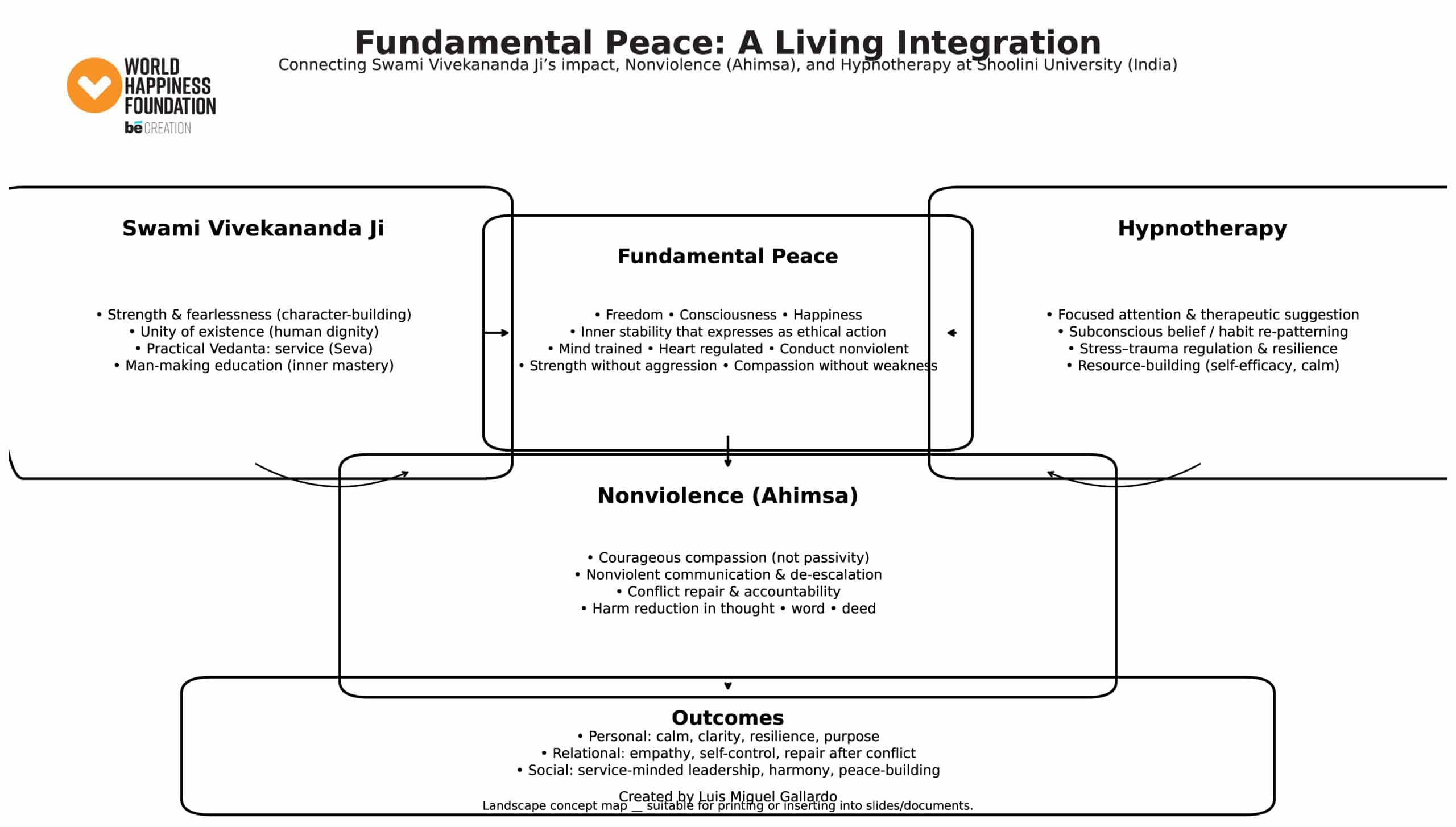
- Fundamental Peace is not just the “absence of problems.” It is the presence of inner steadiness—a baseline clarity that is available when the mind is trained, the heart is regulated, and identity is rooted in something deeper than shifting emotions.
- Vivekananda Ji’s Vedantic lens suggests that beneath mental noise there is a stable ground of being—call it consciousness, Atman, or the deepest Self—where peace is not manufactured but discovered.
This does not deny suffering; it gives us a path through it. It tells us: the mind can be educated; the heart can be purified; the human being can be rebuilt from within.
Nonviolence: Not Mere Restraint, but a Higher Intelligence
Nonviolence is often misunderstood as simple restraint—“don’t hit,” “don’t fight,” “don’t shout.” But real nonviolence is more demanding. It asks: What in me wants to harm? What in me feels threatened? What in me is still at war?
Vivekananda Ji’s spiritual psychology supports nonviolence in three profound ways:
- The unity of existence: If the same divine reality expresses through all beings, then harming another is not just immoral; it is ignorance of our deeper interconnectedness.
- Self-mastery over impulse: He taught discipline, concentration, and control of the mind—qualities without which nonviolence remains a theory rather than a lived capacity.
- Service as the outward form of inner realization: Compassion becomes action. Nonviolence becomes not only “do no harm,” but actively “do good.”
In my work on Fundamental Peace and nonviolence, I frame peace not as a fragile ideal but as a trainable human capability. That is where Vivekananda Ji’s insistence on strength becomes essential: nonviolence requires courage, because it requires meeting provocation without becoming provoked, meeting hatred without becoming hateful, and meeting fear without becoming violent.
The Mind as the Frontier: Why Hypnotherapy Belongs in This Conversation
One of Vivekananda Ji’s most practical contributions is his focus on the mind—its training, its concentration, its powers, and its illusions. His teachings on Raja Yoga and inner discipline speak directly to the modern understanding that transformation is not only intellectual; it is habitual, emotional, and subconscious.
This is the bridge to my teachings on Hypnotherapy at Shoolini University.
Hypnotherapy, when taught and practiced responsibly, is not “magic,” nor is it stage performance. It is a structured method of working with attention, suggestion, imagery, and the subconscious patterns that shape behavior and emotional response. In educational settings, it also becomes a tool for understanding how:
- beliefs are formed and reinforced,
- trauma and conditioning can become automatic responses,
- attention can be trained,
- and inner narratives can be rewritten.
In many ways, the hypnotherapeutic process mirrors a spiritual truth Vivekananda Ji emphasized: human beings do not suffer only because of external events; they suffer because of the meanings and mental patterns they carry. When those patterns change, experience changes.
Fundamental Peace Meets Hypnotherapy: From Inner Noise to Inner Stability
When I connect Fundamental Peace with hypnotherapy, I am essentially working with a central question:
How do we help a person access inner stability even when life is unstable?
Fundamental Peace, as I understand and teach it, includes:
- Self-awareness: the ability to observe one’s own mind without being consumed by it.
- Emotional regulation: the capacity to process strong feelings without spilling them into harm.
- Compassionate cognition: seeing others through the lens of shared humanity rather than threat.
- Nonviolent communication and response: replacing reflex with wisdom.
Hypnotherapy can support this by helping individuals:
- reduce automatic fear responses,
- soften chronic stress patterns,
- reframe limiting beliefs,
- strengthen inner resources through guided imagery and suggestion,
- cultivate calmer physiological states that make nonviolent choices more possible.
To put it simply: nonviolence is easier when the nervous system is not constantly in survival mode. Fundamental Peace becomes practical when the body and mind learn safety from within.
Vivekananda’s “Man-Making Education” and the University Classroom
Teaching at Shoolini University in India, I see every day that education is not only about information—it is about formation. Vivekananda Ji’s phrase “man-making education” is timeless because it asks what education rarely asks now:
- Are we building clarity or confusion?
- Character or mere credentials?
- Inner strength or only external success?
- Service-minded citizens or self-centered competitors?
When hypnotherapy is taught within a broader ethical framework, it becomes a powerful component of “man-making education,” because it deals directly with the formation of the inner human being: attention, belief, identity, habit, impulse, and resilience.
And when Fundamental Peace and nonviolence are woven into this learning, students begin to see that mental skills are not merely personal hacks—they are social responsibilities. A calmer mind creates calmer relationships. A regulated nervous system reduces conflict escalation. A compassionate worldview resists dehumanization. This is not abstract spirituality; it is applied human development.
The Deeper Connection: Vedanta, Consciousness, and Transforming the Subconscious
Vivekananda Ji’s Vedantic vision suggests that beneath our surface identity—roles, fears, defenses—there is a deeper center of consciousness. In practical terms, many people live from the “surface mind”: reactive, conditioned, and easily triggered.
Hypnotherapy, especially when taught with integrity, offers a method to access the deeper layers where conditioning lives. It helps students and clients explore questions such as:
- What belief is driving this pattern?
- What old emotion is shaping this present reaction?
- What internal image of self is silently directing behavior?
- What suggestion—spoken or unspoken—has become “truth” inside me?
In a beautiful alignment, Vivekananda Ji emphasized that spiritual life is, in part, the replacement of false identification with deeper reality. Hypnotherapy can be understood as one of the modern tools that helps facilitate this replacement at the level of habit and emotion—so that insight becomes embodiment.
A Practical Synthesis: Strength, Compassion, and the Nonviolent Mind
If I were to summarize the living synthesis between Vivekananda Ji’s message and my work, it would be this:
- Vivekananda Ji gives us the spiritual anthropology: the human being is capable of greatness; the soul is inherently luminous; strength and compassion must walk together.
- Fundamental Peace gives us the ethical direction: peace is the ground-state we must cultivate; nonviolence is not weakness but wisdom in action.
- Hypnotherapy gives us the applied psychology: methods to work with attention, subconscious patterns, and inner narratives—so peace becomes lived behavior rather than a slogan.
This integration is not a mixing of unrelated fields. It is one continuum: consciousness → conditioning → conduct. Change the consciousness, heal the conditioning, elevate the conduct.
Conclusion: Vivekananda’s Call in Our Time
Swami Vivekananda Ji did not ask the world merely to admire India’s spiritual heritage. He asked India—and humanity—to live it: with strength, dignity, and service. His life reminds us that the most powerful change is not only social or political; it is the transformation of the human interior.
In my work at Shoolini University, and in my commitment to Fundamental Peace, nonviolence, and hypnotherapy education, I see the same challenge Vivekananda Ji addressed: the future depends on the quality of the human mind and heart. When we train attention, purify intention, and strengthen character, we create the conditions for a more peaceful society—not by force, but by awakening.
And perhaps that is his most enduring impact: the insistence that the highest spirituality is not withdrawal from life, but the courage to transform life—starting with ourselves.
…
Explore this topic
Field notes to your inbox
Stay connected to the shift.
Monthly essays from the Observatory, invitations to Fests and Academy cohorts. Written from abundance — never urgency.