
FROM LIGHT WORKERS TO LIGHT LEADERS
Anchoring the New Consciousness Through Soul Work, Incarnated Purpose, and


In the heart of Vietnam – the homeland of Zen Master Thích Nhất Hạnh – a new vision for global flourishing is taking root. As I visit Vietnam to present the philosophy of Happytalism in the local language, it is fitting to honor the wisdom of Thích Nhất Hạnh (fondly known as “Thầy” by his students) that resonates so deeply with this vision. Happytalism is more than a development paradigm; it is a manifesto for “a world of freedom, consciousness, and happiness for all”. These three values – freedom, consciousness, and happiness – form what we call “Fundamental Peace,” meaning peace is not merely the absence of conflict but the presence of liberty, awareness, and joy. Thích Nhất Hạnh’s most influential teachings on inner freedom, mindful consciousness, and true happiness can be seen as key pillars upholding this Fundamental Peace.
As an architect of Happytalism, we recognize Thầy’s impact: his teachings on mindfulness and interconnectedness are “foundational for understanding the symbiosis of individual and collective happiness”. In a visionary and compassionate spirit, let us explore how Thích Nhất Hạnh’s legacy of engaged Buddhism, mindful living, interbeing, and compassionate action aligns with Happytalism’s promise of a peaceful, prosperous society rooted in human flourishing.
At the core of Happytalism lies the conviction that true peace arises from the integration of freedom, consciousness, and happiness. This echoes Thích Nhất Hạnh’s lifelong message that personal transformation and social transformation go hand in hand. I describe Fundamental Peace as a state defined by freedom, consciousness, and happiness – a triad of pillars supporting a world where everyone can thrive. In Thích Nhất Hạnh’s words, “peace in oneself, peace in the world.” He taught that we must cultivate inner freedom – freedom from fear, anger, and discrimination – as a “daily practice” because “freedom is the only condition for happiness”. Happiness, in turn, is not an elusive goal but a way of being available in each moment of awareness. Likewise, Happytalism posits that “without inner freedom and happiness, outer peace remains fragile”.
In other words, a society can only be fundamentally peaceful when its people enjoy the freedom of mind and spirit to live consciously and joyfully. Thích Nhất Hạnh’s gentle reminder that “many people think excitement is happiness… True happiness is based on peace” reinforces the Happytalist view that genuine well-being is grounded in tranquility and freedom, not in relentless competition or material excess. Both Thầy’s teachings and the Happytalist philosophy urge us to cultivate liberty in our hearts, awaken our consciousness, and nurture happiness as the path and destination.
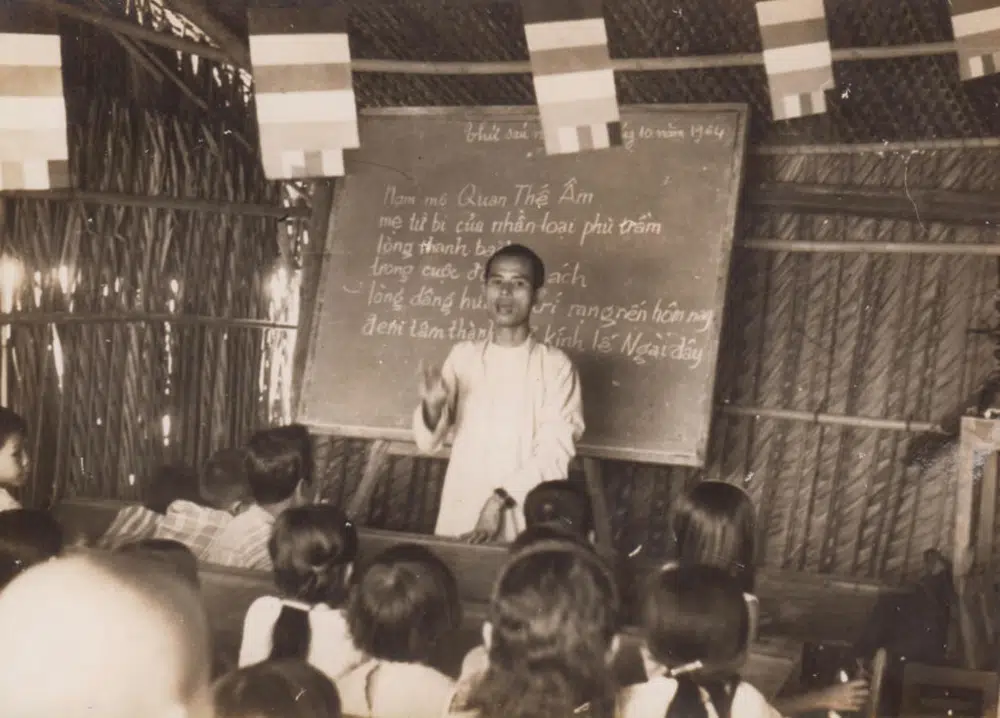
Thích Nhất Hạnh teaching children in rural Vietnam in 1964, at the School of Youth for Social Service. He pioneered “Engaged Buddhism” – bringing compassionate action into communities, an approach that aligns deeply with Happytalism’s call for co-creating a happier society.
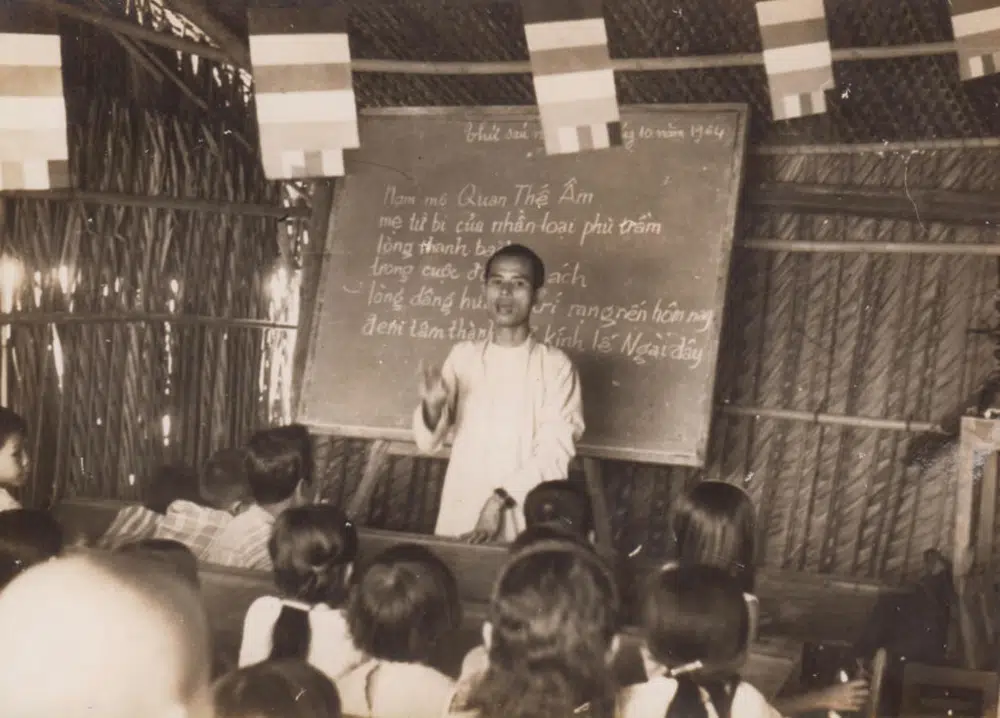
From the early days of his monastic life, Thích Nhất Hạnh believed that spirituality must be actively engaged in relieving suffering in society. In the 1960s, as war raged in Vietnam, he founded youth relief teams, schools, and a new Buddhist order dedicated to social service. He “pioneered Buddhist engagement in social work and rural development,” establishing in 1965 the School of Youth for Social Service – a kind of Peace Corps for Vietnam.
This approach became known as “Engaged Buddhism,” grounded in the insight that mindfulness and compassion should translate into concrete action to build peace and well-being in the world. Happytalism shares this ethos of compassionate engagement: it emphasizes “social cohesion and collective action” to address challenges and “building the new world within the shell of the old” through cooperation. Thích Nhất Hạnh showed that true happiness requires us not only to be peaceful within, but also to act peacefully without – to serve others, promote justice, and heal the wounds of society. He famously persuaded Dr. Martin Luther King Jr. to oppose the Vietnam War by sharing a simple truth: “Men are not our enemies. If we kill men, with whom shall we live?”. Dr. King, inspired by Thầy’s example, nominated him for the Nobel Peace Prize and echoed his message that compassion must guide us toward peace.
Thích Nhất Hạnh taught that working for peace is not a matter of anger or blame, but of love in action. “We should not walk ‘for’ peace. We should be peace as we walk,” he reflected – a powerful reminder that how we do something is as important as what we do. Happytalism, in turn, calls for shifting from a fear-based, competitive mindset to one of “abundance, trust, and generosity,” asking not “Who is to blame?” but rather “How can each of us be part of the solution?”. In embracing engaged Buddhism, we become “happiness activists” co-creating a compassionate society. Every step taken in mindfulness, every act of kindness or justice, is a building block of Fundamental Peace and collective happiness.
At the heart of Thích Nhất Hạnh’s teaching is mindfulness – the energy of being fully present and aware in each moment. He often guided people in the simple practice of mindful breathing to return to the “here and now,” where life is actually available. “Breathing in, I calm my body and mind. Breathing out, I smile. Dwelling in the present moment, I know this is the only moment,” he wrote. This gentle exercise encapsulates an entire philosophy: through conscious breathing and smiling to life, we generate peace within ourselves.
Happytalism likewise underscores the importance of higher consciousness and inner development as foundations for societal well-being. In fact, Happytalism is built on twin pillars of individual and collective development, recognizing that qualities like mindfulness and compassion cultivated at the individual level “radiate into collective change.”. Thích Nhất Hạnh’s influence is evident in this approach – he showed that a mindful individual can transform their family, their community, and eventually the world. He used to say that “happy teachers will change the world,” meaning that educators (and leaders of any kind) who embody inner peace and joy will naturally transmit those to others, creating ripples of positive change.
By practicing conscious living – whether through meditation, mindful walking, or simply drinking tea with full presence – we elevate our own consciousness. This not only reduces our stress and suffering, but also contributes to a more aware and empathetic society. Modern science and positive psychology echo these insights, showing that mindfulness fosters emotional resilience and pro-social behavior. Thầy’s life was a testament to the power of consciousness: even after a severe stroke late in life, he continued to emanate peaceful presence in his silence, teaching by example that being is sometimes more powerful than words or action.
The World Happiness Community embraces this wisdom by promoting mindfulness training, meditation, and emotional well-being practices as key to achieving societal happiness. In essence, to raise the collective consciousness, we must start with ourselves – breathing, smiling, and living each moment deeply. This awakening of hearts and minds is how we “address problems at their roots” and create the conditions for Fundamental Peace.
One of Thích Nhất Hạnh’s most influential contributions to modern spirituality is the concept of Interbeing. He coined this term to describe the reality of radical interdependence: nothing and no one exists in isolation; everything “inter-is” with everything else. In Thầy’s poetic explanation, “You cannot be by yourself alone – you have to inter-be with everybody and everything else.” For example, “if you look deeply into a flower, you find it is made of non-flower elements like sunshine, clouds, rain, and soil… The flower inter-is with the sunshine and rain; it cannot be by itself, alone. It is the case with humans also. I am here because you are there.”.
This profound understanding – that our lives are woven together in a single fabric of being – is also a pillar of Happytalism’s philosophy. The World Happiness vision emphasizes “the interdependence of all species and our interconnection with nature and the planet.” Humans are not separate from each other or from the Earth; rather, “our well-being is entwined with the well-being of all other people, creatures, and ecosystems.” In the language of Happytalism, it is recognized (even by quantum science) that “everything in the universe is connected at a fundamental level… a profound unity that sages have long intuited.”
Thích Nhất Hạnh was one of those sages. He often illustrated interbeing by holding up a sheet of paper and inviting us to see the clouds, the rain, the forest, the logger, and even our own mind in that paper. By this he meant: literally everything in the cosmos has played a part in the existence of this sheet of paper – and likewise in each of us. When we awaken to this truth of interbeing, a natural love and responsibility for others arises. We see that taking care of other people and the planet is taking care of ourselves. This insight is crucial for what Happytalism calls a “paradigm of oneness” in building society. If we truly understand interbeing, policies that prioritize competition or exploitation make no sense, because harming others is ultimately harming ourselves. I
nstead, we shift toward collaboration, shared prosperity, and reverence for life. Thầy applied interbeing to social activism by urging dialogue, understanding, and reconciliation, rather than division. In a world rife with conflict, his message was that we are one human family “inter-being” with a larger web of life. Happytalism channels this message by advocating that we “honor our shared humanity and our collective relationship with a living Earth”.
The goal is a peaceful, sustainable global community where fundamental needs are met and happiness is pursued not in isolation, but together – as an outcome of recognizing our profound interdependence. As Thích Nhất Hạnh’s calligraphy often reminds us: “We are all leaves of one tree” and “the bread in your hand is the body of the cosmos.” In this spirit of interbeing, Happytalism invites us to build an economy and society that cherish belonging, mutual care, and unity, so that human flourishing and planetary flourishing become one and the same.
Freedom, in Thích Nhất Hạnh’s teaching, is far more than political liberty – it is freedom from internal afflictions like fear, ego, anger, and craving. He taught that letting go of these heavy energies is the way to liberate the heart. “Letting go gives us freedom, and freedom is the only condition for happiness. If in our heart we still cling to anything – anger, anxiety, or possessions – we cannot be free,” he wrote. This insight aligns perfectly with Happytalism’s view that inner freedom is a cornerstone of a happy and peaceful society.
In a Happytalist world, well-being is measured not just by external factors but by the degree to which people can live without fear and with authentic fulfillment. Thầy often asked, “What is preventing us from being happy right now?” Usually, it is our own attachments or worries. Through mindfulness and meditation, he showed countless people how to release grudges, reconcile with the past, and thus taste true freedom. One of his well-known maxims is that “the amount of happiness that you have depends on the amount of freedom you have in your heart.”
Indeed, happiness and freedom are inextricably linked: when we are free from mental chains, we naturally experience contentment. Conversely, a society that aims for happiness must empower its people with freedom – freedom of thought, freedom to live in alignment with their values, freedom from want and discrimination. Happytalism envisions just such a society. It reframes progress in terms of increasing people’s capacities to live meaningfully and peacefully. This includes freedom from extreme poverty and fear of violence, but also freedom to develop one’s potential and contribute to the community. Thích Nhất Hạnh’s life illustrated this kind of freedom.
Though exiled from his homeland for 39 years, he never became bitter; he remained tự do (free) in spirit, using his voice to spread messages of forgiveness and hope. He taught that when we understand interbeing and practice mindfulness, we stop being prisoners of the past or slaves to consumerism. We realize, as he did, that “Because you are alive, everything is possible” – each moment can be a new beginning. In practical terms, Thầy guided people to cultivate gratitude and simplicity, suggesting that happiness is available in the very ordinary moments when we are present. This perspective helps dissolve the illusion that happiness must be chased or bought; instead, happiness blossoms naturally from a free and conscious heart.
By integrating this wisdom, Happytalism encourages a culture where success is not defined by accumulation or domination, but by the degree of freedom and happiness shared by all. A fundamentally peaceful world is one where each person has the inner freedom to smile, to love, and to live without fear – and where our systems and institutions protect that freedom as the most precious treasure.
Thích Nhất Hạnh often said, “The way out is in.” By this he meant that to solve the problems of our time – war, inequality, climate change, despair – we must first look inward and transform ourselves. His legacy is a roadmap to Fundamental Peace: start with inner peace and freedom, express it in mindful action, and build communities of love and understanding. This is exactly the journey that Happytalism invites us to undertake on a global scale. It is a journey from fear to trust, from scarcity to generosity, from fragmentation to togetherness. The World Happiness Community envisions “a future where Fundamental Peace – peace built on freedom, consciousness, and happiness – is the norm, not the exception.” Achieving this future means each of us becoming a guardian of that peace in our own sphere, and all of us working together to transform our communities.
In Vietnam, where Thích Nhất Hạnh’s spiritual roots run deep, the message of Happytalism arrives like a blossoming lotus. It carries forward the teachings of a humble monk who showed the world that mindfulness, compassion, and courage can revolutionize society. We are reminded of the image of Thầy leading a walking meditation – a stream of monks, nuns, and laypeople flowing peacefully through tall pines. “There is no need to struggle,” he said. “Enjoy each step. We have already arrived.” In the same way, Happytalism asks us to enjoy the steps toward a new paradigm, knowing that each mindful step is the revolution. By practicing engaged Buddhism and Happytalism, we learn that the means and the ends converge: a happy world is built by living the values of happiness right here, right now.
Visionary yet practical, compassionate yet bold – the spirit of Thích Nhất Hạnh lives on in every initiative for peace and well-being. As we stand at the intersection of his enduring wisdom and the Happytalist vision for the future, we are filled with hope. Imagine a world where policymakers meditate, where businesses measure success in well-being, where schools teach children to breathe and smile, where neighbors truly see each other as brothers and sisters. This is not a utopia but an attainable horizon if we have the courage to apply what Thầy taught: be mindful, be kind, be free inside – and then engage wholeheartedly in society.
In the words of the World Happiness Foundation’s call: “Walk the path of peace, compassion, and love. Choose love as a strategy. Commit to life.” This path is illuminated by Thích Nhất Hạnh’s example, and it leads us to a prosperous society rooted in human flourishing. Let us continue to take mindful steps together, inspired by Thầy’s gentle wisdom and Happytalism’s generous vision, so that freedom, consciousness, and happiness become the guiding lights for all. In doing so, we honor our teacher and actively co-create the Fundamental Peace that he dreamed of – a world where everyone can truly be free and happy.
Sources:
Anchoring the New Consciousness Through Soul Work, Incarnated Purpose, and

By Luis Miguel Gallardo Founder & President, World Happiness Foundation
Why the Deepest Meaning in Your Life Is Already Inside