

THE ROAD MAP TO SUPRACONSCIOUSNESS: From the Diagnosis of a World in Crisis to the Conscious Evolution of Humanity
A Framework for Systemic Transformation Through the Wisdom of Hawkins,
Someone asked me recently what I think the most important job title of the next decade will be.
Not AI Engineer. Not Sustainability Director. Not even Head of Innovation.
Chief Well-Being Officer.
They laughed. A polite laugh—the kind that means: interesting idea, but surely you’re not serious.
I am completely serious.
In fact, I think the emergence of the Chief Well-Being Officer as a genuine executive role—not a rebranded HR function, not a wellness programme with a budget line, but a true seat at the leadership table—is one of the most consequential organizational shifts of our time. And I think we are only just beginning to understand why.
The most important leadership question of our era is not ‘how do we perform better? ‘— it is ‘how do we become the kind of leaders whose presence makes flourishing possible?’
In the last three posts in this series, I have been building a case, from belonging to measurement to the economics of flourishing. Each piece has pointed toward the same question, approaching it from a different angle:
Who leads this?
The Belonging Revolution needs architects. The Gross Global Happiness framework needs champions inside institutions. The Cities and Schools and Hospitals of Happiness need someone in every room where decisions are made who holds the question: and what does this do to human flourishing?
That person is the Chief Well-Being Officer. And the role demands a kind of leadership that our existing models—heroic, transactional, charismatic—are not equipped to produce.
It demands leadership from the inside out.
Let me be direct about something that does not get said enough in leadership conversations.
Most of the institutions that are failing us right now—producing inequality, environmental destruction, mental health crises, cultures of fear and burnout—are led by people who are, by conventional measures, extremely successful. High IQ. Impressive credentials. Decisive. Visionary, even.
And yet. Something is missing.
In the Integrative Transformation Model—the ITM that I have been developing at the intersection of depth psychology, contemplative wisdom, and leadership science—I call this the shadow problem of leadership. The shadow, in Jungian terms, is not evil. It is simply the unintegrated part of the self — the qualities we have not yet brought into the light of awareness.
For most leaders, the shadow contains precisely the capacities that Happytalist leadership requires: vulnerability, tenderness, the willingness to not-know, the ability to feel the human consequences of decisions made from behind a spreadsheet.
We have trained leaders to perform confidence while suppressing doubt. To project certainty while punishing uncertainty. To optimize efficiency while quietly starving the relational fabric that makes organizations alive.
The result is institutions that are technically functional and humanly hollow.
The Chief Well-Being Officer is, among other things, a corrective to that hollowness. But only if the role is inhabited by someone who has done the inner work — who has moved, as the ITM describes it, from shadow to essence.
You cannot create a culture of flourishing from an unexamined inner life. The institution always reflects the consciousness of the people who lead it.
The ITM — Integrative Transformation Model — maps a developmental journey that every leader capable of transformational impact must travel. It is not a linear path. It spirals. You revisit its stations at deeper and deeper levels as life and leadership call you forward.
The journey begins in the mask — the carefully constructed persona that every professional learns to wear. The mask is not dishonest; it is protective. But when the mask becomes the totality of who you bring to leadership, the organization gets a performance instead of a presence.
Moving through the mask means encountering what lies beneath it: the wounds that drive perfectionism, the fears that harden into control, the ungrieved losses that express themselves as cynicism. This is shadow territory. It is uncomfortable. Most leadership development programmes carefully avoid it.
The ITM does not avoid it. Because the research — from developmental psychology, from neuroscience, from forty years of studies on transformational versus transactional leadership — is unambiguous: leaders who have done shadow work are more creative, more resilient, more trusted, and produce more psychologically safe environments than those who have not. Full stop.
Beyond the shadow lies essence — the authentic core of a leader’s being that is neither the polished mask nor the wounded defensive self. Essence is where Vivekananda’s strength lives. Where Thich Nhat Hanh’s peace lives. Where the Mothers of the Lineage — Sarada Devi, The Mother — demonstrated that love, when fully inhabited, becomes the most powerful organizational force in existence.
The Chief Well-Being Officer must be an essence leader. Not perfect. Not permanently serene. But genuinely on the journey — and honest about where they are on it.
Let me be concrete, because this role is too often described in abstractions.
A Chief Well-Being Officer who is operating from the Happytalist framework does at least seven things that no other C-suite role is positioned to do:
The Chief Well-Being Officer is not a wellness manager. They are a civilization builder — working at the scale of one institution at a time.
In my piece on Barbara Brennan’s seven levels of the human energy field — alongside the Vedic koshas and the chakra system — I was exploring what it means to lead as a whole being rather than as a disembodied intellect attached to a decision-making machine.
The insight that has stayed with me is this: every level of the human system — physical, emotional, mental, relational, causal — is simultaneously a leadership capacity. A leader who is only operating from the mental level — from analysis, strategy, rational argument — is leaving enormous leadership bandwidth untouched.
The body knows things the mind has not yet processed. Emotions carry information that data cannot. The subtle energy of a room — the field that Brennan mapped with such precision — is real, and leaders who can read it and work with it have access to a dimension of organizational intelligence that most leadership schools have never acknowledged.
The Chief Well-Being Officer is, in this sense, a whole-being leader. Not a mystic who has retreated from institutional life — a fully grounded, organisationally fluent executive who happens to understand that human beings are not only rational actors, and that the organisations they create are not only rational systems.
They are living ecosystems. And they require leaders who know how to tend them.
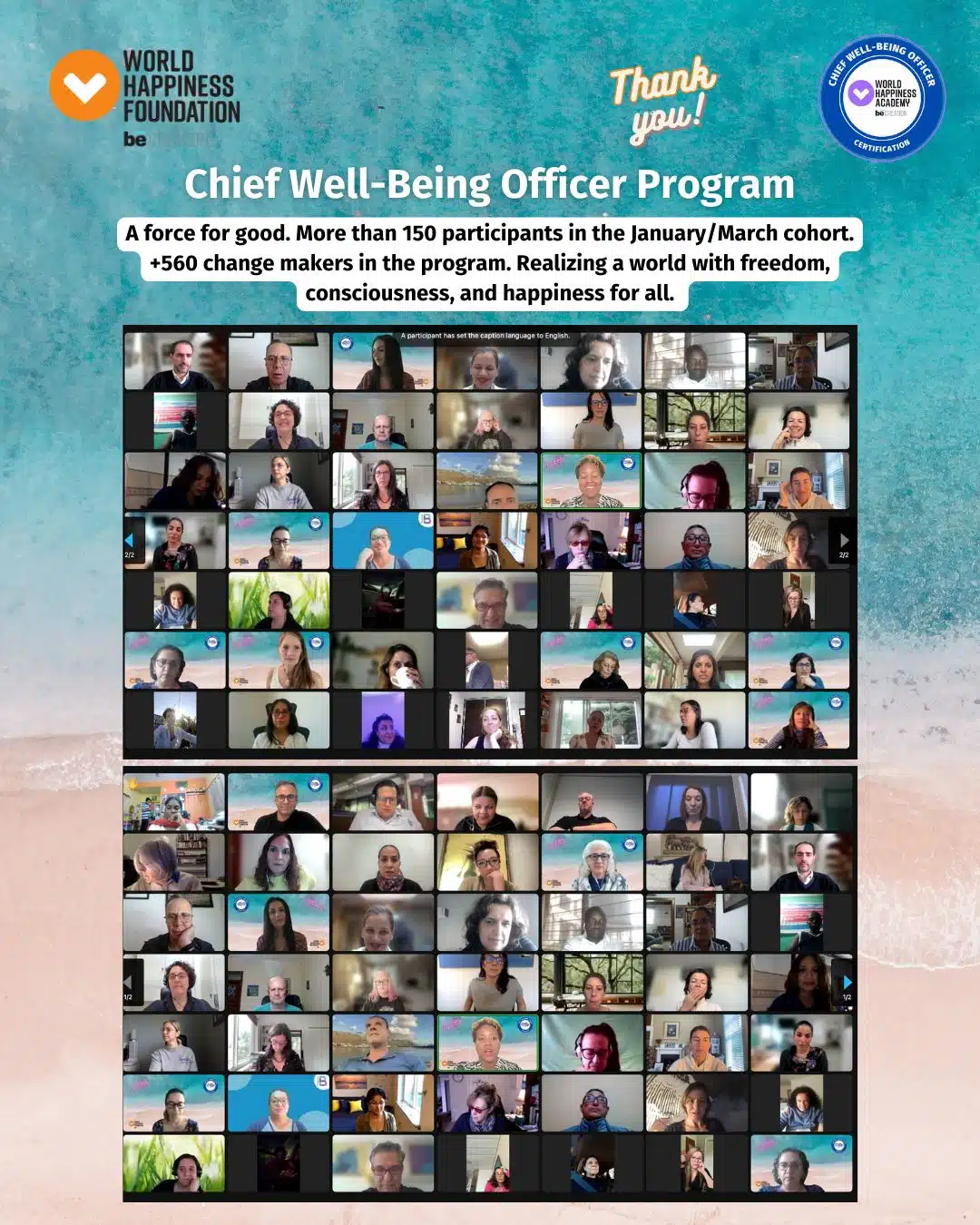
The World Happiness Academy exists precisely to develop this kind of leadership. The Chief Well-Being Officer programme — which I have been building with partners across five continents — is not a certification course. It is a transformation journey.
Participants move through the ITM stages. They encounter their own shadows in a supported, rigorous environment. They learn the GGH framework not as an external tool but as an internal compass. They spend time in the field — in Schools of Happiness, in Cities of Happiness, in the communities where Happytalist principles are being lived rather than theorized.
They go to Bhutan and feel what a society organized around consciousness looks like in its landscape, its governance, its schools. They go to Costa Rica and understand what it means to make institutional choices from a long-term flourishing orientation. They come back changed — not because we changed them, but because they encountered something in themselves that the journey made visible.
That is the only leadership development that lasts.
Let me ask you directly.
In your organization — wherever you lead, whatever its size or sector — is there someone whose explicit mandate is to hold the question of human flourishing?
Not someone who runs the yoga classes and the mental health days. Someone who sits in the room where strategy is decided and asks, with institutional authority: and what does this do to the aliveness of the people who will live inside it?
If the answer is no — or not really, or sort of, sometimes — then you are leading an institution that is flying partially blind. You are optimizing for the metrics you can see and hoping that the ones you cannot — belonging, meaning, psychological safety, long-term resilience — will take care of themselves.
They will not.
The Belonging Revolution needs leaders. The Economy of Flourishing needs champions. The civilization we described in these four posts — grounded in Fundamental Peace, organized around Gross Global Happiness, designed for human connection — needs people inside every institution who hold its possibility alive, every day, in every meeting, in every decision.
That is the Chief Well-Being Officer.
Perhaps it is you.
Join our Chief Well-Being Officer program and become part of the largest CWO Community in the world.
Chief Well-Being Officer | Happytalism | ITM | Leadership | Shadow Work | Fundamental Peace | Consciousness | World Happiness Academy | Whole-Being Leadership | Brennan | Koshas
About the Author
Luis Miguel Gallardo is the Founder & President of the World Happiness Foundation, creator of Happytalism, and Professor of Practice at Shoolini University’s Yogananda School of Spirituality and Happiness. He leads the Chief Well-Being Officer program at the World Happiness Academy.
A Framework for Systemic Transformation Through the Wisdom of Hawkins,
A Comprehensive Global Mapping of Authoritarianism, Armed Conflict, and Violations
Joseph Campbell gave the modern world a powerful language for