consciousness
Mothers of the Lineage: From Love to Service to the Supramental.
When I wrote from Vietnam, I was tracing “Fundamental Peace” as a lived foundation—peace not as a mood but as a way of touching the world, step by step, breath by breath. That writing was guided by Thích Nhất Hạnh’s simple insistence: practice now; arrive now; make the next action kinder. Now, in Ko
February 4, 2026·Luis Miguel Gallardo·8 min read
AI insights
When I wrote from Vietnam, I was tracing “Fundamental Peace” as a lived foundation—peace not as a mood but as a way of touching the world, step by step, breath by breath. That writing was guided by Thích Nhất Hạnh’s simple insistence: practice now; arrive now; make the next action kinder.
Now, in Kolkata, the spiritual air feels different—less about quieting the river and more about learning to become the river: devotional, forceful, tender, relentless. Here, the lineage from Ramakrishna to Vivekananda to Aurobindo isn’t only a sequence of towering men. It is also—crucially—a revelation of the Mother principle moving through history: women whose presence made realization sustainable, made philosophy practical, and made transformation embodied.
This follow-up is for the “mothers” in that lineage—especially three luminous feminine forces:
- Sri Sarada Devi — universal motherhood as love in action.
- Sister Nivedita — the fierce educator-heart that turned ideals into service.
- The Mother — the executive force of integral transformation and the supramental horizon.
And I’m writing them not as “supporting characters,” but as essential currents—without which the lineage’s promise of peace, service, and transformation would remain incomplete.
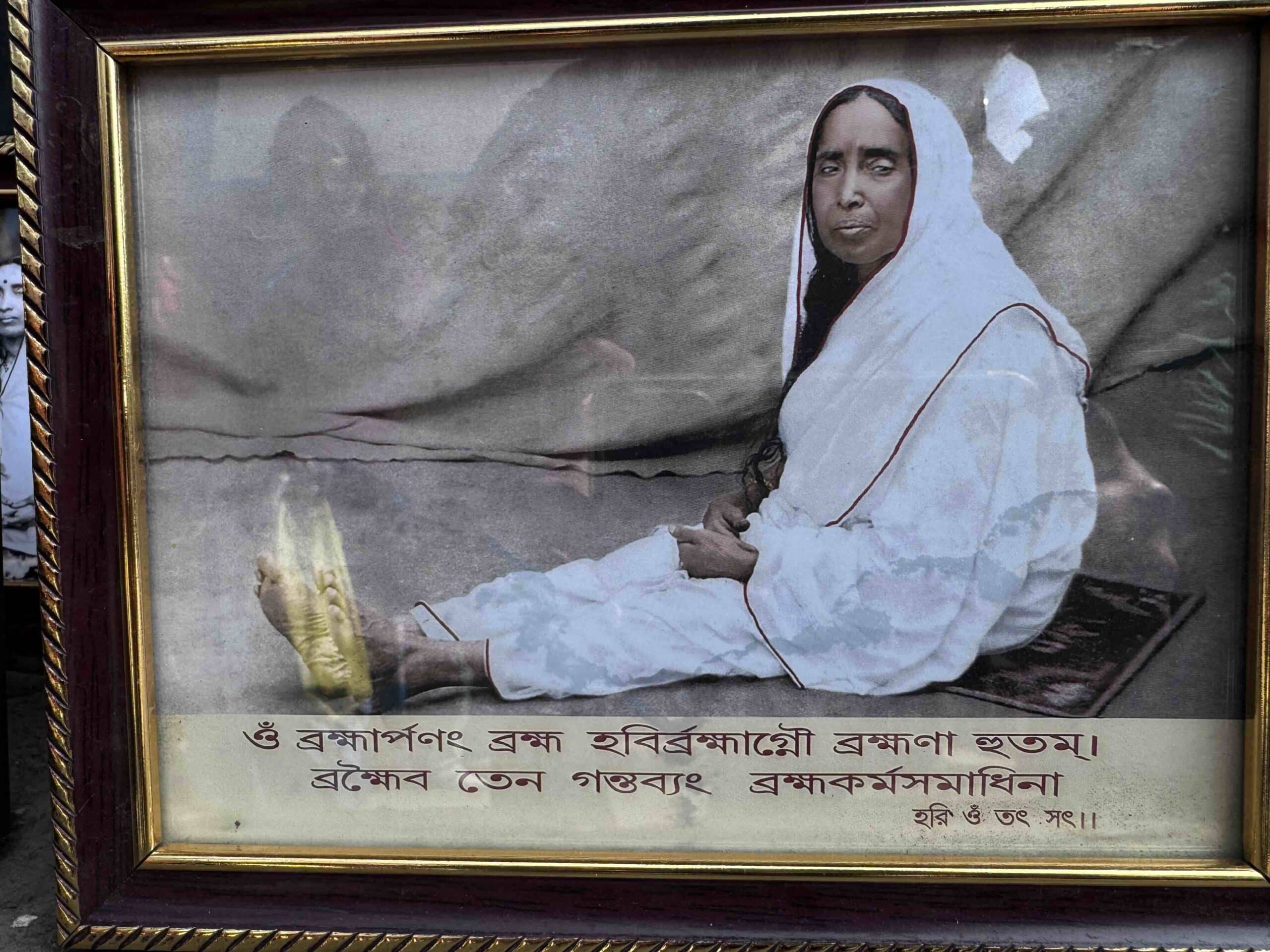
1) Sarada Devi: motherhood as the stability of realized love
Ramakrishna’s path is often summarized as realization through love and direct experience. But love, by itself, can become private ecstasy—an inner fire that doesn’t necessarily translate into a culture, a community, a way for ordinary lives to be held and guided.
That is where Sarada Devi enters—not as an accessory, but as the grounding and continuation of the realization.
At Dakshineswar Kali Temple, the story becomes more than biography; it becomes a map of feminine–masculine harmony. According to accounts from the Ramakrishna tradition, Ramakrishna recognized Sarada Devi as a manifestation of the Divine Mother and ritually worshipped her as such—awakening what the tradition calls “universal Motherhood” in her.
What does that mean in human terms?
It means that the “masculine” principle of aspiration, inquiry, and transcendence (often symbolized as the upward flame of realization) met the “feminine” principle of nurture, inclusion, and embodiment (the capacity to hold many lives without losing the inner centre). And something new became possible: realization that doesn’t flee the world, but mothers it.
After Ramakrishna’s passing, Sarada Devi did what mother-forces often do: she held the movement together, not by loud authority but by steadfast presence. She accepted spiritual seekers, embraced people without distinction, and became a living doorway for hundreds. In the same sources, she is described as remaining simple in lifestyle—serving, forbearing, blessing—while being revered as the Divine Mother.
In other words: she made holiness habitable.
And notice how this already reframes “peace.” Sarada Devi’s peace is not withdrawal. It is the peace that can remain calm while caring for many needs—the peace that isn’t fragile, the peace that can withstand community, conflict, and complexity. That kind of peace is not passive; it’s foundational.
In my Vietnam writing, I called it peace as a foundation, not a performance. Here, Sarada Devi shows what that looks like in a human being who becomes a refuge for others.
2) Vivekananda’s Shakti vision: women as the future-makers of service
Vivekananda’s gift was a universal message and a fierce practicality: service as worship. But even within his universality, he was sharply clear that a society cannot rise while women are neglected.
In The Complete Works of Swami Vivekananda there is a striking line (recorded as a report of a lecture): “The best thermometer to the progress of a nation is its treatment of its women.”
This isn’t a modern “add-on” to his thought. It’s a central lever.
And his relationship to the feminine was not merely “respect.” It was metaphysical. He saw the Mother principle—Shakti—as a power that must reawaken for India (and the world) to regenerate.
A page from Belur Math records a letter in which Vivekananda wrote of Sarada Devi: “Mother has been born to revive that wonderful Shakti in India…” and he repeatedly expressed the wish for a women’s monastic order with Holy Mother as inspiration.
Read that carefully: the “revival” is not about nostalgia. It’s about Shakti returning to history—not only as goddess-language, but as women’s education, women’s spiritual authority, women’s organization, women’s leadership.
That wish later took institutional form in Sri Sarada Math and allied work. But before institutions, it needed a living bridge—someone who would turn universal ideals into immediate, embodied action.
That bridge was Sister Nivedita.
3) Sister Nivedita: the lioness who mothered a new future
If Sarada Devi embodies motherhood as spiritual refuge, Sister Nivedita embodies motherhood as cultural and educational courage.
Her story matters for our time because she shows a rare synthesis:
- intensity without domination
- devotion without passivity
- service without self-erasure
- courage without hatred
Sources from the women’s monastic tradition connected to Ramakrishna describe her as plunging into action during the plague in Kolkata—organizing relief and nursing the sick—often at real cost to her own health. They also describe her founding a girls’ school at Bosepara Lane with the blessings of Holy Mother—pushing against social hesitation and making women’s education tangible, local, real.
The point is not simply “she did good work.” The point is what her being represents in the lineage:
- Vivekananda gives the call: service as worship; uplift women; awaken Shakti.
- Nivedita gives the body: classrooms, hygiene, nursing, the daily grind of changing a culture.
A Belur Math publication note describes her as “a champion of Indian education and Indian Nationalism” and emphasizes the importance of her lectures and writings in the movement’s rejuvenation.
In the arc from Ramakrishna to Vivekananda, Nivedita is one of the clearest examples of feminine–masculine harmony in action:
- The masculine function (in the symbolic sense) brings vision, thrust, universality, and fearless proclamation.
- The feminine function brings gestation, education, care, continuity, and cultural translation.
But here’s the subtle part: Nivedita was not “soft.” She was fierce. And that is a key correction to how “feminine” is often misunderstood. Feminine power is not weakness; it is life-force organized around love.
That’s why I call her a “mother” in this trilogy: she mothered a future that did not yet exist—through education, service, and the stubborn insistence that women must be at the centre of any real regeneration.
4) The Mother and Aurobindo: the feminine as the executive force of transformation
Aurobindo’s promise is integral transformation—divine life on earth. If Ramakrishna reveals the heights of direct God-experience, and Vivekananda turns realization outward into service, Aurobindo aims at something even more demanding: consciousness transforming mind, life, and body—so spirituality is not an escape but an evolutionary change.
And here, the Mother principle becomes unmistakably central.
According to Sri Aurobindo Ashram, The Mother was born Mirra Alfassa in Paris, met Aurobindo in 1914, returned permanently in 1920, and when the Ashram was formed in 1926, Aurobindo entrusted her with its “full material and spiritual charge.” This is already a radical spiritual statement: the work’s embodiment and organization is placed in a woman’s hands—not as administration, but as spiritual governance.
But it goes even deeper.
Aurobindo’s own description of her is explicit: he writes that she should be regarded as the Divine Shakti working in the body “to bring down something not yet expressed in this material world so as to transform life here.”
This is the most direct articulation of feminine–masculine harmony in the entire lineage:
- Aurobindo represents (in symbolic terms) the vastness of consciousness, the vision, the map of the integral path.
- The Mother represents the Consciousness-Force—Shakti as executive power—doing the actual work of descent, organization, education, embodiment.
And the supramental isn’t merely a poetic term here; it’s marked in the tradition as a concrete event: the Ashram’s “Important Dates” page records 29 February 1956 as the “Day of the Supramental Manifestation,” when The Mother had “the concrete experience of the descent of the Supramental Consciousness on Earth.”
Whether one reads that mystically, psychologically, or symbolically, the relevance is clear: the lineage evolves from realization → service → transformation. And in the transformation phase, the feminine is not secondary—it is the very mode of manifestation.
Even the Mother’s outward works mirror this: the Ashram records her founding the Sri Aurobindo International Centre of Education and later founding Auroville in 1968. The “supramental” is not an abstract sky—it’s pressed into education, community, collective life.
5) How the feminine and masculine harmonize into peace, supramental, beyond
So what does all this mean for a world that is tired, polarized, and craving both meaning and practical healing?
For me, the answer is that these three women show a threefold harmony—not between “men and women” as social categories, but between two deep principles within every human and every society:
- Consciousness (clarity, witness, aspiration, universality, discernment)
- Force (love, nurture, creativity, embodiment, organization, compassion)
When these principles split, we see two common failures:
- Consciousness without force becomes beautiful ideas with no traction—insight that never becomes care, philosophy that never becomes shelter.
- Force without consciousness becomes activism without inner grounding—care that burns out, service that turns into resentment, power that loses its soul.
Now look again at the lineage through the mothers:
- Sarada Devi shows force rooted in stillness—motherhood that is vast yet calm; refuge without fragility.
- Nivedita shows force as courageous construction—schools, relief, education, cultural regeneration.
- The Mother shows force as evolutionary embodiment—Shakti as the power that transforms life itself, not just minds.
And if I bring back the lens of Fundamental Peace from Vietnam—peace as practice, peace as ethical living, peace that holds up in markets and bus stations and misunderstandings—then these mothers offer a further step: peace that can build institutions, transmit lineage, and hold collective transformation.
This is where “beyond” becomes real.
- Beyond personal serenity: into collective refuge (Sarada).
- Beyond private spirituality: into service as worship (Nivedita in Vivekananda’s current).
- Beyond moral improvement: into integral transformation (The Mother in Aurobindo’s horizon).
Fundamental peace becomes the ground. The supramental becomes the invitation to evolve consciousness itself. And “beyond” becomes not escape—but embodiment.
Closing practice: a daily ritual of the three Mothers
If you want to make this lineage practical—not as history, but as a living path—try this simple daily ritual for 7 days:
- One minute of arriving Breathe as I wrote in Vietnam: arrive now; soften now; stop running.
- One gesture of devotion Not necessarily religious—just sincere. Offer the day (or the next hour) to what is highest in you.
- One act of service Small, concrete, done today. Make it invisible if possible.
- One act of inner truthfulness Ask: Where am I divided? Where do I perform peace instead of practicing it? Then choose one honest correction.
- One surrender to transformation Not surrender as collapse—surrender as openness: Let the deeper force work in me.
This is how feminine and masculine harmonize: aspiration and grace; clarity and love; realization and service; stillness and action; heaven and earth. Not as theory, but as a way of becoming peace that can carry a world.
…
Field notes to your inbox
Stay connected to the shift.
Monthly essays from the Observatory, invitations to Fests and Academy cohorts. Written from abundance — never urgency.