consciousness
The Witness Within
A Comprehensive Guide to the Awareness That Frees Us — and the Vocation of Those Who Cultivate It by Luis Miguel Gallardo Founder & President, World Happiness Foundation The Capacity Beneath All Capacities There is one capacity that quietly underwrites every meaningful change a human being has ever
May 13, 2026·Luis Miguel Gallardo·19 min read
AI insights
A Comprehensive Guide to the Awareness That Frees Us — and the Vocation of Those Who Cultivate It
by Luis Miguel GallardoFounder & President, World Happiness Foundation
The Capacity Beneath All Capacities
There is one capacity that quietly underwrites every meaningful change a human being has ever made. It is older than psychology, older than philosophy, older than the cities we live in. It is so ordinary that we use it a hundred times a day without noticing — and so extraordinary that those who have followed it to its source have called it, variously, liberation, enlightenment, grace, and home.
The capacity is this: to notice that we are noticing.
To experience an emotion and, in the same instant, to know that an emotion is being experienced. To think a thought and to be aware that a thought is arising. To suffer, to rejoice, to grieve, to love — and within all of it, to find a quiet, unwavering presence that is neither the suffering nor the rejoicing, neither the grief nor the love, but the awareness in which all of these come and go.
In the contemplative traditions, this presence is called the Witness.
For more than two decades — across hypnotherapy rooms in Madrid and Miami, regression work in the Life Between Lives tradition, leadership rooms in Geneva and São Paulo, peace forums at UPEACE, and the founding of the World Happiness Academy — I have watched one thing more reliably than any other: when a person makes contact with the Witness, something changes. Not the content of their life. Not the difficulty of their circumstances. But the relationship between the person and their experience. And from that change, every other change becomes possible.
This essay is a careful, layered exploration of the Witness — what it is, how the great traditions have understood it, what contemporary psychology and neuroscience are confirming about it, the seven progressive levels through which it matures, the practices that cultivate it, and the vocation of those who choose to dedicate their working lives to inviting others into it.
If you find yourself, by the final paragraph, sensing that this work belongs to you — that this is what you are here to do — then you will know how to respond.
I. What the Witness Is
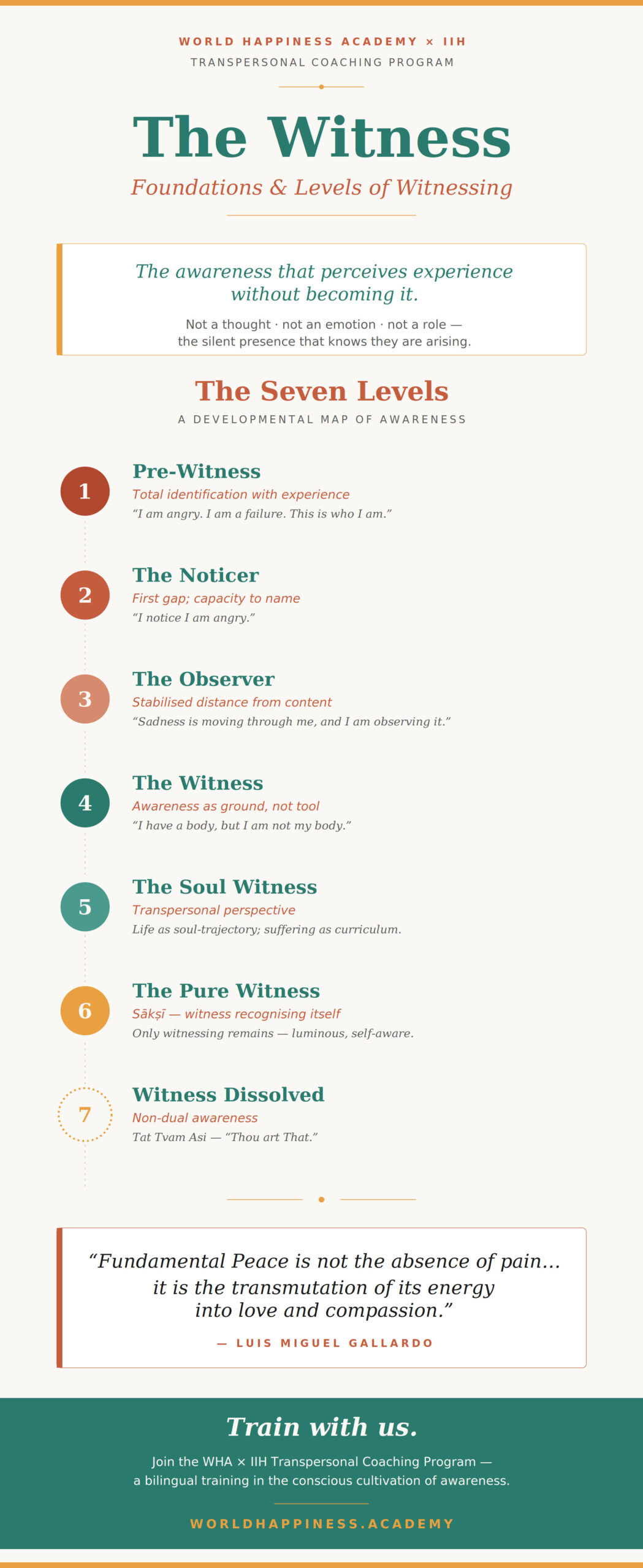
The Witness is the awareness that perceives experience without becoming it.
It is not a thought. Thoughts arise within the Witness, the way clouds arise within a sky. It is not an emotion. Emotions move across the Witness, the way weather moves across the sky. It is not a role — partner, parent, professional, citizen. Roles are performed within the Witness, the way characters are performed within the open space of a stage.
To meet the Witness is to discover that all your life you have been searching for yourself in the wrong place. You looked for yourself in your thoughts and found a constantly shifting commentary. You looked for yourself in your emotions and found a tide that came and went. You looked for yourself in your achievements and your relationships and your stories — and each of these, though precious, turned out to be visited rather than inhabited.
The Witness is what remained when none of those answered.
It is the silent, non-reactive presence that knows the thought is arising, that knows the emotion is moving, that knows the role is being played. It does not push them away. It does not cling. It simply is — luminous, awake, undefended, and quietly free.
Across the wisdom traditions of humanity, this same essential discovery appears under different names. The Sanskrit-speaking sages of the Vedānta called it Sākṣī — the eternal witness — and Draṣṭā, the seer (Patañjali, Yoga Sūtras I.3: tadā draṣṭuḥ svarūpe ’vasthānam — then the seer abides in their own true nature). The Buddhists called it sati — bare awareness — the observing mind that touches experience without clinging to it. The Greek mystics knew it as theōros, the sacred observer, the same root that gives us theory and, more revealingly, theatre.
Roberto Assagioli, the Italian founder of Psychosynthesis, gave us perhaps the most operational formulation in the Western tradition: “I have a body, but I am not my body. I have emotions, but I am not my emotions. I have a mind, but I am not my mind.” Through what he called the disidentification exercise, Assagioli mapped the practical doorway into the Witness for thousands of clinicians and educators.
Ken Wilber, in his Integral framework, named it the “I-I” — the witness that cannot itself be made into an object, because every attempt to look at it reveals only the looking. A. H. Almaas, in the Diamond Approach, called it Essential Identity — the pearl of pure presence at the heart of personhood. Carl Jung intuited it in his concept of the observing ego in service of the Self with a capital S — the totality that includes and transcends the ordinary “I.”
The Internal Family Systems model of Richard Schwartz, perhaps the most influential parts-therapy framework of our time, names it simply Self — the calm, curious, compassionate, courageous presence that, when contacted, can hold all the parts of a fragmented psyche without being any of them.
And in the regression work I have practiced for years — the Life Between Lives® tradition pioneered by Michael Newton — the Witness shows itself as the soul-perspective consciousness that observes the incarnational experience from outside it, recognising the present life as one chapter in a far larger arc.
Different vocabularies. Different metaphysics. The same essential recognition.
The Witness is the bridge between the personal and the transpersonal. Below it, we are identified with content. Beyond it, content dissolves into pure being. The Witness itself is the threshold — the still point at the centre of the spinning wheel of our life, from which transformation becomes not only possible, but inevitable.
II. Why the Witness Matters Now
I want to suggest that the cultivation of the Witness is not merely a personal good. In our particular historical moment, it has become a civilizational necessity.
We live in the most cognitively colonised era in human history. The average adult now consumes — through phones, screens, notifications, advertising, and the ambient noise of algorithmically optimised media — somewhere between five and eleven hours of mediated content every day. The technologies that deliver this content are, by explicit design, engineered to capture attention. The business model of much of the digital economy is, in plain terms, the harvesting of human awareness.
When awareness is harvested, the Witness is the first casualty.
A person whose attention is continuously hijacked cannot witness their own experience. They cannot notice the subtle stirring of an emotion before it becomes a reaction. They cannot perceive the gap between stimulus and response. They cannot recognise the difference between I am angry and anger is arising in me. And without that recognition — without the gap the Witness opens — there is no freedom. There is only reactivity dressed up as personality.
This is not a small problem. It is, I would argue, the central wound of our age. The Global Pain & Trauma Map (GPTM) — the research framework we developed at the World Happiness Foundation across seven domains of suffering — reveals patterns of pain that, beneath their cultural and material specificity, share a common signature: the absence of the Witness. People are inside their suffering rather than able to be with it. Inside their fear rather than able to befriend it. Inside their wounding rather than able to transmute it.
I have written elsewhere — and I will repeat here, because it is the closest thing I have to a creed:
Fundamental Peace is not the absence of pain… it is the transmutation of its energy into love and compassion.
This transmutation is not magic. It is not even mystery, in the obscurantist sense. It is a capacity. And the capacity is precisely the Witness. Pain that is identified with becomes suffering. Pain that is witnessed — held in compassionate, embodied awareness — becomes the raw material of love. This is the alchemy at the heart of what I have called Happytalism, the civilizational paradigm that proposes the conscious cultivation of human flourishing as the central project of our time.
The Witness is therefore not a luxury for contemplatives. It is, in the most concrete sense, the technology by which a wounded humanity becomes capable of healing itself. And those who learn to cultivate it in themselves — and to invite it in others — are not merely practising a craft. They are tending the immune system of a civilisation.
III. What Science Is Beginning to Confirm
The contemplative traditions have known about the Witness for thousands of years. Contemporary cognitive neuroscience is now beginning, in its own language, to describe what those traditions discovered through direct experience.
The work of researchers such as Judson Brewer at Brown University, Norman Farb and Zindel Segal in Toronto, Richard Davidson at the University of Wisconsin–Madison, and many others has begun to map what happens in the brain when a person shifts from being identified with an experience to witnessing it.
Briefly — and with appropriate humility about the limits of any reduction of consciousness to neural correlates — the research suggests several converging findings. There appears to be a distinction between narrative self-focus (the default-mode-network activation associated with rumination, self-referential thinking, the running commentary of the ego) and experiential self-focus (the more present-centered, sensory-rich mode of awareness associated with mindfulness states). Witnessing trains the second at the expense of the first.
There is consistent evidence that sustained witnessing practice is associated with structural changes in the brain: increased grey matter density in regions involved in emotional regulation, attention, and interoception (the awareness of internal bodily states), and decreased reactivity in the amygdala. The Witness, in other words, measurably changes how the nervous system processes experience.
Polyvagal theory, developed by Stephen Porges, offers another lens: the Witness appears to be intimately bound up with the ventral vagal state — the parasympathetic mode of social engagement, safety, and connection. To witness is to be regulated. To be regulated is to be able to witness. They are not separate capacities; they are the same capacity seen from different angles.
I cite this research not because the Witness needs scientific validation to be real — it does not — but because we live in an age that has, perhaps too quickly, dismissed the inner technologies of the contemplative traditions. The convergence of millennia-old wisdom with twenty-first-century neuroscience tells us something important: we are not making this up. The capacity to witness our own experience is a real, trainable, transformative property of the human nervous system, and the methods for cultivating it have been refined across cultures for as long as there have been human beings asking what it means to be free.
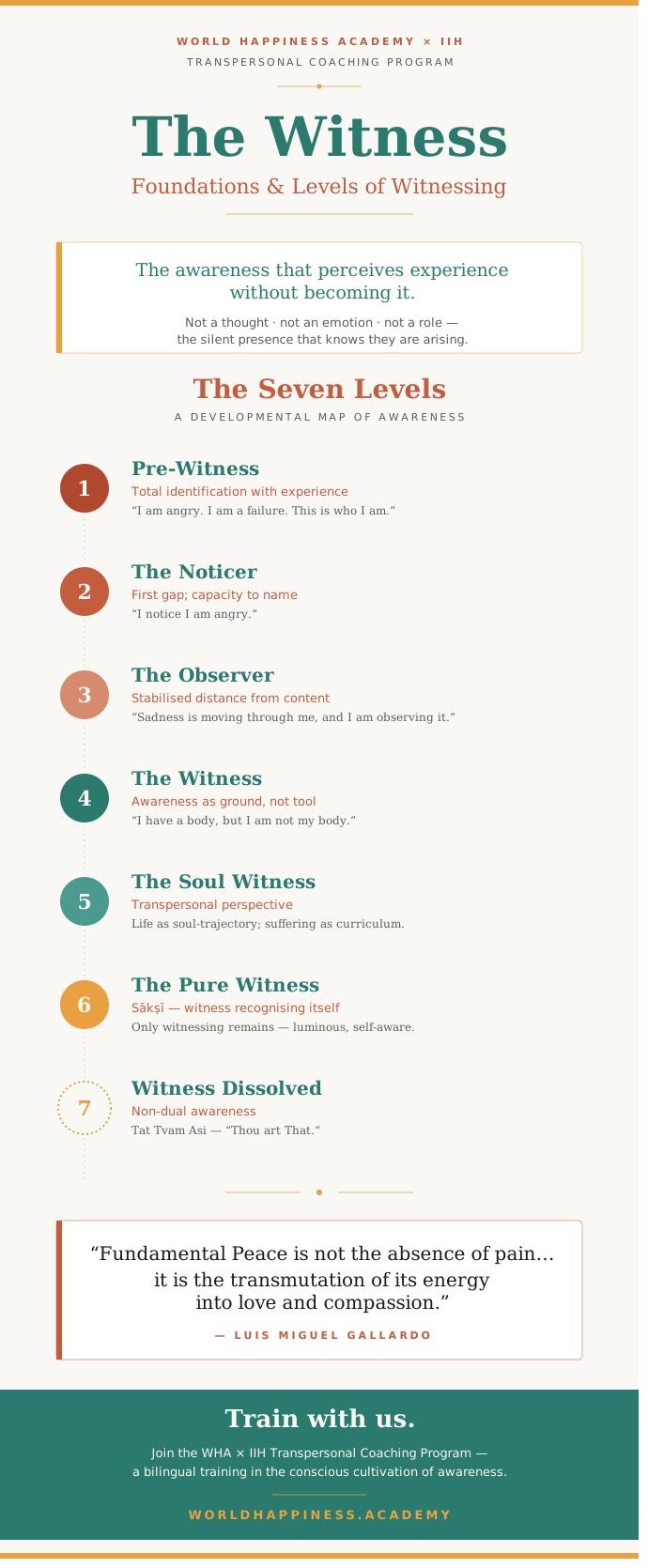
IV. The Seven Levels of Witnessing
What follows is a developmental map. The levels are not rigid stages but fluid capacities — most of us move through several of them within a single day, sometimes within a single conversation. The map serves orientation, not classification. Use it the way a sailor uses a chart: to know where you are, to know where the shoals are, and to remember that the territory itself is always larger than the map.
Level 1 — Pre-Witness: Total Identification
At this level, the person is fused with experience. I am angry. I am a failure. This is who I am. There is no gap between the experiencer and the experienced. Thoughts are taken as truth; emotions are taken as identity; the story is reality. The shadow — what Jung named the disowned material of the psyche — runs the show entirely, because the person is the shadow without knowing it.
This is where most clinical and coaching work begins. It is not a failure or a defect; it is the universal starting point. To meet a person at Level 1 with anything other than warmth and a competent holding environment is to misunderstand what the situation requires.
Level 2 — The Noticer: First Gap
A flicker of separation appears. The person catches themselves: I notice I am angry. The word notice is the threshold word — it signals that an inner observer has, for perhaps the first time, opened its eyes. The gap is small, fragile, easily lost. It will be lost again and again before it stabilises. But it has appeared, and once it has appeared, it can be cultivated.
The work of this level is celebration. To notice that one has noticed is itself an act of the Witness. Each repetition strengthens the muscle of the pause.
Level 3 — The Observer: Stabilised Distance
The gap widens. The person can hold an inner state in awareness for sustained moments without collapsing into it. There is sadness moving through me, and I am observing it. Emotional regulation improves. Reactivity softens. Meta-cognition — the capacity to think about one’s own thinking — develops.
A particular danger appears at this level: spiritual bypassing. The observer can become a defensive distance rather than a loving presence — a way of not feeling dressed up as awareness. The mature transpersonal practitioner is alert to this and ensures that the observer remains embodied, warm, and in contact with the felt sense of what is being observed. A cold witness is a defended witness, and a defended witness is still a self in hiding.
Level 4 — The Witness: Stable Presence
The observer matures into the Witness. Awareness is no longer a tool one picks up — it is recognised as the ground one stands on. The person identifies less with content and more with the awareness that holds content. This is the Self of Psychosynthesis: the “I” that has body, emotions, mind, roles — but is none of them.
At this level, the Shadow–Gift–Essence (SGE) transformation becomes operational. The shadow can be met without being become. The gift — the latent capacity that lay hidden inside the shadow — begins to crystallise. Equanimity becomes available. Paradox can be held without collapse. The person discovers that they can be present to almost anything that arises, without needing it to be other than it is.
This is the working level for most mature coaching. It is also the level the practitioner themselves must have stabilised in order to be of meaningful service to others.
Level 5 — The Soul Witness: Transpersonal Perspective
The Witness widens beyond the biographical self. The person perceives their life from a soul-level vantage — as if observing the incarnation from outside it. Life events read as symbolic. Suffering reframes itself as curriculum. A sense of purpose emerges, not as ego-project but as soul-trajectory.
This is the territory of Life Between Lives consciousness, archetypal awareness, ancestral perception, what Jung called the Self with a capital S, what the Sufis called the Friend, what the Christian mystics called the soul’s ground. Different vocabularies for the same widening.
The danger here is inflation — confusing the soul-perspective with personal grandiosity. The antidote is embodiment and service. Insight at this level must be integrated through the body and translated into action in the world, or it becomes spiritual vanity. The Wheel of Happiness — with its nine spheres and fifty-four indicators — is precisely the instrument by which we translate transpersonal insight back into lived experience, ensuring that what is glimpsed at Level 5 actually shows up in family, work, community, and care for the planet.
Level 6 — The Pure Witness: Sākṣī
The Witness recognises itself. There is no longer a “someone” who witnesses — there is only witnessing itself, luminous and self-aware. This is the I-I of Ramana Maharshi, the causal witness of Wilber, the Ātman of Vedānta.
At this level, the coach is not “doing” anything. Presence itself becomes the intervention. The field around such a practitioner naturally invites the client into deeper witnessing — what the contemplative traditions call darshan, the transmission of being. This is the level that explains why, in the presence of certain teachers across history, ordinary people have spontaneously dropped into states they could not previously access through any technique. The field is the teaching.
Level 7 — Witness Dissolved: Non-Dual Awareness
The final movement: the Witness itself dissolves into what it has been witnessing. The observer and the observed reveal themselves as one seamless presencing. This is non-duality — Advaita, Tat Tvam Asi (“Thou art That”), the union the mystics across traditions point toward.
Here, Fundamental Peace is not an experience one has; it is what one is. The transmutation of pain into love is no longer an event — it is the nature of awareness itself. Compassion arises without effort because there is no other to whom it could be directed. Love is not something one feels; it is what one is made of.
This level cannot be taught. It can only be pointed to. Most coaching work, properly, serves Levels 2 through 5. Levels 6 and 7 are the practitioner’s own ongoing path — the lifelong contemplative practice that keeps the work honest.
V. The Coach as Witness: A Vocational Reflection
Why does this matter for coaches, therapists, mentors, healers, leaders, and educators?
Because the level of witnessing at which the practitioner has stabilised sets the ceiling of what becomes possible for the client.
You cannot reliably guide a person to a level of awareness you have not yourself touched and stabilised. You may use the right techniques. You may say the correct words. You may even produce momentary openings. But the durable transformation that constitutes real transpersonal work happens through resonance — through the practitioner’s nervous system regulating the client’s nervous system, through the practitioner’s stabilised Witness inviting the client’s emerging Witness, through the simple, lawful fact that we cannot consistently take another person where we have not been.
This is why the contemplative life of the practitioner is not a private hobby. It is the curriculum. The student who treats their own inner life as the laboratory becomes the coach others can trust. The student who attempts to coach without the inner work becomes another well-meaning technician adding noise to a noisy world.
And so the question that defines the transpersonal vocation is not what techniques will I master? The techniques will come, and they matter. The question is: what level of witnessing am I willing to cultivate in myself, so that those I serve can stand on the ground I have prepared?
This is a serious question. It is also a radiant one. Because to answer it is to recognise that one’s own life — with all its pain, all its limitation, all its bewilderment — has become the place where the deepest gift is forged. There is no spiritual bypass available to the working transpersonal practitioner. There is only the slow, patient, often humbling work of becoming, in oneself, the awareness one wishes to offer to others.
The good news is that this work is shareable. It is not done alone. The traditions exist; the maps exist; the communities exist; the methods exist. What is required is the choice to begin in earnest — and a place to begin among others who have made the same choice.
VI. Practices for Cultivating the Witness
Before any program, any technique, any framework — there are practices that any reader of this essay can begin today. I offer them in ascending order of subtlety:
The Morning Sit. Before speaking to anyone, before reaching for a device, before beginning the day’s tasks, sit for ten minutes in silence. Do not meditate “well.” Do not try to produce any state. Simply sit and observe what arises. The thoughts will come; let them. The feelings will come; let them. Notice that you are noticing. This is the foundational practice, and it is enough on its own to begin to change the architecture of a life.
The Three Pauses. Set three random alarms across your day. When each sounds, pause for thirty seconds and ask: at what level of witnessing am I in this moment? Do not judge the answer. The act of asking is itself the practice. Over weeks, you will notice the average level rising — not because you have tried to make it rise, but because attention itself trains.
The Labelling Practice. When a strong emotion arises, name it inwardly as a passing event rather than as your identity. Anger is arising. Not I am angry. Sadness is moving through. Not I am sad. The shift is small. Its effect is enormous. Language at this level is not cosmetic — it is the lever by which identification loosens.
The Body Anchor. When you find yourself swept into thought or emotion, return to one of three points of contact: the soles of your feet on the ground, the breath at the nostrils, or the weight of your seat in the chair. The body is the Witness’s most reliable home. Awareness without embodiment becomes dissociation; embodiment without awareness becomes reactivity. The two must travel together.
The Evening Review. Each night before sleep, ask one question: where today did I lose the Witness, and what called me back? Write a single sentence. The accumulated record across months becomes a map of your own development — and the most honest supervision you will ever have.
Parts Dialogue. When you encounter resistance or contradiction in yourself, sit with the resistance as if it were a part of you with its own voice. Ask it what it needs. Listen without arguing. This is the doorway into Internal Family Systems work and into the deeper practices of disidentification. Done seriously, it is transformative.
The Compassion Reach. When you feel the Witness becoming cold or defended, deliberately extend warmth toward whatever you are witnessing. The mature Witness is not detached; it is loving. The Heart and the Witness must be cultivated together, or one will eventually devour the other.
These practices, sustained over time, are the foundation. They are also the floor. Beyond them lie the deeper methods of regression, parts dynamics, transpersonal hypnotherapy, archetypal dialogue, soul retrieval, life-between-lives exploration, and the integration of insight into the everyday spheres of work, relationship, family, community, and planet. Those methods require training, supervision, and community.
Which brings me, finally, to the invitation.
VII. An Invitation
If you have read this far — if some part of you has been quietly nodding through these pages, recognising in this map something you have lived but perhaps not named — then I want to speak to you directly.
The WHA × IIH Transpersonal Coaching Program, offered jointly by the World Happiness Academy and the Institute of Interpersonal Hypnotherapy, exists for exactly this work. It is the formal training in which everything written in this essay becomes operational: the seven levels, the practices, the SGE transformation, the embodiment, the parts work, the regression, the transpersonal frameworks, the supervision, and — at the centre of it all — the slow, patient cultivation of the Witness in the practitioner themselves.
The program is built across three levels — foundational, advanced, and master — each integrating contemplative practice, evidence-based psychology, transpersonal methodology, ethics, and live supervision. Students train in a bilingual community (English and Spanish) drawing from more than sixty countries. Graduates emerge not only with technical competence but with the stabilised inner ground from which transpersonal work becomes possible.
This is not a certification. It is a vocation. We are not training coaches in the conventional sense; we are training Chief Well-being Officers, Transpersonal Coaches, and Facilitators of Fundamental Peace — people whose working life will be devoted to the conscious cultivation of human flourishing in the institutions, communities, and lives entrusted to them.
If you sense that this work belongs to you — if some long-quiet part of you has just stirred at the word vocation — then I invite you, simply and directly, to take the next step.
Visit worldhappiness.academy to learn more about the Transpersonal Coaching Program, the application process, and the upcoming cohort dates. Reach out to our team. Speak with a graduate. Read the program syllabus. Bring your questions. We will meet you with care.
The world does not need more clever technicians. The world needs people who have done their own inner work, who have stabilised the Witness in themselves, and who are willing to dedicate their working lives to the patient cultivation of awareness in others. This is not a small calling. It may be the most important calling of our time.
If you are one of those people, we are waiting for you.
“Fundamental Peace is not the absence of pain… it is the transmutation of its energy into love and compassion.”— Luis Miguel Gallardo
Luis Miguel Gallardo is the Founder and President of the World Happiness Foundation (UN ECOSOC consultative status), a Clinical and Transpersonal Hypnotherapist, ICF PCC Coach, and LBL® certified practitioner. He is the architect of the Happytalism civilizational framework and convenes the WHA × IIH Transpersonal Coaching Program from Madrid and Miami.
…
Field notes to your inbox
Stay connected to the shift.
Monthly essays from the Observatory, invitations to Fests and Academy cohorts. Written from abundance — never urgency.